Does The Hollow-Face Illusion Fool Your Eyes?

The Hollow-Face illusion is perhaps one of the coolest pieces of visual trickery known to mankind, and its awesomeness is only equaled by its simplicity. When a concave (hollow) face mask is illuminated, it appears to the viewer as a normal convex face. You can check out one of the best examples here.
Besides being a great optical illusion, the "Hollow-Face" is also perhaps the most studied. Scientists have long sought to understand why this illusion occurs, with the hopes that understanding it will shed light on human vision and perception.
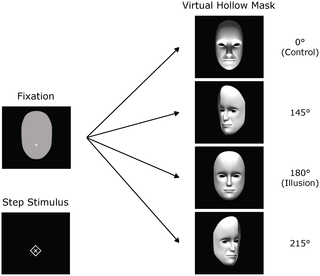
Recently, German researchers published a new study in the online journal PLoS ONE. In it, they examined how subjects' eyes react to the illusion.
Particularly, the researchers focused on a quality of eyesight called vergence. Vergence is the simultaneous movement of a pair of eyes in order to maintain single binocular vision (the kind that we're used to). Our eyes converge -- they rotate towards each other -- when focusing on a nearby object. And they diverge -- rotate away from each other -- when focusing on a far object.
When it comes to the Hollow-Face Illusion, our eyes should theoretically be more convergent when looking at the mask when it's really convex and more divergent when it's really concave. However, by tracking subjects' eyes as they focused on the noses of virtual masks, the current researchers found that our eyes similarly converge when viewing both the convex (normal) and concave (illusionary) masks. Our eyes follow where we perceive the face to be, instead of where it actually is!
The researchers did, however, notice a slight 85-ms delay in the vergence response when subjects were looking at the illusionary mask, which potentially reflects the time it takes for our oculomotor system to override a natural divergent response, they say.
The common wisdom as to how the illusion works is that human brains are programmed to recognize human faces. When looking at the concave face mask you expect to see a human face, so your brain fills in the blanks, so to speak.
Source: Grosjean M, Rinkenauer G, Jainta S (2012) Where Do the Eyes Really Go in the Hollow-Face Illusion? PLoS ONE 7(9): e44706. doi:10.1371/journal.pone.0044706