<?phpxml version="1.0" encoding="utf-8"?>
		<feed xmlns="http://www.w3.org/2005/Atom">
				<title>RealClearScience - Articles</title>
				<link rel="alternate" type="text/html" href="http://www.realclearscience.com/articles/" />
				link rel="self" type="application/atom+xml" href="http://www.realclearscience.com/articles/atom.xml" />
				<id>tag:www.realclearscience.com,2009:/articles//4</id>					
				<updated>Sun, 15 Nov 2020 20:23:16 -0600</updated>
				<entry>
					<title>Pfizer Vaccine: What an Efficacy Rate Above 90% Really Means</title>
					<link rel="alternate" type="text/html" href="https://www.realclearscience.com/articles/2020/11/16/pfizer_vaccine_what_an_efficacy_rate_above_90_really_means_111608.html" />
					<id>tag:www.realclearscience.com,2009:/articles//111608</id>
					<published>2020-11-16T00:00:00Z</published>
					<updated>2020-11-16T00:00:00Z</updated>


					<summary>There was &amp;ndash; rightfully &amp;ndash; a lot of excitement when Pfizer and BioNTech announced interim results from their COVID vaccine trial. The vaccine, called BNT162b2, was reported to have an &amp;ldquo;efficacy rate above 90%&amp;rdquo;. This was soon translated in the press to be 90% &amp;ldquo;effective&amp;rdquo; at preventing COVID-19. Efficacy, effectiveness &amp;ndash; what&amp;rsquo;s the difference?
We academics are very precise in our language and it can be a cause of considerable frustration when the media doesn&amp;rsquo;t appreciate the important distinction between...</summary>
										
					<author><name>Zania Stamataki</name></author><category term="Zania Stamataki" scheme="http://www.sixapart.com/ns/types#category" /><content type="html" xml:lang="en" xml:base="http://www.realclearscience.com/articles/"><![CDATA[<p>There was &ndash; rightfully &ndash; a lot of <a href="https://www.theguardian.com/world/2020/nov/09/covid-19-vaccine-candidate-effective-pfizer-biontech">excitement</a> when Pfizer and BioNTech announced <a href="https://www.pfizer.com/news/press-release/press-release-detail/pfizer-and-biontech-announce-vaccine-candidate-against">interim results</a> from their COVID vaccine trial. The vaccine, called BNT162b2, was reported to have an &ldquo;efficacy rate above 90%&rdquo;. This was soon translated in the press to be 90% &ldquo;<a href="https://edition.cnn.com/2020/11/09/health/pfizer-covid-19-vaccine-effective/index.html">effective</a>&rdquo; at preventing COVID-19. Efficacy, effectiveness &ndash; what&rsquo;s the difference?</p>
<p>We academics are very precise in our language and it can be a cause of considerable frustration when the media doesn&rsquo;t appreciate the important distinction between certain terms. I was recently asked not to use the term &ldquo;efficacy&rdquo; for my radio interview because &ldquo;listeners won&rsquo;t understand what it means&rdquo;. Sometimes accuracy can get in the way of clarity, so it&rsquo;s important to know when to let these things go. However, now is perhaps the time to draw a clear distinction between efficacy and effectiveness.</p>
<h2>What is vaccine efficacy?</h2>
<p><a href="https://www.ncbi.nlm.nih.gov/pmc/articles/PMC3912314/#:%7E:text=Efficacy%20can%20be%20defined%20as,'real%2Dworld'%20conditions.">In short</a>, efficacy is the performance of a treatment under ideal and controlled circumstances, and effectiveness is performance under real-world conditions. So what does this mean in terms of the Pfizer/BioNTech vaccine trial?</p>
<p>Clinical trials are precise and neat, and aim to answer if a vaccine is safe and if it works. To achieve this, the participants who are recruited to have the vaccine (or a placebo) are likely to be generally healthy. In early clinical trials, participants may not be the intended vulnerable group of people we are aiming to protect eventually with this product, for example, children or older people with other conditions.</p>
<p>To work out vaccine efficacy we must compare it to a &ldquo;control&rdquo; treatment, which is usually an irrelevant or known vaccine or similar preparation that shouldn&rsquo;t work for the tested virus. The trials are often &ldquo;double-blinded&rdquo; so the participants don&rsquo;t know which vaccine they received, and the researchers don&rsquo;t know which vaccine they administered until the end of the study.</p>
<p>The Pfizer/BioNTech vaccine reports 90% efficacy, which means that their vaccine prevented COVID-19 symptoms for 90% of volunteers that received the vaccine compared to placebo. This is very high and will probably change by the end of the study. The press release reported the results for 94 participants &ndash; they need 164 to complete the trial, which shouldn&rsquo;t take long. Safe vaccines with efficacy above 50% are expected to be approved for COVID-19.</p>
<h2>How do we measure if a vaccine is effective?</h2>
<p>So what do we mean by vaccine effectiveness? Monitoring of vaccines does not stop after they are approved for use. When the vaccine is deployed, data will continue to be collected to study how well it works over the years for all vaccinated people.</p>
<p>Important parameters include vaccine performance for different groups (age, ethnic background, other conditions), duration of protection (duration of immunity and effectiveness against evolving virus strains), the balance of benefit against harms. Cost effectiveness is also an ongoing consideration, based on comparisons with other vaccine and treatment options.</p>
<p>We don&rsquo;t know what the overall effectiveness of the vaccine will be in preventing COVID-19 symptoms, severe disease or deaths, and it may be several years before studies report on the effectiveness of BNT162b2 for different groups. However, it is unlikely that it will be 90%.</p>
<p>But then very few vaccines &ndash; aside from <a href="https://www.cdc.gov/measles/vaccination.html">measles</a> and <a href="https://www.cdc.gov/vaccines/vpd/varicella/index.html#:%7E:text=Two%20doses%20of%20the%20vaccine,immune%20systems%20or%20pregnant%20women.">chickenpox</a> &ndash; are 90% effective. The flu vaccine is around <a href="https://www.cdc.gov/flu/vaccines-work/vaccineeffect.htm">40%-60% effective</a>, but it still saves millions of lives. And that&rsquo;s something to celebrate.<!-- Below is The Conversation's page counter tag. Please DO NOT REMOVE. --><img src="https://counter.theconversation.com/content/149849/count.gif?distributor=republish-lightbox-basic" border="0" alt="The Conversation" width="1" height="1" style="border: none !important; box-shadow: none !important; margin: 0 !important; max-height: 1px !important; max-width: 1px !important; min-height: 1px !important; min-width: 1px !important; opacity: 0 !important; outline: none !important; padding: 0 !important; text-shadow: none !important;" /><!-- End of code. If you don't see any code above, please get new code from the Advanced tab after you click the republish button. The page counter does not collect any personal data. More info: https://theconversation.com/republishing-guidelines --></p>
<p><span><a href="https://theconversation.com/profiles/zania-stamataki-1034665">Zania Stamataki</a>, Senior Lecturer in Viral Immunology, <em><a href="https://theconversation.com/institutions/university-of-birmingham-1138">University of Birmingham</a></em></span></p>
<p><em><strong>This article is republished from <a href="https://theconversation.com">The Conversation</a> under a Creative Commons license. Read the <a href="https://theconversation.com/pfizer-vaccine-what-an-efficacy-rate-above-90-really-means-149849">original article</a>.</strong></em></p><br/><br/>]]></content>
				</entry>
				<entry>
					<title>Corn Ethanol Seems to Be a Failure, But We&#039;re Probably Stuck With It</title>
					<link rel="alternate" type="text/html" href="https://www.realclearscience.com/blog/2020/11/16/corn_ethanol_seems_to_be_a_failure_but_were_probably_stuck_with_it.html" />
					<id>tag:www.realclearscience.com,2009:/articles//111606</id>
					<published>2020-11-16T00:00:00Z</published>
					<updated>2020-11-16T00:00:00Z</updated>


					<summary>The other day I was filling up my twelve-year-old car at the gas station, and after returning the hose to the pumping unit, swore loudly. I had made a terrible mistake...
I had accidentally filled my car&apos;s gas tank with E-15.
E-15 is only available at about 2 to 3% of gas stations in the United States, so for those unaware, it means that 15% of the fuel is composed of ethanol. Ethanol is ethyl alcohol. Produced by the fermentation of sugars, the chemical compound is found in antiseptics, liquors, and fuels, amongst many other places.
Unfortunately for your car and your pocketbook, it...</summary>
										
					<author><name>Ross Pomeroy</name></author><category term="Ross Pomeroy" scheme="http://www.sixapart.com/ns/types#category" /><content type="html" xml:lang="en" xml:base="http://www.realclearscience.com/articles/"><![CDATA[<p>The other day I was filling up my twelve-year-old car at the gas station, and after returning the hose to the pumping unit, swore loudly. I had made a terrible mistake...</p>
<p>I had accidentally filled my car's gas tank with E-15.</p>
<p>E-15 is only available at about <a href="https://e360.yale.edu/features/the_case_against_ethanol_bad_for_environment">2 to 3%</a> of gas stations in the United States, so for those unaware, it means that 15% of the fuel is composed of ethanol. Ethanol is ethyl alcohol. Produced by the fermentation of sugars, the chemical compound is found in antiseptics, liquors, and fuels, amongst many other places.</p>
<p>Unfortunately for your car and your pocketbook, it doesn't contain as much energy as pure gasoline. <a href="https://e360.yale.edu/features/the_case_against_ethanol_bad_for_environment">According to the U.S. Department of Energy</a>, vehicles typically travel 3% to 4% fewer miles per gallon on E-10 and 4% to 5% fewer miles per gallon on E-15. Fuels comprised of at least 15% ethanol can also gradually <a href="https://www.popularmechanics.com/cars/hybrid-electric/a6244/e15-gasoline-damage-engine/">corrode engines</a> in older car models, like mine.</p>
<p>So why do we put ethanol in cars? It all started in the name of energy independence...</p>
<p>The <a href="https://www.theatlantic.com/ideas/archive/2019/11/ethanol-has-forsaken-us/602191/">first subsidy</a> for ethanol as fuel arrived under the Carter administration when Americans, shocked by turbulent, rising oil prices, grasped at straws, or more specifically, corn stalks, seeking to cushion the blow. But&nbsp;ethanol's boom truly arrived thirty years later with the passage of the<a href="https://www.epa.gov/renewable-fuel-standard-program"> Renewable Fuel Standard</a> program, requiring a small percentage of "renewable" biofuels &ndash; almost always corn ethanol &ndash; to make up a small proportion of conventional gasoline in transportation fuels, usually about ten percent.</p>
<div class="body-photo-inline">
<div class="body-photo"><img class="body-photo-inline" src="http://assets.realclear.com/images/52/526950_5_.jpg" border="0" width="721" height="481" />
<div class="hover-social" data-feed-name="New pumps at Rich Bohnen's service station at 60th and Penn Ave. S. in Minneapolis are seen in a Monday, Oct. 28, 2013 photo. The higher-ethanol fuel blend called E15 has hit the Twin Cities through an unusual marriage between the state corn growers and independent gas stations. The first E15 pump opened this month at Rich Bohnen's station in south Minneapolis, under a new brand name Minnoco with new pumping equipment designed for E15 that was financed by the corn growers' trade group.  (APP Photo/Star Tribune, Jeff Wheeler)  MANDATORY CREDIT; ST. PAUL PIONEER PRESS OUT; MAGS OUT; TWIN CITIES TV OUT" data-feed-caption="APP Photo/Star Tribune, Jeff Wheeler" data-feed-photo="http://assets.realclear.com/images/52/526950_5_.jpg">
<div class="socialBar" data-style="full" data-dialog="feed">
<div class="left toolset"></div>
</div>
</div>
</div>
<div class="body-photo-byline">APP Photo/Star Tribune, Jeff Wheeler</div>
</div>
<p>Fifteen years after the program's inception, it's becoming apparent that corn ethanol has been a failure for everyone except corn growers. For starters, it has driven up the price of corn. Again, that's great for corn farmers and corn-growing states like Iowa, Illinois, Nebraska, and Minnesota, but not so great for consumers across the country. Whether its for feeding livestock, distilling sugars, or making food products, corn goes in to much of the stuff we eat, so when its price goes up because of ethanol, <a href="https://www.npr.org/2010/12/22/132082743/if-your-meat-prices-rise-you-can-blame-ethanol">food prices increase</a> for all Americans.</p>
<p>"The ethanol program functions as a hidden food tax&mdash;the most regressive of all taxes,"&nbsp;Mario Loyola, a senior fellow at the Competitive Enterprise Institute, <a href="https://www.theatlantic.com/ideas/archive/2019/11/ethanol-has-forsaken-us/602191/">wrote for <em>The Atlantic</em></a> last year. "And the effects on poor Americans are magnified for poor countries that depend on imports of food."</p>
<p>Ethanol's government-mandated grasp on agriculture is best exemplified with a startling statistic: "In the United States, the cultivation of corn for ethanol now requires a staggering 38 million acres of land&mdash;an area larger than the state of Illinois. By comparison, the total area of cropland used to produce grains and vegetables that humans eat is only about twice that acreage," Loyola wrote.</p>
<p>This might not be that big of a problem if corn ethanol were actually beneficial for the environment. While the U.S. Department of Agriculture <a href="https://www.usda.gov/media/blog/2019/04/02/building-evidence-corn-ethanols-greenhouse-gas-profile">insists that it is</a>, reducing greenhouse gas emissions by an average of 21% compared to gasoline, other analyses from independent scientists paint a murkier picture. A 2016 <a href="https://www.climatecentral.org/news/study-biofuels-worse-for-climate-than-gasoline-20634">study</a> by scientists at the University of Michigan Energy Institute found that corn ethanol is actually more carbon intensive. Another <a href="https://www.sciencedirect.com/science/article/pii/S0301421516303962">study found that boosting corn ethanol reduces the price of gasoline</a>, making consumers drive more, and thus pollute more.</p>
<p>"The fuel rebound effect is so strong, and the climate benefits of the biofuels are so small, especially for corn ethanol, that emissions increase," <a href="https://www.climatecentral.org/news/ethanol-backfiring-for-climate-change-20760">said Jason Hill</a>, an energy and sustainability researcher at the University of Minnesota.</p>
<p>Adding insult to evidence-based injury against corn ethanol is the fact that it's not even needed for American energy independence. The U.S. oil boom over the past ten years coupled with rising fuel efficiency standards have put the <a href="https://www.businessinsider.com/us-oil-exports-higher-imports-country-energy-independence-2020-9">country in one of its strongest positions ever in that regard</a>.</p>
<p>So, again, corn ethanol seems to have little effective use, yet currently claims an area of land larger than the state of Illinois for its production.</p>
<p>With his mind on the future of Earth and humanity, Tim Searchinger, Senior Fellow and Technical Director at the World Resources Institute, says that's madness.</p>
<p>"We have to produce 50 percent more food without clearing more land. And now somebody says: Here's what I want to do; I want to take the most productive cropland in the world and I'm going to use it for a little bit of greenhouse gas reductions," <a href="https://insideclimatenews.org/news/14062019/trump-ethanol-climate-change-benefit-science-questions-emissions-data-usda">Searchinger told Inside Climate News</a>.</p>
<p>But despite the considerable case against corn ethanol, we're likely going to be stuck with it for at least a while longer. No politician wants to alter a status quo that monetarily affects so many farmers. Moreover, ethanol actually increases gasoline's octane rating, which in turn makes it so the fuel doesn't burn too soon inside engines. Because ethanol is presently so cheap, a result of government subsidies and regulation, <a href="https://www.npr.org/sections/thesalt/2016/02/10/466010209/the-shocking-truth-about-americas-ethanol-law-it-doesnt-matter-for-now">the oil refining industry is happy to put it in its fuels in place of more expensive additives</a>.</p>
<p>I, on the other hand, am still not happy about putting it in my car.</p><br/><br/>]]></content>
				</entry>
				<entry>
					<title>The People Whose Minds Are Completely Blank</title>
					<link rel="alternate" type="text/html" href="https://www.realclearscience.com/blog/2020/11/12/the_people_whose_minds_are_completely_blank.html" />
					<id>tag:www.realclearscience.com,2009:/articles//111602</id>
					<published>2020-11-12T00:00:00Z</published>
					<updated>2020-11-12T00:00:00Z</updated>


					<summary>One day, a lively and successful businessman was bitten by a wasp, triggering an unexpected encephalopathy of the brain. Afterwards, he was a changed man, doing almost nothing all day and expressing little interest in anyone else. But this apathy could be swiftly reversed with even the tiniest stimulation from another human being &amp;ndash; offering a newspaper or challenging him to a game of bridge, for example. It&apos;s as if the man could react, but not act.
Cases similar to this one have been documented in the medical literature. There was a patient who at one point laid on his bed for...</summary>
										
					<author><name>Ross Pomeroy</name></author><category term="Ross Pomeroy" scheme="http://www.sixapart.com/ns/types#category" /><content type="html" xml:lang="en" xml:base="http://www.realclearscience.com/articles/"><![CDATA[<p>One day, a lively and successful businessman was bitten by a wasp, triggering an unexpected <a href="https://www.google.com/search?client=firefox-b-1-d&amp;q=encephalopathy">encephalopathy</a> of the brain. Afterwards, he was a changed man, doing almost nothing all day and expressing little interest in anyone else. But this apathy could be swiftly reversed with even the tiniest stimulation from another human being &ndash; offering a newspaper or challenging him to a game of bridge, for example. It's as if the man could react, but not act.</p>
<p>Cases similar to this one have been documented in the medical literature. There was a patient who at one point laid on his bed for thirty minutes with an unlit cigarette in his mouth. When asked what he was doing, he matter-of-factly responded, "I am waiting for a light". Another person spent 45 minutes standing with his hands on a lawn mower, frozen and unable to move. But when prompted by his son to cut the grass, he immediately sprang into action. A man referred to as Mr. M in a <a href="https://www.cambridge.org/core/journals/psychological-medicine/article/research-letter-autoactivation-deficit-in-schizophrenia-a-case-report/D74CC97918FF25A4D6A8DC8C5D512BDB">case report</a> required external prodding for all of his daily activities, even eating. On one occasion he almost got burned by staying too long in the shower until he was told to turn the water off.</p>
<p>The syndrome striking these people is called Auto-Activation Deficit (AAD).&nbsp; First characterized by French researchers <a href="https://europepmc.org/article/med/6726263">back in 1984</a>, it seems to be caused by damage to the basal ganglia, which in turn disrupts fibers which control the activation of mental processing. The <a href="https://www.neuroscientificallychallenged.com/blog/what-are-basal-ganglia">basal ganglia</a> constitute numerous structures found near the base of the brain. Collectively, they are best known for their role in triggering wanted movements while inhibiting unwanted movements.</p>
<p>"Patients with AAD do not try, or do not want to move, but they can move without difficulty when incited to do so," researchers at <a href="https://www.inserm.fr/en">INSERM</a> <a href="https://onlinelibrary.wiley.com/doi/abs/10.1002/mds.1185">wrote in 2001</a>. "It might be said that the mind of patients with AAD is on stand-by when they are alone, but recovers almost all of its capabilities when stimulated by social interactions."</p>
<p>But some patients with AAD experience an even more curious symptom: they cannot think.</p>
<p>"Their mind is 'empty, a total blank,' they say. In the most typical cases, they have no thoughts and no projections in the future," the researchers wrote.</p>
<p>"Patients with AAD remain with an empty mind while in the waking state. They describe a mental state, that, to our knowledge, has never been reported, and which is almost unimaginable to a normal conscious human being: conscious awareness without any content."</p>
<p>Strangely, however, some AAD patients with this mental blankness are <a href="https://academic.oup.com/brain/article/136/10/3076/329883">able to dream</a>, though their dreams are shorter, simpler, and seemingly devoid of emotion. The French scientists who made this discovery said it suggests that basic dreams are generated by brainstem stimulation, but full dreaming with stories, social interactions, and emotion require the involvement of higher-order cortical areas, like the basal ganglia.</p>
<p>Fortunately for patients with AAD, it's growing increasingly clear that dopamine agonists, drugs which imitate the actions of the neurotransmitter <a href="https://www.webmd.com/mental-health/what-is-dopamine#1">dopamine</a>, <a href="https://pubmed.ncbi.nlm.nih.gov/25876742/">can effectively treat the condition in most instances</a>. People with the disorder are no longer doomed to paralyzing apathy and numbing mental blankness.</p><br/><br/>]]></content>
				</entry>
				<entry>
					<title>Will the Coronavirus Evolve to Be Less Deadly?</title>
					<link rel="alternate" type="text/html" href="https://www.realclearscience.com/articles/2020/11/12/will_the_coronavirus_evolve_to_be_less_deadly_111605.html" />
					<id>tag:www.realclearscience.com,2009:/articles//111605</id>
					<published>2020-11-12T00:00:00Z</published>
					<updated>2020-11-12T00:00:00Z</updated>


					<summary>No lethal pandemic lasts forever. The 1918 flu, for example, crisscrossed the globe and claimed tens of millions of lives, yet by 1920, the virus that caused it had become significantly less deadly, causing only ordinary seasonal flu. Some pandemics have lasted longer, like the Black Death, which swept out of Central Asia in 1346, spread across Europe, and ultimately may have killed as many as a third of the inhabitants of Europe, the Middle East, and parts of Asia. That pandemic, too, came to an end, roughly seven years after it started, probably because so many had perished or developed...</summary>
										
					<author><name>Wendy Orent</name></author><category term="Wendy Orent" scheme="http://www.sixapart.com/ns/types#category" /><content type="html" xml:lang="en" xml:base="http://www.realclearscience.com/articles/"><![CDATA[<p><span class="dropcap">N</span><span class="bolded">o lethal pandemic</span> lasts forever. The 1918 flu, for example, crisscrossed the globe and claimed tens of millions of lives, yet by 1920, the virus that caused it had become significantly less deadly, causing only ordinary seasonal flu. Some pandemics have lasted longer, like the Black Death, which swept out of Central Asia in 1346, spread across Europe, and ultimately may have killed as many as a third of the inhabitants of Europe, the Middle East, and parts of Asia. That pandemic, too, came to an end, roughly seven years after it started, probably because so many had perished or developed immunity.</p>
<p>As far as scientists and historians can tell, the bacterium that caused the Black Death never lost its virulence, or deadliness. But the pathogen responsible for the 1918 influenza pandemic, which still wanders the planet as a strain of seasonal flu, evolved to become less deadly, and it&rsquo;s possible that the pathogen for the 2009 H1N1 pandemic did the same. Will SARS-CoV-2, the virus that causes Covid-19, follow a similar trajectory? Some scientists say the virus has already evolved in a way that makes it easier to transmit. But as for a possible decline in virulence, most everyone says it&rsquo;s too soon to tell. Looking to the past, however, may offer some clues.</p>
<p>The idea that circulating pathogens gradually become less deadly over time is very old. It seems to have originated in the writings of a 19th-century physician, Theobald Smith, who first suggested that there is a &ldquo;delicate equilibrium&rdquo; between parasite and host, and argued that, over time, the deadliness of a pathogen should decline since it is really not in the interest of a germ to kill its host. This notion became conventional wisdom for many years, but by the 1980s, researchers had begun challenging the idea.</p>
<p>In the early 1980s, the mathematical biologists Roy Anderson and Robert May, proposed that germs transmit best when hosts shed a lot of the pathogen, which may often mean when they are quite sick. If you&rsquo;re really sick, you are &mdash; the argument goes &mdash; shedding lots of virus, which makes it easier for the next host to pick it up. So virulence and transmissibility go hand in hand, until the germ gets so deadly it winds up killing its host too soon, and therefore can&rsquo;t spread at all. This is known as the transmission-virulence trade-off. The most familiar example is that of <a href="https://www.pnas.org/content/114/35/9397">the myxoma virus</a>, a pathogen introduced to Australia in 1950 to rid the country of rabbits. Initially, the virus killed more than 90 percent of Australian rabbits it infected. But over time, a tense truce developed: Rabbits evolved resistance, the myxoma germ declined in virulence, and both rabbits and germ remained in precarious balance for some time.</p>
<p>A second theory, developed by evolutionary epidemiologist Paul Ewald, which he calls the "theory of virulence,&rdquo; suggests that, as a rule, the deadlier the germ, the less likely it is to spread. The reason: If victims are quickly immobilized (think of Ebola, for example), then they can&rsquo;t readily spread the infection. By this thinking, if a germ requires a mobile host to spread, its virulence will, of necessity, decline. Like the older conventional wisdom, the theory of virulence recognizes that many germs will evolve less virulence as they circulate and adapt to the human population. But Ewald&rsquo;s theory also proposes that germs all have their own strategies to spread, and some of those strategies allow the germ to maintain high virulence <em>and</em> transmissibility.</p>
<p>Durability, Ewald says, is one such strategy. Variola virus, which causes smallpox, is very durable in the external environment, and it can have a high death rate of 10 to 40 percent. Ewald calls it and other durable germs &ldquo;sit-and-wait&rdquo; pathogens. Some deadly infections are spread from very sick hosts by vectors: fleas, lice, mosquitos, or ticks. Others, such as cholera, are spread in water. Still others, such as hospital-acquired staph infections, are spread by people taking care of the sick or dying. This is what happened in the women&rsquo;s hospitals of the 19th century, when doctors spread puerperal or &ldquo;childbed&rdquo; fever from one postpartum woman to another.</p>
<p>All of these strategies, according to Ewald, may prevent a germ&rsquo;s otherwise inevitable slide to lower virulence.</p>
<hr class="hr-separator" />
<p><span class="dropcap">S</span><span class="bolded">o what do these</span> evolutionary theories suggest about SARS-CoV-2 and its likely trajectory? Is the novel coronavirus likely to decline in virulence as it cycles from person to person across the world?</p>
<p>SARS, an earlier outbreak of a serious coronavirus that disrupted the world from 2002 to 2003, offers an interesting contrast. That virus seemed to spread late in the course of infection from people who were very sick, and it eventually infected around 8,000 people, killing 774 before being driven out of existence by a hard-fought global effort to isolate sick patients. But SARS-CoV-2, researchers know, is transmissible early in the infection. There is no necessary relationship between transmissibility and severity. Even asymptomatic cases may shed significant amounts of virus, and there doesn&rsquo;t necessarily seem to be an increased risk with exposure to sicker people.</p>
<p>It seems unlikely, therefore, that the course of SARS-CoV-2 evolution will strictly reflect Anderson and May&rsquo;s transmission-virulence trade-off model. To predict SARS-CoV-2&rsquo;s evolutionary trajectory, Ewald looks to the durability of the virus instead. He points out that SARS-CoV-2 infectious particles last on various surfaces between hours and days, making it approximately as durable as influenza virus. He argues, therefore, that SARS-CoV-2 is likely to evolve virulence to levels much like that of seasonal influenza, with a typical death rate of 0.1 percent.</p>
<p>But there&rsquo;s still no way to be certain that&rsquo;s the course SARS-CoV-2 will take. And even the current death rate is uncertain because <a href="https://www.statista.com/statistics/1105914/coronavirus-death-rates-worldwide/">differences in testing</a> for the coronavirus from country to country make a complete accounting of global infections impossible.</p>
<p>Still, scientists might have already observed evolutionary change in the virus, though apparently in the direction of increased transmissibility, not of lower virulence. A team led by Bette Korber, a computational biologist at Los Alamos National Laboratory, <a href="https://www.cell.com/cell/fulltext/S0092-8674(20)30820-5">published a paper</a> in the journal Cell in July showing that a strain carrying a mutation identified as D614G appeared to be replacing the initial strain that first emerged out of Wuhan, China. Korber and her team suggested that, on the basis of their research &mdash; conducted in cells in culture &mdash; the new strain seemed to be more infectious than the original. While the paper notes in its limitations that &ldquo;infectiousness and transmissibility are not always synonymous,&rdquo; Korber says the findings are consistent with higher transmissibility.</p>
<p>As with an earlier <a href="https://www.biorxiv.org/content/10.1101/2020.04.29.069054v1.full#disqus_thread">version of the study</a> <a href="https://www.healthnewsreview.org/2020/05/mutant-coronavirus-story-upsets-scientists-about-preprint-journalism/">shared</a> prior to peer review in April, this conclusion was soon <a href="https://www.virology.ws/2020/07/09/no-evidence-for-increased-human-transmission-of-sars-cov-2/">subjected</a> to a <a href="https://www.nature.com/articles/d41586-020-02544-6#correction-0">barrage</a> of <a href="https://www.nationalgeographic.com/science/2020/07/why-this-coronavirus-mutation-not-cause-for-alarm-cvd/#close">criticism</a>: The replacement that Korber had taken for evidence that the change had been selected for, others ascribed to accident or to other evolutionary processes. Echoing a limitation noted in the Cell paper, critics further emphasized that cell culture studies aren&rsquo;t able to replicate the complexities of real life, so results should be interpreted with caution. Shortly after the Cell paper was published, Yale epidemiologist and virologist Nathan Grubaugh <a href="https://www.nationalgeographic.com/science/2020/07/why-this-coronavirus-mutation-not-cause-for-alarm-cvd/#close">told National Geographic</a>, &ldquo;There is a huge gap between infectiousness in a lab and human transmission.&rdquo;</p>
<p>Neither Grubaugh nor his colleague Angela Rasmussen, a virologist at Columbia University who has also <a href="https://www.cell.com/cell/pdf/S0092-8674(20)30817-5.pdf">expressed skepticism</a> regarding the mutation&rsquo;s impact on transmissibility, responded to requests for comment.</p>
<div class="trigger-in-view in-view-delay-200">
<table id="promo-table">
<tbody>
<tr>
<td align="center" valign="top"><img src="https://undark.org/wp-content/uploads/2020/03/cv19.png" border="0" width="80px" style="padding-top: 13px;" /></td>
<td style="padding-left: 50px;"><br />
<p style="color: #5c6670;"><em>For all of Undark's coverage of the global Covid-19 pandemic, please visit our extensive <a href="../../covid19">coronavirus archive</a>.</em></p>
</td>
</tr>
</tbody>
</table>
</div>
<p>But time has shown &mdash; and scientists including Grubaugh agree &mdash; that this new strain <a href="https://www.nature.com/articles/d41586-020-02544-6">is now the primary one</a>. As Korber puts it: &ldquo;The D614G strain is now the pandemic. You can hardly even sample the [original] Wuhan virus anymore. In early March, the virus was a different virus than it is today.&rdquo; This near-complete replacement of the original strain indicates that selection &mdash; likely selection toward greater transmissibility &mdash; was responsible for the shift, says Korber.</p>
<p>According to Ewald&rsquo;s analysis, high transmissibility is often associated with lower virulence. He expects to see evidence that SARS-CoV-2 is evolving in that direction. Still, right now, it&rsquo;s hard to tease apart this kind of viral evolution from improvements in testing, treatment, and social distancing. SARS-CoV-2 testing, for instance, is more accessible than it was earlier in the pandemic. This means patients are hospitalized and treated sooner, offering a better chance at survival, wrote Cameron Wolfe, an infectious disease physician and researcher at Duke University who treats many Covid-19 patients, in an email. Further, he wrote, experimental treatments might be helping hospitalized patients, while some of the most vulnerable people &mdash; those in nursing homes &mdash; are now better protected from exposure.</p>
<p>&ldquo;Everyone talks about viral evolution&rdquo; potentially leading to decreased mortality, wrote Wolfe. &ldquo;But I haven&rsquo;t seen any conclusive data to support that hypothesis yet.&rdquo;</p>
<hr class="hr-separator" />
<p><span class="dropcap">L</span><span class="bolded">ike plague</span>, Covid-19 is a stealth infection, and that might ultimately slow evolution toward lower virulence. <em>Yersinia pestis,</em> the germ that causes plague, tamps down the early immune response, so that infected people can travel and spread infection for days before they feel sick. Similarly, people infected with SARS-CoV-2 seem capable of infecting others before experiencing any symptoms. This sly mode of viral spread may make the evolution of lower virulence less likely, as infected but asymptomatic people are the perfect mobile viral delivery systems.</p>
<p>Yet even without an evolutionary process pushing SARS-CoV-2 towards lower virulence, over time, the virus might affect people differently, said Columbia University virologist Vincent Racaniello. &ldquo;SARS-CoV-2 may become less deadly, not because the virus changes, but because very few people will have no immunity,&rdquo; he said. In other words, if you&rsquo;re exposed to the virus as a child (when it doesn&rsquo;t seem to make people particularly sick) and then again and again in adulthood, you&rsquo;ll only get a mild infection. Racaniello points out that the four circulating common cold coronaviruses &ldquo;all came into humans from animal hosts, and they may have been initially quite virulent.&rdquo; Now, he says, they infect 90 percent of children at young ages. At later ages, all you get is the common cold.</p>
<p>Compared to influenza viruses, coronaviruses are more stable and less likely to evolve in response to pre-existing immunity. As a result, many experts argue, safe and effective vaccines remain the best chance for escaping the maze of Covid-19 infection. Regular boosters may be necessary as the virus cycles, not because the virus is rapidly evolving, but because human immunity may wane.</p>
<p>Such an outcome would mark the end of this current pandemic. Yet even then, experts believe, some version of the virus will continue to circulate, perhaps as a common cold virus or an occasional deadly outbreak among the unvaccinated, for many years, if not forever.</p>
<hr class="hr-separator" />
<p><em>Wendy Orent is an Atlanta-based anthropologist and science writer specializing in health and disease. She is the author of &ldquo;Plague: The Mysterious Past and Terrifying Future of the World&rsquo;s Most Dangerous Disease&rdquo; and &ldquo;Ticked: The Battle Over Lyme Disease in the South.&rdquo;</em></p>
<p><strong><em>This article was originally published on <a href="https://undark.org">Undark</a>. Read the <a href="https://undark.org/?p=60525">original article</a>.</em></strong></p><br/><br/>]]></content>
				</entry>
				<entry>
					<title>When Did Humans First Go to War?</title>
					<link rel="alternate" type="text/html" href="https://www.realclearscience.com/articles/2020/11/11/when_did_humans_first_go_to_war_111604.html" />
					<id>tag:www.realclearscience.com,2009:/articles//111604</id>
					<published>2020-11-11T00:00:00Z</published>
					<updated>2020-11-11T00:00:00Z</updated>


					<summary>When modern humans arrived in Europe around 40,000 years ago, they made a discovery that was to change the course of history.
The continent was already populated by our evolutionary cousins, the Neanderthals, which recent evidence suggests had their own relatively sophisticated culture and technology. But within a few thousand years the Neanderthals were gone, leaving our species to continue its spread to every corner of the globe.
Precisely how Neanderthals became extinct remains a subject of fierce debate among researchers. The two main explanations given in recent years have been...</summary>
										
					<author><name>John Stewart &amp; Martin Smith</name></author><category term="Martin Smith" scheme="http://www.sixapart.com/ns/types#category" /><content type="html" xml:lang="en" xml:base="http://www.realclearscience.com/articles/"><![CDATA[<p>When modern humans arrived in Europe around 40,000 years ago, they made a discovery that was to change the course of history.</p>
<p>The continent was already populated by our evolutionary cousins, the Neanderthals, which recent evidence suggests had their own relatively <a href="https://theconversation.com/how-we-discovered-that-neanderthals-could-make-art-92127">sophisticated culture</a> <a href="https://theconversation.com/neanderthals-javelin-athletes-helped-us-show-how-effective-they-were-at-hunting-with-weapons-110464">and technology</a>. But within a few thousand years the Neanderthals were gone, leaving our species to continue its spread to every corner of the globe.</p>
<p>Precisely how Neanderthals became extinct remains a subject of fierce debate among researchers. The two main explanations given in recent years have been competition with the recently arrived modern humans and <a href="https://www.pnas.org/content/115/37/9116">global climate change</a>.</p>
<p>The persistence of <a href="https://www.discovermagazine.com/planet-earth/how-much-neanderthal-dna-do-humans-have">Neanderthal genetic material</a> in all modern people outside of Africa shows the two species interacted and even had sex. But it&rsquo;s possible that there were other kinds of interactions as well.</p>
<p>Some researchers <a href="https://journals.plos.org/plosone/article?id=10.1371/journal.pone.0003972">have suggested</a> that competition for resources such as prey and raw materials for stone tools may have taken place. Others have proposed violent interactions and <a href="https://theconversation.com/war-in-the-time-of-neanderthals-how-our-species-battled-for-supremacy-for-over-100-000-years-148205">even warfare</a> took place, and that this may have caused the Neanderthals&rsquo; demise.</p>
<p>This idea might seem compelling, given our species&rsquo; violent history of warfare. But proving the existence of early warfare is a problematic (although fascinating) area of research.</p>
<h2>War or murder?</h2>
<p><a href="https://www.researchgate.net/publication/260983364_The_head_burials_from_Ofnet_cave_an_example_of_warlike_conflict_in_the_Mesolithic">New studies</a> keep moving the threshold at which there is evidence for human warfare progressively earlier. But finding such evidence is fraught with problems.</p>
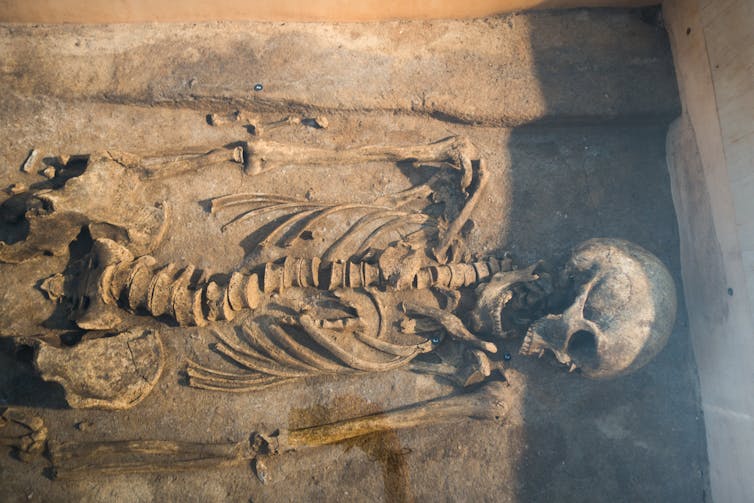
<p>Only preserved bones with injuries from weapons can give us a secure indication of violence at a given time. But how do you separate examples of murder or a family feud from prehistoric &ldquo;war&rdquo;?</p>
<figure class="align-center "><img src="https://images.theconversation.com/files/368013/original/file-20201106-21-57d5em.jpg?ixlib=rb-1.1.0&amp;q=45&amp;auto=format&amp;w=754&amp;fit=clip" border="0" alt="Human skeleton on rocky surface." width="615" height="410" /> <figcaption> <span class="caption">Preserved skeletons provide the best evidence of early warfare.</span> <span class="attribution"><a href="https://commons.wikimedia.org/wiki/File:Stone_age_remains_(25160248506).jpg" class="source">Thomas Quine/Wikimedia</a>, <a href="http://creativecommons.org/licenses/by/4.0/" class="license">CC BY</a></span> </figcaption></figure>
<p>To an extent, this question has been resolved by <a href="https://www.nature.com/articles/s41467-018-04773-w">several examples</a> of <a href="https://www.pnas.org/content/112/36/11217">mass killing</a>, where <a href="https://oxford.universitypressscholarship.com/view/10.1093/acprof:osobl/9780199573066.001.0001/acprof-9780199573066-chapter-6">whole communities</a> were massacred and buried together at a number of European sites dating to the Neolithic period (about 12,000 to 6,000 years ago, when agriculture first emerged).</p>
<p>For a while, these discoveries appeared to have settled the question, suggesting that farming led to a population explosion and pressure for groups to fight. However, <a href="https://www.nature.com/articles/nature16477">even earlier instances</a> of group killing suggested by the bones of hunter gatherers have re-opened the debate.</p>
<h2>Defining warfare</h2>
<p>A further challenge is that it is very difficult to arrive at a definition of war applicable to prehistoric societies, without becoming so broad and vague that it loses meaning. As social anthropologist <a href="https://www.press.umich.edu/11586/warless_societies_and_the_origin_of_war">Raymond Kelly</a> argues, while group violence may take place among tribal societies, it is not always regarded as &ldquo;war&rdquo; by those involved.</p>
<p>For example, in the dispensation of justice for homicide, witchcraft or other perceived social deviance, the &ldquo;perpetrator&rdquo; might be attacked by a dozen others. However, in such societies acts of warfare also commonly involve a single individual being ambushed and killed by a coordinated group.</p>
<p>Both scenarios essentially look identical to an outside observer, yet one is regarded as an act of war while the other is not. In this sense, war is defined by its social context rather than simply by the numbers involved.</p>
<p>A key point is that a very particular kind of logic comes into play where any member of an opposing group is seen as representing their whole community, and so becomes a &ldquo;valid target&rdquo;. For example, one group might kill a member of another group in retribution for a raid that the victim wasn&rsquo;t involved in.</p>
<p>In this sense, war is a state of mind involving abstract and lateral thinking as much as a set of physical behaviours. Such acts of war may then be perpetrated (usually by males) against women and children as well as men, and <a href="https://www.nature.com/articles/nature16477">we have</a> <a href="https://journals.plos.org/plosone/article?id=10.1371/journal.pone.0102822">evidence of</a> <a href="https://www.journals.uchicago.edu/doi/pdf/10.1086/204594">this behaviour</a> among skeletons of early modern humans.</p>
<h2>Fossil record</h2>
<p>So what does all this mean for the question of whether modern humans and Neanderthals went to war?</p>
<p>There is no doubt that Neanderthals engaged in and were the recipients of acts of violence, with <a href="https://www.sciencedirect.com/science/article/pii/S030544031200297X">fossils showing</a> <a href="https://www.pnas.org/content/99/9/6444">repeated examples</a> of blunt injuries, mostly to the head. But many of these predate the appearance of modern humans in Europe and so cannot have occurred during meetings between the two species.</p>
<p>Similarly, among the sparse fossil record of early anatomically modern humans, <a href="https://onlinelibrary.wiley.com/doi/10.1002/ajpa.24163">various examples</a> of weapon injuries exist, but the majority date to thousands of years after the Neanderthals&rsquo; disappearance.</p>
<p>Where we do have evidence of violence towards Neanderthals it is almost exclusively <a href="https://www.nature.com/articles/s41586-018-0696-8">among male victims</a>. This means it is less likely to represent &ldquo;warfare&rdquo; as opposed to competition between males.</p>
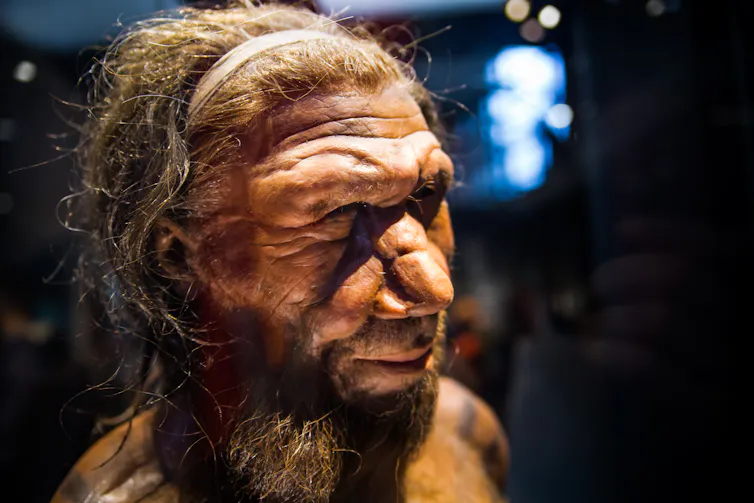
<p>While there is no doubt Neanderthals committed violent acts, the extent to which they were capable of conceptualising &ldquo;war&rdquo; in the way it is understood by modern human cultures is debatable. It is certainly possible that violent altercations could have taken place when members of the small, scattered populations of these two species came into contact (although we have no conclusive evidence for such), but these cannot realistically be characterised as warfare.</p>
<p>Certainly, we can see a pattern of violence-related trauma in modern human skeletons from the Upper Palaeolithic period (50,000 to 12,000 years ago) that remains the same into the more recent Mesolithic and Neolithic times. However, it is not at all clear that Neanderthals follow this pattern</p>
<figure class="align-center "><img src="https://images.theconversation.com/files/368251/original/file-20201109-22-9gmu3y.jpg?ixlib=rb-1.1.0&amp;q=45&amp;auto=format&amp;w=754&amp;fit=clip" border="0" alt="Recreation of Neanderthal male head" width="610" height="407" /> <figcaption> <span class="caption">Would Neanderthals have considered conflict with modern humans &lsquo;warfare&rsquo;?</span> <span class="attribution"><a href="https://www.shutterstock.com/image-photo/london-uk-march-11-2018-neanderthal-1130172149" class="source">National History Museum/IR Stone/Shutterstock</a></span> </figcaption></figure>
<p>On the bigger question of whether modern humans were responsible for the extinction of Neanderthals, it&rsquo;s worth noting that Neanderthals in many parts of Europe seem to <a href="https://www.sciencedirect.com/science/article/abs/pii/S1040618211001819">have gone extinct</a> before our species had arrived. This suggests modern humans can&rsquo;t be completely to blame, whether through war or competition.</p>
<p>However, what was present throughout the period was dramatic and persistent climate change that <a href="https://science.sciencemag.org/content/335/6074/1317">appears to have decreased</a> the Neanderthals&rsquo; <a href="https://www.sciencedirect.com/science/article/abs/pii/S027737911830831X">preferred woodland habitats</a>. Modern humans, although they had just left Africa, seem to have been more flexible to different environments and so better at dealing with the increasingly common colder open habitats that may have challenged Neanderthals&rsquo; ability to survive.</p>
<p>So although the first modern Europeans may have been the first humans capable of organised warfare, we can&rsquo;t say this behaviour was responsible or even necessary for the disappearance of Neanderthals. They may have simply been the victims of the natural evolution of our planet.<!-- Below is The Conversation's page counter tag. Please DO NOT REMOVE. --><img src="https://counter.theconversation.com/content/149637/count.gif?distributor=republish-lightbox-basic" border="0" alt="The Conversation" width="1" height="1" style="border: none !important; box-shadow: none !important; margin: 0 !important; max-height: 1px !important; max-width: 1px !important; min-height: 1px !important; min-width: 1px !important; opacity: 0 !important; outline: none !important; padding: 0 !important; text-shadow: none !important;" /><!-- End of code. If you don't see any code above, please get new code from the Advanced tab after you click the republish button. The page counter does not collect any personal data. More info: https://theconversation.com/republishing-guidelines --></p>
<p><span><a href="https://theconversation.com/profiles/martin-smith-1175163">Martin Smith</a>, Principal Academic In Forensic and Biological Anthropology, <em><a href="https://theconversation.com/institutions/bournemouth-university-1215">Bournemouth University</a></em> and <a href="https://theconversation.com/profiles/john-stewart-679770">John Stewart</a>, Associate Professor of Evolutionary Palaeoecology, <em><a href="https://theconversation.com/institutions/bournemouth-university-1215">Bournemouth University</a></em></span></p>
<p><em><strong>This article is republished from <a href="https://theconversation.com">The Conversation</a> under a Creative Commons license. Read the <a href="https://theconversation.com/when-did-humans-first-go-to-war-149637">original article</a>.</strong></em></p><br/><br/>]]></content>
				</entry>
				<entry>
					<title>Weird &#039;Gravitational Molecules&#039; Could Orbit Black Holes</title>
					<link rel="alternate" type="text/html" href="https://www.realclearscience.com/articles/2020/11/10/weird_gravitational_molecules_could_orbit_black_holes_111603.html" />
					<id>tag:www.realclearscience.com,2009:/articles//111603</id>
					<published>2020-11-10T00:00:00Z</published>
					<updated>2020-11-10T00:00:00Z</updated>


					<summary>&amp;nbsp;


Black holes are notable for many things, especially their simplicity. They&apos;re just &amp;hellip; holes. That are &quot;black.&quot; This simplicity allows us to draw surprising parallels between black holes and other branches of physics. For example, a team of researchers has shown that a special kind of particle can exist around a pair of black holes in a similar way as an electron can exist around a pair of hydrogen atoms &amp;mdash; the first example of a &quot;gravitational molecule.&quot; This strange object may give us hints to the identity of dark matter and the...</summary>
										
					<author><name>Paul Sutter</name></author><category term="Paul Sutter" scheme="http://www.sixapart.com/ns/types#category" /><content type="html" xml:lang="en" xml:base="http://www.realclearscience.com/articles/"><![CDATA[<p>&nbsp;</p>
<div class="body-photo-inline">
<div class="body-photo"><img class="body-photo-inline" src="http://assets.realclear.com/images/43/436627_5_.jpg" border="0" width="721" height="131" />
<div class="hover-social" data-feed-name="null" data-feed-caption="Live Science" data-feed-photo="http://assets.realclear.com/images/43/436627_5_.jpg">
<div class="socialBar" data-style="full" data-dialog="feed">
<div class="left toolset"></div>
</div>
</div>
</div>
</div>
<p>Black holes are notable for many things, especially their simplicity. They're just &hellip; holes. That are "black." This simplicity allows us to draw surprising parallels between black holes and other branches of physics. For example, a team of researchers has shown that a special kind of particle can exist around a pair of black holes in a similar way as an electron can exist around a pair of <a href="https://www.livescience.com/28466-hydrogen.html">hydrogen atoms</a> &mdash; the first example of a "gravitational molecule." This strange object may give us hints to the identity of <a href="https://www.livescience.com/dark-matter.html">dark matter</a> and the ultimate nature of <a href="https://www.livescience.com/space-time.html">space-time</a>.</p>
<p><strong>Ploughing the field</strong><br />To understand how the new research, which was published in September to the preprint database <a href="https://arxiv.org/abs/2010.00008">arXiv</a>, explains the existence of a gravitational molecule, we first need to explore one of the most fundamental &ndash;- and yet sadly almost never talked about &ndash;- aspects of modern physics: the field.</p>
<p><em><strong>Related: <a href="https://www.livescience.com/64993-weirdest-celestial-objects.html">The 12 strangest objects in the universe</a></strong></em></p>
<p>A field is a mathematical tool that tells you what you might expect to find as you travel from place to place in the universe. For example, if you've ever seen a TV weather report of temperatures in your local area, you're looking at a viewer-friendly representation of a field: As you travel around your town or state, you'll know what kind of temperatures you're likely to find, and where (and whether you need to bring a jacket).</p>
<p>This kind of field is known as a "scalar" field, because "scalar" is the fancy mathematical way of saying "just a single number." There are other kinds of fields out there in physics-land, like "vector" fields and "tensor" fields, which provide more than one number for every location in space-time. (For example, if you see a map of wind speed and direction splashed on your screen, you're looking at a vector field.) But for the purposes of this research paper, we only need to know about the scalar kind.</p>
<p><strong>The atomic power couple</strong><br />In the heydays of the mid-20th century, physicists took the concept of the field &mdash; which had been around for centuries at that point, and was absolutely old-hat to the mathematicians &mdash; and went to town with it.</p>
<p>They realized that fields aren't just handy mathematical gimmicks &mdash; they actually describe something super-fundamental about the inner workings of reality. They discovered, basically, that everything in the universe is really a field.</p>
<p><em><strong>Related: <a href="https://www.livescience.com/57849-greatest-mathematical-equations.html">The 11 most beautiful mathematical equations</a><br /></strong></em></p>
<p>Take the humble electron. We know from quantum mechanics that it's pretty tough to pin down exactly where an electron is at any given moment . When quantum mechanics first emerged, this was a pretty nasty mess to understand and untangle, until the field came along.</p>
<p>In modern physics, we represent the electron as a field &mdash; a mathematical object that tells us where we're likely to spot the electron the next time we look. This field reacts to the world around it &mdash; say, because of the electric influence of a nearby atomic nucleus &mdash; and modifies itself to change where we ought to see the electron.</p>
<p>The end result is that electrons can appear only in certain regions around an atomic nucleus, giving rise to the entire field of chemistry (I'm simplifying a bit, but you get my point).&nbsp;</p>
<p><strong>Black hole buddies</strong></p>
<p>And now the black hole part. In atomic physics, you can completely describe an <a href="https://www.livescience.com/65427-fundamental-elementary-particles.html">elementary particle</a> (like an electron) in terms of three numbers: its mass, its spin and its electric charge. And in gravitational physics, you can completely describe a black hole in terms of three numbers: its mass, its spin and its electron charge.</p>
<p>Coincidence? The jury's out on that one, but for the time being we can exploit that similarity to better understand black holes.</p>
<p>In the jargon-filled language of particle physics that we just explored, you can describe an <a href="https://www.livescience.com/37206-atom-definition.html">atom</a> as a tiny nucleus surrounded by the electron field. That electron field responds to the presence of the nucleus, and allows the electron to appear only in certain regions. The same is true for electrons around two nuclei, for example in a diatomic molecule like hydrogen (H2.)</p>
<p>You can describe the environment of a black hole similarly. Imagine the tiny singularity at a black heart somewhat akin to the nucleus of an atom, while the surrounding environment &mdash; a generic scalar field &mdash; is similar to the one that describes a <a href="https://www.livescience.com/65427-fundamental-elementary-particles.html">subatomic particle</a>. That scalar field responds to the presence of the black hole, and allows its corresponding particle to appear only in certain regions. And just as in diatomic molecules, you can also describe scalar fields around two black holes, like in a binary black hole system.</p>
<p>The authors of the study found that scalar fields can indeed exist around binary black holes. What's more, they can form themselves into certain patterns that resemble how electron fields arrange themselves in molecules. So, the behavior of scalar fields in that scenario mimics how electrons behave in diatomic molecules, hence the moniker "gravitational molecules."</p>
<p>Why the interest in scalar fields? Well for one, we don't understand the nature of dark matter or <a href="https://www.livescience.com/what-is-dark-energy.html">dark energy</a>, and it's possible both dark energy and dark matter could be made up of one or more scalar fields), just like electrons are made up of the electron field.</p>
<p>If dark matter is indeed composed of some sort of scalar field, then this result means that dark matter would exist in a very strange state around binary black holes &mdash; the mysterious dark particles would have to exist in very specific orbits, just like electrons do in atoms. But binary black holes don't last forever; they emit gravitational radiation and eventually collide and coalesce into a single black hole. These dark matter scalar fields would affect any gravitational waves emitted during such collisions, because they would filter, deflect and reshape any waves passing through regions of increased dark matter density. This means we might be able to detect this kind of dark matter with enough sensitivity in existing gravitational wave detectors.</p>
<p>In short: We soon might be able to confirm the existence of gravitational molecules, and through that open a window into the hidden dark sector of our cosmos.</p>
<p><em>Originally <a href="https://www.livescience.com/black-holes-gravitational-molecules-evidence.html">published</a> on Live Science.</em></p><br/><br/>]]></content>
				</entry>
				<entry>
					<title>&quot;Avocado Hand&quot;: As the Fruit Soars in Popularity, So Do Gruesome Injuries</title>
					<link rel="alternate" type="text/html" href="https://www.realclearscience.com/quick_and_clear_science/2020/11/09/avocado_hand_as_the_fruit_soars_in_popularity_so_do_gruesome_injuries.html" />
					<id>tag:www.realclearscience.com,2009:/articles//111600</id>
					<published>2020-11-09T00:00:00Z</published>
					<updated>2020-11-09T00:00:00Z</updated>


					<summary>Over the last decade, emergency room physicians started noticing it more and more... Patients, primarily in their early thirties, coming in with grisly knife injuries to their non-dominant hands, almost all of which required surgical repair. Each time, the cause was the same &amp;ndash; they were slicing an avocado.
The trend has since garnered a name: &quot;Avocado Hand,&quot; and deservedly so. A study published earlier this year to the American Journal of Emergency Medicine found that between&amp;nbsp;1998 and 2017 there were an estimated 50,413 avocado-related knife injuries in the United...</summary>
										
					<author><name>Ross Pomeroy</name></author><category term="Ross Pomeroy" scheme="http://www.sixapart.com/ns/types#category" /><content type="html" xml:lang="en" xml:base="http://www.realclearscience.com/articles/"><![CDATA[<p>Over the last decade, emergency room physicians started noticing it more and more... Patients, primarily in their early thirties, coming in with grisly knife injuries to their non-dominant hands, almost all of which required surgical repair. Each time, the cause was the same &ndash; they were slicing an avocado.</p>
<p>The trend has since garnered a name: "Avocado Hand," and deservedly so. A study published <a href="https://pubmed.ncbi.nlm.nih.gov/31303536/">earlier this year to the <em>American Journal of Emergency Medicine</em></a> found that between&nbsp;1998 and 2017 there were an estimated 50,413 avocado-related knife injuries in the United States. The bulk of those &ndash;&nbsp;27,059 &ndash; occurred between 2013 and 2017, suggesting a rapid increase in recent years closely correlated with the fruit's rise in culinary popularity.</p>
<p>This past week, a team of doctors from the United Kingdom <a href="https://www.worldscientific.com/doi/10.1142/S2424835520500423?url_ver=Z39.88-2003&amp;rfr_id=ori%3Arid%3Acrossref.org&amp;rfr_dat=cr_pub++0pubmed&amp;">published a study</a> exploring thirty-five documented incidents of avocado-related hand injury, seeking to characterize them and discern methods of prevention.</p>
<p>The overwhelming majority of injuries occurred when attempting to remove the avocado's large, hard seed, called a "stone".</p>
<p>"All patients reported that they had pressed the knife tip down perpendicularly onto the avocado seed and that it slipped off it and plunged into their hand," the doctors wrote.</p>
<p>And the injuries were not at all minor.</p>
<p>"All patients presenting with these injuries required surgical exploration and repair. Structures damaged that required repair included; tendon repairs, digital nerve repairs, and pulley repair/reconstruction."</p>
<p>Multiple hospital follow-ups and rehabilitation were also necessary.</p>
<p>Recognizing the preponderance and severity of "Avocado Hand", the researchers offered a step-by-step guide to preparing one of the fruits for consumption.</p>
<div class="body-photo-inline">
<div class="body-photo"><img class="body-photo-inline" src="http://assets.realclear.com/images/52/526441_5_.png" border="0" width="733" height="388" />
<div class="hover-social" data-feed-name="null" data-feed-caption="Sajid et al. / The Journal of Hand Surgery" data-feed-photo="http://assets.realclear.com/images/52/526441_5_.png">
<div class="socialBar" data-style="full" data-dialog="feed">
<div class="left toolset"></div>
</div>
</div>
</div>
<div class="body-photo-title">How to properly prepare an avocado.</div>
<div class="body-photo-byline">Sajid et al. / The Journal of Hand Surgery</div>
</div>
<p>"Keeping fingers out of the way, the flesh of the fruit is cut circumferentially around the stone. The two halves are twisted and separated. The knife is then tapped into the stone and it is removed. The fruit can then be further prepared."</p><br/><br/>]]></content>
				</entry>
				<entry>
					<title>Did the Polls Fail Again? It&#039;s Complicated.</title>
					<link rel="alternate" type="text/html" href="https://www.realclearscience.com/articles/2020/11/07/did_the_polls_fail_again_its_complicated_111601.html" />
					<id>tag:www.realclearscience.com,2009:/articles//111601</id>
					<published>2020-11-07T00:00:00Z</published>
					<updated>2020-11-07T00:00:00Z</updated>


					<summary>by Michael Schulson - Undark Magazine
Four years ago, polls indicated that then-Democratic presidential nominee Hillary Clinton would handily beat her Republican opponent, Donald J. Trump. Based on those polls, one prominent election forecaster, Princeton University neuroscience professor Sam Wang, even called the race for Clinton several weeks before Election Day, promising to eat an insect if he was wrong.
Wang ate a cricket on CNN, and in May of 2017, a committee at the American Association for Public Opinion Research, or AAPOR, released a post-mortem of the polls&amp;rsquo; performance....</summary>
										
					<author><name>Michael Schulson</name></author><category term="Michael Schulson" scheme="http://www.sixapart.com/ns/types#category" /><content type="html" xml:lang="en" xml:base="http://www.realclearscience.com/articles/"><![CDATA[<p><strong>by <a href="https://undark.org/undark-author/michael-schulson/">Michael Schulson - Undark Magazine</a></strong></p>
<p><span class="dropcap">F</span><span class="bolded">our years ago,</span> polls indicated that then-Democratic presidential nominee Hillary Clinton would handily beat her Republican opponent, Donald J. Trump. Based on those polls, one prominent election forecaster, Princeton University neuroscience professor Sam Wang, even called the race for Clinton several weeks before Election Day, promising to eat an insect if he was wrong.</p>
<p>Wang <a href="https://www.cnn.com/videos/politics/2016/11/12/pollster-eats-bug-after-trump-win-smerconish.cnn">ate a cricket</a> on CNN, and in May of 2017, a committee at the American Association for Public Opinion Research, or AAPOR, <a href="https://www.aapor.org/Education-Resources/Reports/An-Evaluation-of-2016-Election-Polls-in-the-U-S.aspx">released a post-mortem</a> of the polls&rsquo; performance. The report acknowledged shortcomings and suggested reforms to &ldquo;reduce the likelihood of another black eye for the profession.&rdquo;</p>
<p>Many pollsters and forecasters did make changes before the 2020 election. Once again, though, polls pointed toward big Democratic wins in key states, fueling optimism among progressives. And on Tuesday night, as it became clear that polls and forecasts had once again substantially underestimated the extent of support for Trump, the backlash was quick.</p>
<p>&ldquo;We should never again put as much stock in public opinion polls, and those who interpret them, as we&rsquo;ve grown accustomed to doing,&rdquo; Washington Post media critic Margaret Sullivan <a href="https://www.washingtonpost.com/lifestyle/media/we-still-dont-know-much-about-this-election--except-that-the-media-and-pollsters-blew-it-again/2020/11/04/40c0d416-1e4a-11eb-b532-05c751cd5dc2_story.html">wrote</a> on the morning after Election Day. The discipline, she continued, &ldquo;seems to be irrevocably broken, or at least our understanding of how seriously to take it is.&rdquo; A headline in The Atlantic&rsquo;s Ideas section <a href="https://www.theatlantic.com/ideas/archive/2020/11/polling-catastrophe/616986/">declared</a> a &ldquo;polling crisis.&rdquo; A disgruntled columnist for The Daily Beast <a href="https://www.thedailybeast.com/dear-pollsters-you-suck-and-were-finished-with-you">joked</a> that it was time &ldquo;to kill all the pollsters.&rdquo;</p>
<p>Election forecasters did predict that Biden would win the electoral college, which &mdash;&nbsp;as of this writing &mdash;&nbsp;appears to be correct, though disputes over that outcome may well take weeks or months to settle. But as with 2016, the odds of such a close race were again considered small, and polling errors were particularly pronounced in Florida and parts of the Midwest. For example, <a href="https://www.nytimes.com/live/2020/presidential-polls-trump-biden">polling averages</a> at The New York Times had indicated that Biden was up by 10 percentage points in Wisconsin and 8 in Michigan, and that Ohio would narrowly go to Trump. Complex models at <a href="https://projects.economist.com/us-2020-forecast/president">The Economist</a> and FiveThirtyEight produced similar projections. Instead, the Trump campaign has <a href="https://www.npr.org/2020/11/05/931478765/trump-asks-for-a-wisconsin-recount-though-its-unlikely-to-change-the-outcome">vowed to ask</a> for a recount in Wisconsin, Biden appears to have only narrowly won Michigan, and Trump won Ohio by around 8 points. (All of these tallies are still provisional.)</p>
<p>Does this mean that something is fundamentally broken about political polling? Some experts say that&rsquo;s not entirely fair. &ldquo;I think it&rsquo;s clear that there were some problems with polling this year, but a lot of this reaction strikes me as very premature,&rdquo; said Courtney Kennedy, the director of survey research at the Pew Research Center and the chair of AAPOR&rsquo;s 2016 post-mortem committee, in a Thursday afternoon interview.</p>
<p>&ldquo;It&rsquo;s like, my goodness, let&rsquo;s pump the brakes,&rdquo; she added. &ldquo;The election is not even over, there are still millions of votes to be counted.&rdquo;</p>
<hr class="hr-separator" />
<p><span class="dropcap">K</span><span class="bolded">ennedy and other</span> experts acknowledge that the 2020 election polls raise questions for pollsters about some of their methods. But many pollsters also argue that the backlash reflects misguided conceptions about what polls actually do &mdash; and that some blame lies with the wider ecosystem of pollsters, poll aggregators, and forecasters that has blossomed in the past 15 years.</p>
<p>At the base of this informational food chain are the pollsters, who use a range of information-gathering methods &mdash; including interviewer phone calls, online questionnaires, automated calls, and sometimes text messages &mdash; to reach samples of voters and to gauge their feelings on a variety of issues. Poll aggregators then take large numbers of those surveys and average them together, in the hopes of getting more reliable figures than any single poll. Many aggregators are also forecasters, feeding their figures into complex computer models that attempt to actually predict election outcomes. This is the methodology that <a href="https://en.wikipedia.org/wiki/FiveThirtyEight#Genesis_and_history">would eventually make</a> Nate Silver&rsquo;s FiveThirtyEight operation famous, and it is what many large media companies, from The New York Times to CNN, now emulate as a matter of election-year routine.</p>
<p>Andreas Graefe, an election forecasting researcher, said that these forecasting models have become more sophisticated, and they've improved to include and account for a wide array of potential errors. But, he added, &ldquo;I wouldn&rsquo;t say that that really helped accuracy.&rdquo; Graefe has helped run <a href="https://pollyvote.com/en/">PollyVote</a>, an academic election forecasting project, since 2007. Over that time, he said, he has seen election forecasting become a big business. &ldquo;What has changed, definitely, is forecasts as a media product,&rdquo; he said.</p>
<p>Silver worked as a baseball analyst before he began forecasting elections. The two roles, <a href="https://fivethirtyeight.com/features/no-im-not-chuck-todd/">he wrote</a> in 2008, &ldquo;are really quite similar,&rdquo; and he has risen to prominence at a time when politics coverage has come to more closely resemble sports media. (CNN president Jeff Zucker, who has pushed the network to model elements of its election coverage on ESPN, <a href="https://www.nytimes.com/2017/04/04/magazine/cnn-had-a-problem-donald-trump-solved-it.html">told</a> The New York Times in 2017 that &ldquo;the idea that politics is sport is undeniable, and we understood that and approached it that way.&rdquo;)</p>
<p>Remarkably on-target predictions in the 2008 and 2012 elections helped propel poll aggregators and forecasters like Silver to new national prominence. Then, in the 2016 presidential election, most forecasting models consistently and substantially underestimated Trump&rsquo;s success. While a few were more cautious, some popular forecasters had projected that Clinton&rsquo;s odds of winning were close to 100 percent, feeding confidence among progressives.</p>
<p>The subsequent AAPOR report analyzed why some of the polls underlying these forecasts had been so wrong. Part of the issue, the committee concluded, was that pollsters had sampled too few White voters without a college education, who had turned out heavily for Trump. In addition, the AAPOR committee found, many voters had made up their minds shortly before the election, perhaps after responding to polls &mdash; and most of those went for Trump.</p>
<p>The committee also examined the argument that some people simply lied to pollsters about their intention to vote for Clinton, perhaps because they were embarrassed about their decision to support Trump instead. (This has sometimes been called the &ldquo;<a href="https://www.pewresearch.org/fact-tank/2016/11/09/why-2016-election-polls-missed-their-mark/">shy Trumper hypothesis</a>.&rdquo;) The polling association found little evidence for this, but some experts continue to argue that the effect may play a role in what one scholar described as Trump&rsquo;s &ldquo;unpollability.&rdquo;</p>
<p>Whatever the constellation of reasons, many pollsters made adjustments in 2020 in an attempt to correct for potential blind spots. But, again, Trump outperformed the polls in many closely watched swing states, and some experts say it&rsquo;s now apparent that some aspects of the electorate&rsquo;s mood and tendencies are not being captured by existing survey methods. &ldquo;It&rsquo;s pretty clear that some people in the country&rdquo; &ndash; perhaps especially Republicans and people without college degrees &ndash; &ldquo;are less likely to take surveys,&rdquo; said Kennedy. &ldquo;We knew that. But the feeling was, that&rsquo;s okay, we can overcome that as long as the pollster is really responsible and skilled and weights their data properly.&rdquo;</p>
<p>Essentially, these pollsters, drawing on other sources of data, fine-tune their samples to reflect the estimated number of self-identified Republicans in a given area. That way, even if Republicans are, say, systematically less likely to answer the phone than Democrats, they would be adequately represented in the sample. But, Kennedy said, it&rsquo;s now unclear if weighting methods like this worked. It&rsquo;s also possible, she added, that the Republicans who agree to be interviewed for polls are not very good proxies for Republicans who don&rsquo;t take surveys. &ldquo;That&rsquo;s kind of an alarming possibility,&rdquo; she said.</p>
<hr class="hr-separator" />
<p><span class="dropcap">S</span><span class="bolded">till, Kennedy and</span> other pollsters point out that even the best polls are just estimates. So are forecasts. After the 2016 election, prominent poll aggregators tried to do more to convey the fuzziness in their models. FiveThirtyEight, for example, <a href="https://fivethirtyeight.com/features/how-we-designed-the-look-of-our-2020-forecast/">started showing</a> a range of possible outcomes at the top of its forecast, instead of leading with a specific number.</p>
<p>Whether those changes were effective at preventing unwarranted confidence among election watchers is unclear. &ldquo;The forecasters can do great work on communication in their own right, but once they&rsquo;ve put it out there, they&rsquo;ve lost control of it,&rdquo; said Natalie Jackson, the director of research at the Public Religion Research Institute, a nonprofit research institute that conducts public opinion polls on a variety of different topics with a special emphasis on religion. Even people who are well aware of the limits of election forecasts, she said, seem to check them constantly &mdash; maybe in search, she thinks, of comfort or clarity.</p>
<p>&ldquo;Humans are just really bad with uncertainty,&rdquo; she said.</p>
<p>Indeed, Jackson and other experts argue that the buzz around predicting elections &mdash; along with some of the backlash when those predictions seem to fall short &mdash; misses the actual function of opinion polling. &ldquo;The purpose of polls is not to predict an election,&rdquo; said Ashley Kirzinger, associate director of public opinion and survey research at the Kaiser Family Foundation.</p>
<p>&ldquo;What we&rsquo;re trying to do,&rdquo; she added, &ldquo;is provide some insight into what voters are thinking about in the months and weeks leading up to an election.&rdquo;</p>
<p>Pollsters ask voters about their opinions on key issues, not just their vote. But, said Kirzinger, &ldquo;I think the public, unfortunately, has taken polls to mean just &lsquo;things that feed aggregators,&rsquo; and not actually dig into what the polls are actually telling us.&rdquo;</p>
<p>Aggregators and forecasters, meanwhile, suggest that the public needs to better learn what aggregation and forecasting actually do, which is to model and then give odds to a <em>variety</em> of potential outcomes, not to predict a winner. When FiveThirtyEight gave Trump, in the waning days of the 2020 campaign, a 10 percent chance of victory, for example, the site very prominently contextualized those odds: &ldquo;A 10 percent chance of winning is not a zero percent chance,&rdquo; the site <a href="https://projects.fivethirtyeight.com/2020-election-forecast/">reminded visitors</a>. &ldquo;In fact, that is roughly the same odds that it&rsquo;s raining in downtown Los Angeles. And it&nbsp;<em>does</em>&nbsp;rain there.&rdquo;</p>
<p>Whether or not that&rsquo;s a comfort to voters who feel that the forecasts failed them again, Graefe says there&rsquo;s a place for this sort of pre-election survey data crunching. &ldquo;I&rsquo;m an advocate of trying to inform voters, and decision makers in general, and giving them the best information possible,&rdquo; he said. The models in 2020, he pointed out, suggested, seemingly correctly, that Biden could win even if there was a large polling error &mdash; information that, he said, has value.</p>
<p>Not everyone agrees. Jackson, the PRRI researcher, was the senior polling editor at HuffPost during the 2016 election. That year, the site&rsquo;s popular aggregation and forecasting tool gave Clinton a <a href="https://www.huffpost.com/entry/polls-hillary-clinton-win_n_5821074ce4b0e80b02cc2a94">98 percent chance</a> of victory &mdash;&nbsp;exceedingly high odds that Nate Silver and then-HuffPost Washington bureau chief Ryan Grim had <a href="https://www.politico.com/story/2016/11/nate-silver-huffington-post-polls-twitter-230815">sparred over</a> prior to the election. Grim later <a href="https://twitter.com/ryangrim/status/796205487951843328">publicly admitted</a> that HuffPost&rsquo;s models had failed.</p>
<p>This experience, Jackson said, pushed her to think more critically about how she was using data. After the 2008 and 2012 elections, the tools had seemed reliable, she recalled. &ldquo;I wasn&rsquo;t thinking about it necessarily in public-good terms. I was thinking about it in terms of what an interesting use of the data, and what an interesting statistical modeling exercise this is,&rdquo; she said. After 2016, she began to reevaluate the reasons for the work. Now, she said, &ldquo;I don&rsquo;t particularly see that forecasting serves the public good in a very convincing way.&rdquo;</p>
<p>Speaking on Thursday afternoon, Jackson acknowledged looming issues with polling methods in the 2020 election. But the culture around forecasting, she suggested, has created impossible expectations for the field. &ldquo;We now expect that there are a lot of polls,&rdquo; she said. &ldquo;We put them together and make pretty aggregates. Forecasters use them to project what&rsquo;s going to happen. All of those things combined create an expectation that polls will be predictive in a way that they&rsquo;re just not ever going to be able to do perfectly.&rdquo;</p>
<p>Like Kirzinger, Jackson thinks that process misses the real benefit of polling, which is &ldquo;to tell the story of what people think.&rdquo; But the demand for predictions remains strong. &ldquo;We&rsquo;ve gotten to a point in society where everything is at our fingertips, 24 hours a day,&rdquo; Jackson said. &ldquo;We think the answer to who&rsquo;s going to win an election should be, too.&rdquo;</p>
<p><em><strong>This article was originally published on <a href="https://undark.org">Undark</a>. Read the <a href="https://undark.org/2020/11/06/polls-surveys-forecasts-2020-trump-fail/">original article</a>.</strong></em></p><br/><br/>]]></content>
				</entry>
				<entry>
					<title>Some Surgeries Are Performed Millions of Times Per Year Even Though They Are No Better Than Placebo</title>
					<link rel="alternate" type="text/html" href="https://www.realclearscience.com/blog/2020/11/07/some_surgeries_are_performed_millions_of_times_per_year_even_though_they_are_no_better_than_placebo.html" />
					<id>tag:www.realclearscience.com,2009:/articles//111591</id>
					<published>2020-11-07T00:00:00Z</published>
					<updated>2020-11-07T00:00:00Z</updated>


					<summary>When you take a pharmaceutical drug, you expect it to have undergone rigorous testing to ensure that it&apos;s safe and effective. You probably have the same expectations for when you&apos;re going under the knife. But surgeries aren&apos;t actually required to face that same level of scrutiny. As Dr. Chuck Dinerstein,&amp;nbsp;Medical Director at the American Council on Science and Health, explained:

&quot;A new therapy involving a medication requires the approval of the FDA, and that requires evidence that the new drug is at least &amp;ldquo;non-inferior&amp;rdquo; to what is already...</summary>
										
					<author><name>Ross Pomeroy</name></author><category term="Ross Pomeroy" scheme="http://www.sixapart.com/ns/types#category" /><content type="html" xml:lang="en" xml:base="http://www.realclearscience.com/articles/"><![CDATA[<p>When you take a pharmaceutical drug, you expect it to have undergone rigorous testing to ensure that it's safe and effective. You probably have the same expectations for when you're going under the knife. But surgeries aren't actually required to face that same level of scrutiny. As Dr. Chuck Dinerstein,&nbsp;Medical Director at the American Council on Science and Health, <a href="https://www.acsh.org/news/2017/07/27/surgerys-placebo-effect-11609">explained</a>:</p>
<blockquote>
<p>"A new therapy involving a medication requires the approval of the FDA, and that requires evidence that the new drug is at least &ldquo;non-inferior&rdquo; to what is already available. Not so for a new surgical technique or device. For my surgical brethren, all we need is a good idea and our &ldquo;can do&rdquo; attitude takes over, and we try out a new technique, instrument or operation. Once the novel surgical &ldquo;treatment&rdquo; is being used, then we can do those studies, &ldquo;non-inferior&rdquo; may be more our opinion than a statistical finding."&nbsp;</p>
</blockquote>
<p>So, in a sense, surgeries can be trusted as much as surgeons' and anatomists' expertise can be trusted. For the overwhelming majority of surgical procedures, this works out just fine, but for some, it does not.</p>
<p>The greatest offender may be arthroscopic knee surgery. Performed some <a href="https://www.bettermovement.org/blog/2017/many-orthopedic-surgeries-dont-work">700,000 times per year</a> in the United States, it is the most popular <a href="https://en.wikipedia.org/wiki/Orthopedic_surgery">orthopedic</a> surgery. During the procedure, a surgeon makes a small incision over the knee joint, then might remove inflamed tissue, repair a meniscus, or remove bone fragments or cartilage, <a href="https://orthoinfo.aaos.org/en/treatment/knee-arthroscopy/">among other potential actions</a>. Unfortunately, two years post-operation, patients <a href="https://www.ncbi.nlm.nih.gov/pmc/articles/PMC5541494/">experience little to no benefit in terms of pain or knee function</a> compared to patients who managed their knee pain more conservatively through actions like weight loss, exercise, and the use of over-the-counter pain medications.</p>
<p>Even more damning for the popular procedure, when doctors <a href="https://www.nejm.org/doi/full/10.1056/nejmoa1305189">peformed a study</a> testing knee arthroscopy against a placebo "sham" surgery, where some patients unknowingly only received a small incision, there were no advantages for patients who received the genuine procedure.</p>
<p>An identical fate has befallen other popular surgeries. Hundreds of thousands of shoulder operations performed every year in the United States <a href="https://pubmed.ncbi.nlm.nih.gov/24397703/">lack significant evidential support</a>. Subacromial decompression, intended to relieve shoulder impingement, <a href="https://www.npr.org/sections/health-shots/2017/11/20/565406503/popular-surgery-to-ease-chronic-shoulder-pain-called-into-question">was found to be no better than placebo surger</a>y. Acromioplasty, meant to repair damaged rotator cuffs, is likely <a href="https://www.bettermovement.org/blog/2017/many-orthopedic-surgeries-dont-work">no better than targeted exercise</a> when it comes to relieving pain.</p>
<p>Moving down to the body's midsection, a popular spinal surgery called vertebroplasty was found to be <a href="https://www.reuters.com/article/idUSN05248821">comparable to sham surgery back in 2009</a>.&nbsp;During the procedure, medical cement is inserted into the spine to strengthen it, with the hopes of alleviating back pain. More than a decade later, vertebroplasty is still performed tens of thousands of times each year despite its apparent ineffectiveness.</p>
<p>Being operated upon is expensive, time-consuming, and carries risks, so it's vital that procedures actually help patients. Unfortunately, surgeries are rarely tested in controlled settings against a placebo. Many doctors insist that this is for ethical reasons &ndash; why cut into somebody if you're not actually going to do anything? But as science reporter Trace Dominguez <a href="https://www.youtube.com/watch?v=tFTDNotO0Hs">pointed out</a>, "If a surgery was widespread but later proved ineffective, then didn&rsquo;t performing all those operations expose more people to risk than if a small trial had the placebo option?"</p>
<p>While one could not ethically pit a life-saving surgical procedure against a placebo, there are plenty of elective surgeries, particularly those intended to treat pain, <a href="https://www.bmj.com/content/348/bmj.g3253">that absolutely merit scientific scrutiny</a>. The current status quo is wasting hundreds of millions of dollars a year cutting into patients unnecessarily.</p><br/><br/>]]></content>
				</entry>
				<entry>
					<title>Fluffy Pterosaurs Reignite the Debate Over the Origin of Feathers</title>
					<link rel="alternate" type="text/html" href="https://www.realclearscience.com/articles/2020/11/06/fluffy_pterosaurs_reignite_the_debate_over_the_origin_of_feathers_111599.html" />
					<id>tag:www.realclearscience.com,2009:/articles//111599</id>
					<published>2020-11-06T00:00:00Z</published>
					<updated>2020-11-06T00:00:00Z</updated>


					<summary>When fossils of the oldest known bird, Archaeopteryx, were first discovered almost 160 years ago, the find created a puzzle that has troubled palaeontologists ever since.
These fossils were celebrated for their chimera-like combination of supposedly reptilian features (such as a bony tail and jaws with teeth) and those seemingly unique to birds &amp;ndash; in particular, feathers. They helped demonstrate that birds actually evolved from dinosaurs.
But they also presented a major evolutionary problem. The prehistoric feathers were indistinguishable from those of birds today. So it...</summary>
										
					<author><name>Zixiao Yang &amp; Maria McNamara</name></author><category term="Maria McNamara" scheme="http://www.sixapart.com/ns/types#category" /><content type="html" xml:lang="en" xml:base="http://www.realclearscience.com/articles/"><![CDATA[<p>When fossils of the oldest known bird, <em>Archaeopteryx</em>, were first discovered almost 160 years ago, the find created a puzzle that has troubled palaeontologists ever since.</p>
<p>These fossils were celebrated for their chimera-like combination of supposedly reptilian features (such as a bony tail and jaws with teeth) and those seemingly unique to birds &ndash; in particular, feathers. They helped demonstrate that birds actually evolved from dinosaurs.</p>
<p>But they also presented a major evolutionary problem. The prehistoric feathers were indistinguishable from those of birds today. So it wasn&rsquo;t clear how or when feathers evolved, and in what kinds of ancient beasts.</p>
<p>Spectacular fossil discoveries from China in the mid-1990s upended our notions of feather evolution, as they revealed that feathers are not, in fact, unique to birds, but also occurred in many dinosaurs. Over the past 30 years, further fossil finds have revealed remarkable details of the evolution of feathers and flight.</p>
<p>Today, more recent discoveries of what appear to be feathered fossils of pterosaurs, the flying cousins of dinosaurs, have led to the theory that feathers first evolved even earlier with the ancestors of all these creatures. But not everyone is convinced, and the debate over the origins of feathers continues.</p>
<h2>Feathered dinosaurs</h2>
<p>Dinosaurs had many more types of feathers than we see in birds today. Some dinosaurs had four wings. Some species dispensed with wings altogether and glided using <a href="https://link.springer.com/chapter/10.1007/978-3-030-27223-4_5">large flaps of skin</a>). At least some dinosaurs had <a href="https://www.nature.com/articles/nature08740">colourful feathers</a>, used for <a href="https://science.sciencemag.org/content/327/5971/1369">camouflage and mating displays</a>.</p>
<p>And as feathers evolved, so too did the skin of dinosaurs and birds &ndash; even starting to <a href="https://www.nature.com/articles/s41467-018-04443-x">produce dandruff</a>. But still, for many years, feathers were known only from maniraptoran dinosaurs (the group of species which actually includes birds).</p>
<p>There were hints that feather evolution wasn&rsquo;t that simple. Feather-like structures, also termed &ldquo;protofeathers&rdquo;, were reported in <a href="https://www.nature.com/articles/20670">ornithischian dinosaurs</a>. Theoretical models predict that the first feathers would have resembled <a href="https://prumlab.yale.edu/publications/evolutionary-origin-and-diversification-feathers">hair-like filaments</a>. The simple hair-like shape of the fossil filaments, however, led some workers to doubt whether they really were feathers, rather than degraded remains of some other material, such as skin collagen.</p>
<figure class="align-center zoomable"><a href="https://images.theconversation.com/files/367004/original/file-20201102-19-1uwg2oi.jpg?ixlib=rb-1.1.0&amp;q=45&amp;auto=format&amp;w=1000&amp;fit=clip"><img src="https://images.theconversation.com/files/367004/original/file-20201102-19-1uwg2oi.jpg?ixlib=rb-1.1.0&amp;q=45&amp;auto=format&amp;w=754&amp;fit=clip" border="0" alt="Illustration of a grey two-legged dinosaur with feathers." width="602" height="452" /></a> <figcaption> <span class="caption"><em>Kulindadromeus</em> was one of the earliest known dinosaurs with feathers.</span> <span class="attribution"><a href="https://commons.wikimedia.org/wiki/File:Kulindadromeus_NT_small.jpg" class="source">Nobu Tamura/Wikimedia</a>, <a href="http://creativecommons.org/licenses/by-sa/4.0/" class="license">CC BY-SA</a></span> </figcaption></figure>
<p>In 2014, a Jurassic ornithischian dinosaur from Siberia known as <em>Kulindadromeus</em> <a href="https://science.sciencemag.org/content/345/6195/451">was discovered</a> that had both simple monofilaments and more complex feathers emerging from its skin. This dinosaur confirmed that feathers are not just a feature of maniraptoran dinosaurs, but probably originated before the major dinosaur groups diverged.</p>
<p>Clearly, the ability to grow feathers evolved with dinosaurs, although some dinosaur groups, especially the large sauropsids and the armoured ankylosaurs and stegosaurs, may have later lost this ability. But having skin outgrowths (hair), and later losing them is well known in mammals, including whales and elephants.</p>
<p>The question has become not whether feathers are unique to birds, but whether they are unique even to dinosaurs. Fuzzy hair-like fibres reminiscent of dinosaurian &ldquo;protofeathers&rdquo; have been known for some time in pterosaurs. The pterosaur filaments were traditionally termed &ldquo;pycnofibres&rdquo; and were considered distinct from feathers in form and evolution.</p>
<p>But in 2018 <a href="https://www.nature.com/articles/s41559-018-0728-7">we discovered</a> simple filaments and, remarkably, three types of branched feathers preserved in pterosaurs from the Yanliao Biota fossil deposits from the mid-Jurassic epoch, located in China. Although the branching structure is not quite the same as in birds today, the feathers are rich in keratin, the protein commonly found in feathers and hair, and contain colour-bearing melanosomes.</p>
<p>This discovery strongly suggests that the fuzzy pycnofibres of other pterosaurs are also primitive feathers. This likely means that the ability to grow feathers evolved once, around 100 million years before <em>Archaeopteryx</em>, and was passed down to various groups of species.</p>
<p>Not surprisingly, this notion of feathery pterosaurs has proven contentious and other researchers <a href="https://www.nature.com/articles/s41559-020-01308-9">have challenged our ideas</a>. The <a href="https://www.nature.com/articles/s41559-020-01309-8">debate focuses</a> on a few key issues, with questions regarding preservation of the feathers front and centre.</p>
<p>Leicester University&rsquo;s Dave Unwin and Portsmouth University&rsquo;s Dave Martill argue that the pterosaur structures may be too degraded for us to be certain that they are feathers, and that they could actually be degraded skin fibres. But the characteristics of the feathers aren&rsquo;t consistent with degradation and unravelling of composite fibres. They are also sinuous and lack the spatial organisation of skin fibres and contain melanosomes, which are not incorporated into skin collagen.</p>
<p>Unwin and Martill also point out that the keratin and other chemical evidence we found could be contamination. But this seems unlikely because it was only found in the feathers and not in the surrounding tissue.</p>
<p>Another issue is that other pterosaur fossils only have simple hair-like filaments and not branched structures. But birds today have many different feather types, so these filaments could be a different or early, simple form of feather &ndash; an idea supported by the theoretical models.</p>
<h2>Ongoing debate</h2>
<p>It is always a good idea to question interpretations of new fossils, especially where the evolutionary implications are far-reaching, although we believe the evidence for pterosaur feathers is there in the fossils. Clearly, however, there is more to be done, and we are currently conducting more tests on the fossils in order to better understand the chemical composition and structure of the feathers.</p>
<p>Ultimately, if we are correct, it seems that the first feathers will be found in the ancestors of pterosaurs and dinosaurs in the Early Triassic epoch, roughly 252 million to 247 million years ago. Unfortunately, we don&rsquo;t have any fossils showing soft tissue preservation from this time period.</p>
<p>But if we&rsquo;ve learned anything from the fossil record of feathers, it&rsquo;s to expect that more will be discovered. Over the years we&rsquo;ve had to repeatedly broaden our search for fossils with feathers, and for what ancient feathers looked like. Who knows what insights future fossils will bring.<!-- Below is The Conversation's page counter tag. Please DO NOT REMOVE. --><img src="https://counter.theconversation.com/content/149119/count.gif?distributor=republish-lightbox-basic" border="0" alt="The Conversation" width="1" height="1" style="border: none !important; box-shadow: none !important; margin: 0 !important; max-height: 1px !important; max-width: 1px !important; min-height: 1px !important; min-width: 1px !important; opacity: 0 !important; outline: none !important; padding: 0 !important; text-shadow: none !important;" /><!-- End of code. If you don't see any code above, please get new code from the Advanced tab after you click the republish button. The page counter does not collect any personal data. More info: https://theconversation.com/republishing-guidelines --></p>
<p><span><a href="https://theconversation.com/profiles/maria-mcnamara-1033552">Maria McNamara</a>, Senior Lecturer in Geology, <em><a href="https://theconversation.com/institutions/university-college-cork-1321">University College Cork</a></em> and <a href="https://theconversation.com/profiles/zixiao-yang-1172541">Zixiao Yang</a>, PhD Candidate in Palaeontology, <em><a href="https://theconversation.com/institutions/nanjing-university-786">Nanjing University</a></em></span></p>
<p><em><strong>This article is republished from <a href="https://theconversation.com">The Conversation</a> under a Creative Commons license. Read the <a href="https://theconversation.com/the-mystery-of-feather-origins-how-fluffy-pterosaurs-have-reignited-debate-149119">original article</a>.</strong></em></p><br/><br/>]]></content>
				</entry>
				<entry>
					<title>&#039;Mind Over Matter&#039; Is Real, But It Won&#039;t Take You all the Way</title>
					<link rel="alternate" type="text/html" href="https://www.realclearscience.com/articles/2020/11/05/mind_over_matter_is_real_but_it_wont_take_you_all_the_way_111598.html" />
					<id>tag:www.realclearscience.com,2009:/articles//111598</id>
					<published>2020-11-05T00:00:00Z</published>
					<updated>2020-11-05T00:00:00Z</updated>


					<summary>For most people, running a marathon sounds like a lot of work &amp;mdash; and they probably wouldn&amp;rsquo;t even consider completing more than one within 24 hours.
The will to go the extra mile is what lies at the very heart of ultra-endurance events (and that&amp;rsquo;s exactly why they&amp;rsquo;re called &amp;ldquo;ultra&amp;rdquo;).
These events are for athletes who go beyond the typical marathon distance of about 42km, or engage in physical exertion for more than six hours. They&amp;rsquo;re generally performed via biking, swimming or running, but can also be held in activities such...</summary>
										
					<author><name>Kendall George</name></author><category term="Kendall George" scheme="http://www.sixapart.com/ns/types#category" /><content type="html" xml:lang="en" xml:base="http://www.realclearscience.com/articles/"><![CDATA[<p>For most people, running a marathon sounds like a lot of work &mdash; and they probably wouldn&rsquo;t even consider completing more than one within 24 hours.</p>
<p>The will to go the extra mile is what lies at the very heart of ultra-endurance events (and that&rsquo;s exactly why they&rsquo;re called &ldquo;ultra&rdquo;).</p>
<p>These events are for athletes who go beyond the typical marathon distance of about 42km, or engage in physical exertion for more than six hours. They&rsquo;re generally performed via biking, swimming or running, but can also be held in activities such as kayaking.</p>
<p>Our new research published in the journal <a href="https://journals.plos.org/plosone/article?id=10.1371/journal.pone.0241284">PLOS One</a> looks at the role of &ldquo;mental toughness&rdquo; in the performance of ultra-endurance runners. Our findings suggest mind over matter is a real phenomenon &mdash; but can only get you so far.</p>
<h2>The nitty-gritty of ultra-endurance events</h2>
<p>On-foot ultra-marathons are <a href="https://qz.com/quartzy/1401295/ultra-marathons-what-does-running-100-miles-do-to-your-body/">notoriously challenging</a>, with distances starting around 56km and going upwards of 150km. They&rsquo;re often held in remote mountainous settings and almost always involve unpredictable course conditions and massive shifts in altitude.</p>
<hr />
<p><em> <strong> Read more: <a href="https://theconversation.com/i-ran-100-miles-in-a-day-this-is-what-happened-to-my-body-101640">I ran 100 miles in a day &ndash; this is what happened to my body</a> </strong> </em></p>
<hr />
<p>Unsurprisingly, <a href="https://www.frontiersin.org/articles/10.3389/fphys.2018.00634/full">research</a> on ultra-marathon runners has found this unique population experiences a range of difficult circumstances during these events.</p>
<p>The most common physical reasons for withdrawal include nausea, vomiting, blisters and/or muscle pain. Alongside extreme physical pain and discomfort, it&rsquo;s also common to experience intense fatigue, unpleasant emotions and negative thoughts.</p>
<figure class="align-center zoomable"><a href="https://images.theconversation.com/files/367614/original/file-20201104-15-92lsww.jpg?ixlib=rb-1.1.0&amp;q=45&amp;auto=format&amp;w=1000&amp;fit=clip"><img src="https://images.theconversation.com/files/367614/original/file-20201104-15-92lsww.jpg?ixlib=rb-1.1.0&amp;q=45&amp;auto=format&amp;w=754&amp;fit=clip" border="0" alt="Woman tired from running." width="609" height="406" /></a> <figcaption> <span class="caption">Ultra-marathon runners can experience joint pain, muscle damage, blurry vision, headaches, dizziness and interrupted digestion.</span> <span class="attribution"><span class="source">Shutterstock</span></span> </figcaption></figure>
<h2>Is it really mind over matter?</h2>
<p>&ldquo;Mental toughness&rdquo; is usually associated with the ability to either remain consistent in the face of challenges, or to quickly recover from setbacks and adversity.</p>
<p>We wanted to investigate what motivates ultra-endurance athletes to keep going despite obvious physical and mental challenges. To do this, we focused on a group of 56 ultra-marathon runners who competed in the Hawaiian Ultra Running Trail 100, or <a href="https://hurt100.com/">HURT100</a>.</p>
<p>This 160.1km endurance run is a difficult five-lap course in the mountains above the city of Honolulu, Hawaii. The track has little clear running space and runners spend most of the course navigating through tree roots and crossing streams. Topping it off is about 7,500m of cumulative elevation gain and loss over the course.</p>
<p>The elite athletes in our study completed two questionnaires, from which we found mental toughness didn&rsquo;t seem to predict performance within the group.</p>
<p>Thus, we conclude there may be a &ldquo;threshold&rdquo; level of mental toughness one must overcome to even be able to prepare for, and compete in, such an event. But beyond this, other psychological, physical and logistical factors appear to have a greater impact on performance.</p>
<p>We also compared our group of ultra-marathon runners to athletes in other sports including hockey, tennis, professional football, high performance male athletics and mixed martial arts. We discovered the runners had significantly higher levels of mental toughness.</p>
<p>In terms of which specific characteristics led to greater mental toughness, such as confidence, commitment, personal responsibility or control over one&rsquo;s thoughts &mdash; &ldquo;self-efficacy&rdquo; scored high.</p>
<p>This refers to an athlete&rsquo;s belief in their ability to execute a task. For example, whether they believed they could complete the HURT100 distance within the 36-hour cut off time.</p>
<hr />
<p><em> <strong> Read more: <a href="https://theconversation.com/will-the-genetic-screening-of-athletes-change-sport-as-we-know-it-122781">Will the genetic screening of athletes change sport as we know it?</a> </strong> </em></p>
<hr />
<h2>Traversing the human mind</h2>
<p>Our research has practical implications for athletes, whether they want to increase their own mental toughness, or know what it takes to run in an ultra-marathon event.</p>
<p>Having advanced knowledge of the mechanisms underpinning mental toughness (such as self-efficacy) could also help sport psychologists and coaches create more effective and targeted training programs.</p>
<p>That said, our findings do open doors to more questions. What other factors could predict performance in ultra-marathon runners? How wide is the range of characteristics that can be linked to mental toughness? And can these be learned by anyone?</p>
<p>Some may argue people are just born with greater levels of mental toughness and it&rsquo;s in their genes. Others claim this can be developed over time as a result of individual experiences. It seems the age-old nature versus nurture <a href="https://believeperform.com/mental-toughness-nature-vs-nurture/">debate persists</a>.</p>
<hr />
<p><em>Acknowledgement: the author would like to acknowledge the study&rsquo;s first author, <a href="https://theconversation.com/profiles/anthony-brace-1174303">Anthony Brace</a>, who is a Master of Psychology Candidate (Sport and Exercise) at the University of Queensland.</em><!-- Below is The Conversation's page counter tag. Please DO NOT REMOVE. --><img src="https://counter.theconversation.com/content/149447/count.gif?distributor=republish-lightbox-basic" border="0" alt="The Conversation" width="1" height="1" style="border: none !important; box-shadow: none !important; margin: 0 !important; max-height: 1px !important; max-width: 1px !important; min-height: 1px !important; min-width: 1px !important; opacity: 0 !important; outline: none !important; padding: 0 !important; text-shadow: none !important;" /><!-- End of code. If you don't see any code above, please get new code from the Advanced tab after you click the republish button. The page counter does not collect any personal data. More info: https://theconversation.com/republishing-guidelines --></p>
<p><span><a href="https://theconversation.com/profiles/kendall-george-1139446">Kendall George</a>, Lecturer, Nursing and Midwifery and Midwifery Program Leader, <em><a href="https://theconversation.com/institutions/university-of-the-sunshine-coast-1068">University of the Sunshine Coast</a></em></span></p>
<p><em><strong>This article is republished from <a href="https://theconversation.com">The Conversation</a> under a Creative Commons license. Read the <a href="https://theconversation.com/we-studied-mental-toughness-in-ultra-marathon-runners-mind-over-matter-is-real-but-wont-take-you-all-the-way-149447">original article</a>.</strong></em></p><br/><br/>]]></content>
				</entry>
				<entry>
					<title>Did Neanderthals Go to War With Homo Sapiens?</title>
					<link rel="alternate" type="text/html" href="https://www.realclearscience.com/articles/2020/11/04/did_neanderthals_go_to_war_with_homo_sapiens.html" />
					<id>tag:www.realclearscience.com,2009:/articles//111597</id>
					<published>2020-11-04T00:00:00Z</published>
					<updated>2020-11-04T00:00:00Z</updated>


					<summary>Around 600,000 years ago, humanity split in two. One group stayed in Africa, evolving into us. The other struck out overland, into Asia, then Europe, becoming Homo neanderthalensis &amp;ndash; the Neanderthals. They weren&amp;rsquo;t our ancestors, but a sister species, evolving in parallel.
Neanderthals fascinate us because of what they tell us about ourselves &amp;ndash; who we were, and who we might have become. It&amp;rsquo;s tempting to see them in idyllic terms, living peacefully with nature and each other, like Adam and Eve in the Garden. If so, maybe humanity&amp;rsquo;s ills...</summary>
										
					<author><name>Nick Longrich </name></author><category term="Nick Longrich " scheme="http://www.sixapart.com/ns/types#category" /><content type="html" xml:lang="en" xml:base="http://www.realclearscience.com/articles/"><![CDATA[<p>Around 600,000 years ago, humanity split in two. One group stayed in Africa, evolving into us. The other struck out overland, into Asia, then Europe, becoming <em>Homo neanderthalensis</em> &ndash; the Neanderthals. They weren&rsquo;t our ancestors, but a sister species, evolving in parallel.</p>
<p>Neanderthals fascinate us because of what they tell us about ourselves &ndash; who we were, and who we might have become. It&rsquo;s tempting to see them in idyllic terms, living peacefully with nature and <a href="https://www.amazon.com/Kindred-Neanderthal-Life-Love-Death/dp/147293749X/ref=sr_1_2?dchild=1&amp;keywords=neanderthal&amp;qid=1603538197&amp;sr=8-2">each other</a>, like Adam and Eve in the Garden. If so, maybe humanity&rsquo;s ills &ndash; especially our territoriality, violence, wars &ndash; aren&rsquo;t innate, but modern inventions.</p>
<p>Biology and paleontology paint a darker picture. Far from peaceful, Neanderthals were likely skilled fighters and dangerous warriors, rivalled only by modern humans.</p>
<h2>Top predators</h2>
<p>Predatory land mammals are territorial, especially pack-hunters. Like <a href="https://science.sciencemag.org/content/269/5228/1260/tab-pdf">lions</a>, wolves and <em>Homo sapiens</em>, Neanderthals were cooperative big-game hunters. These predators, sitting atop the food chain, have few predators of their own, so overpopulation drives <a href="https://science.sciencemag.org/content/269/5228/1260/tab-pdf">conflict</a> over <a href="https://link.springer.com/article/10.1007/s10071-016-0994-1">hunting</a> grounds. Neanderthals faced the same problem; if other species didn&rsquo;t control their numbers, conflict would have.</p>
<figure class="align-center "><img src="https://images.theconversation.com/files/366460/original/file-20201029-17-zpn47h.jpg?ixlib=rb-1.1.0&amp;q=45&amp;auto=format&amp;w=754&amp;fit=clip" border="0" alt="Two lions fighting in a desert." width="614" height="332" /> <figcaption> <span class="caption">Lion prides expand their populations- until the conflict with other prides.</span> <span class="attribution"><a href="https://www.shutterstock.com/image-photo/hennie-briedenhann-kgalagadi-march-2013-two-646983451" class="source">Hennie Briedendhann/Shutterstock</a></span> </figcaption></figure>
<p>This territoriality has deep roots in humans. Territorial conflicts are also <a href="https://www.sciencedirect.com/science/article/pii/S0960982210004598">intense in our closest relatives</a>, <a href="https://www.annualreviews.org/doi/pdf/10.1146/annurev.anthro.32.061002.120046">chimpanzees</a>. Male chimps routinely gang up to attack and kill males from rival bands, <a href="https://www.annualreviews.org/doi/pdf/10.1146/annurev.anthro.32.061002.120046">a behaviour strikingly like human warfare</a>. This implies that cooperative aggression evolved in the common ancestor of chimps and ourselves, <a href="https://www.pnas.org/content/105/9/3226">7 million years</a> ago. If so, Neanderthals will have inherited these same tendencies towards cooperative aggression.</p>
<h2>All too human</h2>
<p>Warfare is an intrinsic part of being human. War isn&rsquo;t a modern invention, but an <a href="https://theconversation.com/were-other-humans-the-first-victims-of-the-sixth-mass-extinction-126638">ancient, fundamental</a> part of our humanity. <a href="https://books.google.co.uk/books?hl=en&amp;lr=&amp;id=Q8MHKQrFeEEC&amp;oi=fnd&amp;pg=PA3&amp;dq=war+before+civilization&amp;ots=jeXNGI0igA&amp;sig=CFY1fZ2R-OaHCor4DlS8eG7HA-A#v=onepage&amp;q=war%20before%20civilization&amp;f=false">Historically, all peoples</a> warred. Our oldest writings are filled with war stories. <a href="https://www.amazon.com/Constant-Battles-Why-We-Fight-ebook/dp/B00DTDFOFG">Archaeology</a> reveals ancient fortresses and <a href="https://www.cambridge.org/core/journals/antiquity/article/lost-in-combat-a-scrap-metal-find-from-the-bronze-age-battlefield-site-at-tollense/9984BB85B2126C139E5ACA5111236307/core-reader">battles</a>, and sites of prehistoric massacres going back millennia.</p>
<p>To war is human &ndash; and Neanderthals were very like us. We&rsquo;re remarkably similar in our skull and skeletal anatomy, and share <a href="https://science.sciencemag.org/content/328/5979/710">99.7% of our DNA</a>. Behaviourally, Neanderthals were astonishingly like us. They <a href="https://www.pnas.org/content/108/13/5209/">made fire</a>, <a href="https://www.cambridge.org/core/journals/antiquity/article/new-neanderthal-remains-associated-with-the-flower-burial-at-shanidar-cave/E7E94F650FF5488680829048FA72E32A">buried their dead</a>, fashioned <a href="https://www.pnas.org/content/107/3/1023">jewellery from seashells</a> and <a href="https://www.pnas.org/content/107/47/20234">animal teeth</a>, <a href="https://www.pnas.org/content/111/37/13301">made artwork</a> and <a href="https://www.nature.com/articles/nature18291">stone shrines</a>. If Neanderthals shared so many of our creative instincts, they probably shared many of our destructive instincts, too.</p>
<h2>Violent lives</h2>
<figure class="align-center zoomable"><a href="https://images.theconversation.com/files/365321/original/file-20201024-18-as0zok.jpg?ixlib=rb-1.1.0&amp;q=45&amp;auto=format&amp;w=1000&amp;fit=clip"><img src="https://images.theconversation.com/files/365321/original/file-20201024-18-as0zok.jpg?ixlib=rb-1.1.0&amp;q=45&amp;auto=format&amp;w=754&amp;fit=clip" border="0" alt="Collection of prehistoric javelins." width="613" height="296" /></a> <figcaption> <span class="caption">Neanderthal javelins, 300,000 years ago, Sch&ouml;ningen, Germany.</span> <span class="attribution"><span class="source">Prof. Dr. Thomas Terberger</span></span> </figcaption></figure>
<p>The archaeological record confirms Neanderthal lives were anything but peaceful.</p>
<p><em>Neanderthalensis</em> were skilled <a href="https://www.pnas.org/content/106/38/16034">big game hunters</a>, <a href="https://www.sciencedirect.com/science/article/pii/S0047248415002080">using spears</a> to take <a href="https://onlinelibrary.wiley.com/doi/epdf/10.1002/1099-1212%28200009/10%2910%3A5%3C379%3A%3AAID-OA558%3E3.0.CO%3B2-4">down deer, ibex, elk, bison, even rhinos and mammoths</a>. It defies belief to think they would have hesitated to use these weapons if their families and lands were threatened. Archaeology suggests such conflicts were commonplace.</p>
<hr />
<p><em> <strong> Read more: <a href="https://theconversation.com/neanderthals-javelin-athletes-helped-us-show-how-effective-they-were-at-hunting-with-weapons-110464">Neanderthals: javelin athletes helped us show how effective they were at hunting with weapons</a> </strong> </em></p>
<hr />
<p>Prehistoric warfare leaves telltale signs. A club to the head is an efficient way to kill &ndash; clubs are fast, powerful, precise weapons &ndash; so prehistoric <em>Homo sapiens</em> <a href="https://www.nature.com/articles/s41586-018-0696-8/">frequently show trauma</a> to the skull. <a href="https://www.pnas.org/content/99/9/6444">So</a> too <a href="https://www.sciencedirect.com/science/article/pii/0305440395900136">do</a> <a href="https://www.nature.com/articles/s41586-018-0696-8/">Neanderthals</a>.</p>
<figure class="align-center "><img src="https://images.theconversation.com/files/365322/original/file-20201024-23-1q6bpvy.jpg?ixlib=rb-1.1.0&amp;q=45&amp;auto=format&amp;w=754&amp;fit=clip" border="0" alt="Damaged Neanderthal skull." width="614" height="614" /> <figcaption> <span class="caption">The Saint-C&eacute;saire Neanderthal skull suffered a blow that split the skull. 36,000 years ago, France.</span> <span class="attribution"><span class="source">Smithsonian Institution</span></span> </figcaption></figure>
<p>Another sign of warfare is the parry fracture, a break to the lower arm caused by warding off blows. Neanderthals also show <a href="https://www.sciencedirect.com/science/article/pii/0305440395900136">a lot of broken arms</a>. At least one Neanderthal, from Shanidar Cave in Iraq, was <a href="https://www.sciencedirect.com/science/article/pii/S004724840900092X">impaled by a spear</a> to the chest. Trauma was <a href="https://www.nature.com/articles/s41586-018-0696-8/">especially common in young Neanderthal males</a>, as were deaths. Some injuries could have been sustained in hunting, but the patterns match those predicted for a people engaged in intertribal warfare- small-scale but intense, prolonged conflict, wars dominated by guerrilla-style raids and ambushes, with rarer battles.</p>
<h2>The Neanderthal resistance</h2>
<p>War leaves a subtler mark in the form of territorial boundaries. The best evidence that Neanderthals not only fought but excelled at war, is that they met us and weren&rsquo;t immediately overrun. Instead, for around 100,000 years, Neanderthals resisted <a href="https://theconversation.com/were-other-humans-the-first-victims-of-the-sixth-mass-extinction-126638">modern human expansion</a>.</p>
<figure class="align-center zoomable"><a href="https://images.theconversation.com/files/365323/original/file-20201024-23-10ckr5s.jpg?ixlib=rb-1.1.0&amp;q=45&amp;auto=format&amp;w=1000&amp;fit=clip"><img src="https://images.theconversation.com/files/365323/original/file-20201024-23-10ckr5s.jpg?ixlib=rb-1.1.0&amp;q=45&amp;auto=format&amp;w=754&amp;fit=clip" border="0" alt="Map of Eurasia and Africa showing territories of different human ancestors and relatives." width="613" height="527" /></a> <figcaption> <span class="caption">The out-of-Africa offensive.</span> <span class="attribution"><span class="source">Nicholas R. Longrich</span></span> </figcaption></figure>
<p>Why else would we take so long <a href="https://theconversation.com/genetic-studies-reveal-diversity-of-early-human-populations-and-pin-down-when-we-left-africa-65745">to leave Africa</a>? Not because the environment was hostile but because Neanderthals were already thriving in Europe and Asia.</p>
<p>It&rsquo;s exceedingly unlikely that modern humans met the Neanderthals and decided to just live and let live. If nothing else, population growth inevitably forces humans to acquire more land, to ensure sufficient territory to hunt and forage food for their children. But an aggressive military strategy is also good evolutionary strategy.</p>
<figure class="align-center "><img src="https://images.theconversation.com/files/364007/original/file-20201016-21-sodxh.jpg?ixlib=rb-1.1.0&amp;q=45&amp;auto=format&amp;w=754&amp;fit=clip" border="0" alt="Painting of Napoleon Bonaparte on horseback." width="613" height="459" /> <figcaption> <span class="caption"><em>Homo sapiens</em> has a history of aggressive military expansion.</span> </figcaption></figure>
<p>Instead, for thousands of years, we must have tested their fighters, and for thousands of years, we kept losing. In weapons, tactics, strategy, we were fairly evenly matched.</p>
<p>Neanderthals probably had tactical and strategic advantages. They&rsquo;d occupied the Middle East for millennia, doubtless gaining intimate knowledge of the terrain, the seasons, how to live off the native plants and animals. In battle, their massive, muscular builds must have made them devastating fighters in close-quarters combat. <a href="https://royalsocietypublishing.org/doi/10.1098/rspb.2013.0168">Their huge eyes</a> likely gave Neanderthals superior low-light vision, letting them manoeuvre in the dark for ambushes and dawn raids.</p>
<h2><em>Sapiens</em> victorious</h2>
<p>Finally, the stalemate broke, and the tide shifted. We don&rsquo;t know why. It&rsquo;s possible the invention of superior ranged weapons &ndash; <a href="https://www.cambridge.org/core/journals/antiquity/article/indications-of-bow-and-stonetipped-arrow-use-64-000-years-ago-in-kwazulunatal-south-africa/89AF638BE5E64CEAC63363EFDD4D5E8F">bows</a>, <a href="https://www.sciencedirect.com/science/article/pii/S030544030500230X">spear-throwers</a>, <a href="https://www.nature.com/articles/329436a0">throwing clubs</a> &ndash; let lightly-built <em>Homo sapiens</em> harass the stocky Neanderthals from a distance using hit-and-run tactics. Or perhaps <a href="https://www.pnas.org/content/106/38/16034">better hunting and gathering techniques</a> let <em>sapiens</em> feed bigger tribes, creating numerical superiority in battle.</p>
<figure class="align-center "><img src="https://images.theconversation.com/files/364012/original/file-20201016-13-jevkl6.jpg?ixlib=rb-1.1.0&amp;q=45&amp;auto=format&amp;w=754&amp;fit=clip" border="0" alt="US army soldier stands guard at damanged street corner." width="608" height="396" /> <figcaption> <span class="caption">US Army, Iraq War, Ramadi. <em>Homo sapiens</em> is extremely skilled at war.</span> </figcaption></figure>
<p>Even after primitive <em>Homo sapiens</em> broke out of Africa <a href="https://www.nature.com/articles/s41586-019-1376-z">200,000 years ago</a>, it took over 150,000 years to conquer Neanderthal lands. In <a href="https://www.nature.com/articles/338756a0">Israel</a> and <a href="https://www.nature.com/articles/s41586-019-1376-z">Greece</a>, archaic <em>Homo sapiens</em> took ground only to <a href="https://www.nature.com/articles/s41586-019-1376-z">fall back</a> against <a href="https://www.nature.com/articles/330159a0">Neanderthal counteroffensives</a>, before a final offensive by modern <em>Homo sapiens</em>, starting <a href="https://science.sciencemag.org/content/331/6016/453">125,000 years ago</a>, eliminated them.</p>
<p>This wasn&rsquo;t a blitzkrieg, as one would expect if Neanderthals were either pacifists or inferior warriors, but a long war of attrition. Ultimately, we won. But this wasn&rsquo;t because they were less inclined to fight. In the end, we likely just became better at war than they were.<!-- Below is The Conversation's page counter tag. Please DO NOT REMOVE. --><img src="https://counter.theconversation.com/content/148205/count.gif?distributor=republish-lightbox-basic" border="0" alt="The Conversation" width="1" height="1" style="border: none !important; box-shadow: none !important; margin: 0 !important; max-height: 1px !important; max-width: 1px !important; min-height: 1px !important; min-width: 1px !important; opacity: 0 !important; outline: none !important; padding: 0 !important; text-shadow: none !important;" /><!-- End of code. If you don't see any code above, please get new code from the Advanced tab after you click the republish button. The page counter does not collect any personal data. More info: https://theconversation.com/republishing-guidelines --></p>
<p><span><a href="https://theconversation.com/profiles/nicholas-r-longrich-209117">Nicholas R. Longrich</a>, Senior Lecturer in Evolutionary Biology and Paleontology, <em><a href="https://theconversation.com/institutions/university-of-bath-1325">University of Bath</a></em></span></p>
<p><strong><em>This article is republished from <a href="https://theconversation.com">The Conversation</a> under a Creative Commons license. Read the <a href="https://theconversation.com/war-in-the-time-of-neanderthals-how-our-species-battled-for-supremacy-for-over-100-000-years-148205">original article</a>.</em></strong></p><br/><br/>]]></content>
				</entry>
				<entry>
					<title>Knifefish Suck So Hard They Can Make Water &#039;Boil&#039;</title>
					<link rel="alternate" type="text/html" href="https://www.realclearscience.com/quick_and_clear_science/2020/11/03/knifefish_suck_so_hard_they_can_make_water_boil.html" />
					<id>tag:www.realclearscience.com,2009:/articles//111595</id>
					<published>2020-11-03T00:00:00Z</published>
					<updated>2020-11-03T00:00:00Z</updated>


					<summary>Biologists Victor M. Ortega-Jimenez and Christopher P. J. Sanford at Kennesaw State University have discovered that black ghost knifefish can create suction with enough speed and power to make water cavitate, a form of boiling, in laboratory settings. Cavitation creates bubbles which form and collapse in the blink of an eye, producing powerful compressional waves and extremely high temperatures in the process. It results from sudden, immense changes of pressure.
Ortega-Jimenez and Sanford detailed the amazing underwater feat in a paper published last week to the journal Scientific...</summary>
										
					<author><name>Ross Pomeroy</name></author><category term="Ross Pomeroy" scheme="http://www.sixapart.com/ns/types#category" /><content type="html" xml:lang="en" xml:base="http://www.realclearscience.com/articles/"><![CDATA[<p>Biologists Victor M. Ortega-Jimenez and Christopher P. J. Sanford at Kennesaw State University have discovered that black ghost knifefish can create suction with enough speed and power to make water cavitate, <a href="https://www.quora.com/What-is-the-difference-between-boiling-and-cavitation">a form of boiling</a>, in laboratory settings. Cavitation creates bubbles which form and collapse in the blink of an eye, producing powerful compressional waves and extremely high temperatures in the process. It results from sudden, immense changes of pressure.</p>
<p>Ortega-Jimenez and Sanford detailed the amazing underwater feat in a <a href="https://www.nature.com/articles/s41598-020-75788-x">paper</a> published last week to the journal <a href="https://www.nature.com/srep/">Scientific Reports</a>.</p>
<p>Black ghost knifefish natively dwell in the rivers of Panama and South America, but are popular in home aquariums across the world. They primarily eat riverine insects and perform most of their hunting at night. Knifefish are known for their remarkable electrical senses, and sport an electric field-producing organ used mostly for navigation and communication.</p>
<p>Ortega-Jimenez and Sanford knew of these fascinating traits when they purchased four black ghost knifefish at a local pet store in Kennesaw, Georgia, but the duo had a sneaking suspicion that there were more abilities waiting to be revealed.</p>
<p>Aware that these fish were prodigious suckers, rapidly generating low pressures in their mouths to draw in prey, Ortega-Jimenez and Sanford sought to find out just how powerful this skill was. So they used a high-speed camera to observe black ghost knifefish feeding in various conditions. They were amazed at what they saw.</p>
<p>"We discovered that knifefish while generating suction at the tip of an 8 mm long capillary tube (1.5 mm diameter), open to the air, induce a rapid jet of water toward the mouth which in turn can generate cavitation bubbles. Approximately 3 ms after the onset of suction, we registered a maximum flow speed and acceleration of up to  7 m/s and  4500 m/s2 respectively," they wrote.</p>
<p>That's more than 450 times the acceleration from gravity!</p>
<div class="body-photo-inline">
<div class="body-photo"><img class="body-photo-inline" src="http://assets.realclear.com/images/52/525904_5_.png" border="0" width="733" height="309" />
<div class="hover-social" data-feed-name="Frame sequence filmed at 500 frames/s of a fish suction feeding a the tip of a sealed tube, showing large cavitation bubbles." data-feed-caption="Ortega-Jiminez &amp; Sanford / Scientific Reports" data-feed-photo="http://assets.realclear.com/images/52/525904_5_.png">
<div class="socialBar" data-style="full" data-dialog="feed">
<div class="left toolset"></div>
</div>
</div>
</div>
<div class="body-photo-title">Frame sequence filmed at 500 frames/s of a fish suction feeding a the tip of a sealed tube, showing large cavitation bubbles.</div>
<div class="body-photo-byline">Ortega-Jiminez &amp; Sanford / Scientific Reports</div>
</div>
<p>Two other marine animals, <a href="https://www.realclearscience.com/video/2017/07/28/watch_a_mantis_shrimps_powerful_punch_at_40000_fps.html">mantis shrimp</a> and pistol shrimp, are the only other species known to use cavitation for prey capture, employing crushing punches to create shockwaves.</p>
<p>According to <a href="https://ornithopterus.com/">Ortega-Jimenez</a> and Sanford, the knifefish' suction resulted in "a powerful jet, a hammer-like sound, and cavitation bubbles in a capillary tube." You can watch a video of their experiments below.</p>
<p style="text-align: center;"><iframe src="https://www.youtube.com/embed/dGAsxX-S34k" frameborder="0" width="500" height="283"></iframe></p>
<p>"We suggest that this nocturnal and riverine fish may use cavitation to facilitate prey extraction, capture and intake of small prey, hiding inside the matrix of submerged vegetation or between microcracks of rocks," the researchers say.</p>
<p><strong>Source:</strong> Ortega-Jimenez, V.M., Sanford, C.P.J. Knifefish&rsquo;s suction makes water boil. <em>Sci Rep</em> 10, 18698 (2020). <a href="https://www.nature.com/articles/s41598-020-75788-x">https://doi.org/10.1038/s41598-020-75788-x</a></p><br/><br/>]]></content>
				</entry>
				<entry>
					<title>Why Black Holes Are the Scariest Things in the Universe</title>
					<link rel="alternate" type="text/html" href="https://www.realclearscience.com/articles/2020/11/03/why_black_holes_are_the_scariest_things_in_the_universe_111596.html" />
					<id>tag:www.realclearscience.com,2009:/articles//111596</id>
					<published>2020-11-03T00:00:00Z</published>
					<updated>2020-11-03T00:00:00Z</updated>


					<summary>Black holes &amp;ndash; regions in space where gravity is so strong that nothing can escape &amp;ndash; are a hot topic in the news these days. Half of the 2020 Nobel Prize in Physics was awarded to Roger Penrose for his mathematical work showing that black holes are an inescapable consequence of Einstein&amp;rsquo;s theory of gravity. Andrea Ghez and Reinhard Genzel shared the other half for showing that a massive black hole sits at the center of our galaxy.
Black holes are scary for three reasons. If you fell into a black hole left over when a star died, you would be shredded. Also, the...</summary>
										
					<author><name>Chris Impey</name></author><category term="Chris Impey" scheme="http://www.sixapart.com/ns/types#category" /><content type="html" xml:lang="en" xml:base="http://www.realclearscience.com/articles/"><![CDATA[<p>Black holes &ndash; regions in space where gravity is so strong that nothing can escape &ndash; are a hot topic in the news these days. Half of the <a href="https://theconversation.com/2020-nobel-prize-in-physics-awarded-for-work-on-black-holes-an-astrophysicist-explains-the-trailblazing-discoveries-147614">2020 Nobel Prize in Physics</a> was awarded to Roger Penrose for his mathematical work showing that black holes are an inescapable consequence of Einstein&rsquo;s theory of gravity. Andrea Ghez and Reinhard Genzel shared the other half for showing that <a href="https://www.nobelprize.org/prizes/physics/2020/popular-information/">a massive black hole sits at the center of our galaxy</a>.</p>
<p>Black holes are scary for three reasons. If you fell into a black hole left over when a star died, you would be shredded. Also, the massive black holes seen at the center of all galaxies have insatiable appetites. And black holes are places where the laws of physics are obliterated.</p>
<p><a href="https://scholar.google.com/citations?user=OrRLRQ4AAAAJ&amp;hl=en">I&rsquo;ve been studying black holes for over 30 years</a>. In particular, <a href="http://chrisimpey-astronomy.com/all-books">I&rsquo;ve focused on the supermassive black holes</a> that lurk at the center of galaxies. Most of the time they are inactive, but when they are active and eat stars and gas, the region close to the black hole can outshine the entire galaxy that hosts them. Galaxies where the black holes are active are called <a href="https://www.universetoday.com/73222/what-is-a-quasar/">quasars</a>. With all we&rsquo;ve learned about black holes over the past few decades, there are still many <a href="https://wwnorton.com/books/9780393357509">mysteries to solve</a>.</p>
<h2>Death by black hole</h2>
<p>Black holes are expected to form when a massive star dies. After the star&rsquo;s nuclear fuel is exhausted, its core collapses to the densest state of matter imaginable, a hundred times denser than an atomic nucleus. That&rsquo;s so dense that protons, neutrons and electrons are no longer discrete particles. Since black holes are dark, they are found when <a href="https://astronomy.com/news/2018/10/a-new-way-to-spot-black-holes-in-binary-star-systems">they orbit a normal star</a>. The properties of the normal star allow astronomers to infer the properties of its dark companion, a black hole.</p>
<p>The first black hole to be confirmed was <a href="https://doi.org/10.1088%2F0004-637X%2F742%2F2%2F84">Cygnus X-1</a>, the brightest X-ray source in the Cygnus constellation. Since then, about 50 black holes have been discovered in systems where a normal star orbits a black hole. They are the nearest examples of about <a href="https://astronomy.com/magazine/2019/08/a-brief-history-of-black-holes">10 million that are expected to be scattered through the Milky Way</a>.</p>
<p>Black holes are tombs of matter; nothing can escape them, not even light. The <a href="https://en.wikipedia.org/wiki/Spaghettification">fate of anyone falling into a black hole</a> would be a painful &ldquo;spaghettification,&rdquo; an idea popularized by Stephen Hawking in his book <a href="http://www.randomhousebooks.com/books/77010/">&ldquo;A Brief History of Time</a>.&rdquo; In spaghettification, the intense gravity of the black hole would pull you apart, separating your bones, muscles, sinews and even molecules. As the poet Dante described the words over the gates of hell in his poem Divine Comedy: Abandon hope, all ye who enter here.</p>
<figure class="align-center zoomable"><a href="https://images.theconversation.com/files/366548/original/file-20201029-21-1kj8w8f.jpg?ixlib=rb-1.1.0&amp;q=45&amp;auto=format&amp;w=1000&amp;fit=clip"><img src="https://images.theconversation.com/files/366548/original/file-20201029-21-1kj8w8f.jpg?ixlib=rb-1.1.0&amp;q=45&amp;auto=format&amp;w=754&amp;fit=clip" border="0" alt="" width="608" height="354" /></a> <figcaption> <span class="caption">A photograph of a black hole at the center of galaxy M87. The black hole is outlined by emission from hot gas swirling around it under the influence of strong gravity near its event horizon.</span> <span class="attribution"><a href="https://www.gettyimages.com/detail/news-photo/in-this-handout-photo-provided-by-the-national-science-news-photo/1136111087?adppopup=true" class="source">National Science Foundation via Getty Images</a></span> </figcaption></figure>
<h2>A hungry beast in every galaxy</h2>
<p>Over the past 30 years, observations with the Hubble Space Telescope have shown that <a href="https://www.spacetelescope.org/science/black_holes/">all galaxies have black holes at their centers</a>. Bigger galaxies have bigger black holes.</p>
<p>Nature knows how to make black holes over a staggering range of masses, from star corpses a few times the mass of the Sun to monsters tens of billions of times more massive. That&rsquo;s like the difference between an apple and the Great Pyramid of Giza.</p>
<p>Just last year, astronomers published the <a href="https://www.nature.com/articles/d41586-019-01155-0">first-ever picture of a black hole</a> and its event horizon, a 7-billion-solar-mass beast at the center of the M87 elliptical galaxy.</p>
<p>It&rsquo;s over a thousand times bigger than the black hole in our galaxy, whose discoverers snagged this year&rsquo;s Nobel Prize. These black holes are dark most of the time, but when their gravity pulls in nearby stars and gas, they flare into intense activity and pump out a huge amount of radiation. Massive black holes are dangerous in two ways. If you get too close, the enormous gravity will suck you in. And if they are in their active quasar phase, you&rsquo;ll be blasted by high-energy radiation.</p>
<p>How bright is a quasar? Imagine hovering over a large city like Los Angeles at night. The roughly 100 million lights from cars, houses and streets in the city correspond to the stars in a galaxy. In this analogy, the black hole in its active state is like a light source 1 inch in diameter in downtown LA that outshines the city by a factor of hundreds or thousands. Quasars are the brightest objects in the universe.</p>
<h2>Supermassive black holes are strange</h2>
<p>The <a href="https://astronomy.com/news/2019/12/this-huge-galaxy-has-the-biggest-black-hole-ever-measured">biggest black hole discovered so far</a> weighs in at 40 billion times the mass of the Sun, or 20 times the size of the solar system. Whereas the outer planets in our solar system orbit once in 250 years, this much more massive object spins once every three months. Its outer edge moves at half the speed of light. Like all black holes, the huge ones are shielded from view by an <a href="https://www.space.com/black-holes-event-horizon-explained.html">event horizon</a>. At their centers is <a href="https://www.nationalgeographic.com/science/space/universe/black-holes/">a singularity, a point in space where the density is infinite.</a> We can&rsquo;t understand the interior of a black hole because the laws of physics break down. Time freezes at the event horizon and gravity becomes infinite at the singularity.</p>
<p>The good news about massive black holes is that you could survive falling into one. Although their gravity is stronger, the stretching force is weaker than it would be with a small black hole and it would not kill you. The bad news is that the event horizon marks the edge of the abyss. Nothing can escape from inside the event horizon, so you could not escape or report on your experience.</p>
<p>[<em>Deep knowledge, daily.</em> <a href="https://theconversation.com/us/newsletters/the-daily-3?utm_source=TCUS&amp;utm_medium=inline-link&amp;utm_campaign=newsletter-text&amp;utm_content=deepknowledge">Sign up for The Conversation&rsquo;s newsletter</a>.]</p>
<p>According to Stephen Hawking, black holes are <a href="https://www.vox.com/science-and-health/2018/3/14/17119320/stephen-hawking-hawking-radiation-explained">slowly evaporating</a>. In the far future of the universe, long after all stars have died and galaxies have been wrenched from view by the accelerating cosmic expansion, black holes will be the last surviving objects.</p>
<p>The most massive black holes will take an <a href="https://www.forbes.com/sites/startswithabang/2018/11/03/ask-ethan-how-do-black-holes-actually-evaporate/#353eac4f24a1">unimaginable number of years to evaporate</a>, estimated at 10 to the 100th power, or 10 with 100 zeroes after it. The scariest objects in the universe are almost eternal.<!-- Below is The Conversation's page counter tag. Please DO NOT REMOVE. --><img src="https://counter.theconversation.com/content/148615/count.gif?distributor=republish-lightbox-basic" border="0" alt="The Conversation" width="1" height="1" style="border: none !important; box-shadow: none !important; margin: 0 !important; max-height: 1px !important; max-width: 1px !important; min-height: 1px !important; min-width: 1px !important; opacity: 0 !important; outline: none !important; padding: 0 !important; text-shadow: none !important;" /><!-- End of code. If you don't see any code above, please get new code from the Advanced tab after you click the republish button. The page counter does not collect any personal data. More info: https://theconversation.com/republishing-guidelines --></p>
<p><span><a href="https://theconversation.com/profiles/chris-impey-536311">Chris Impey</a>, University Distinguished Professor of Astronomy, <em><a href="https://theconversation.com/institutions/university-of-arizona-959">University of Arizona</a></em></span></p>
<p><strong><em>This article is republished from <a href="https://theconversation.com">The Conversation</a> under a Creative Commons license. Read the <a href="https://theconversation.com/the-scariest-things-in-the-universe-are-black-holes-and-here-are-3-reasons-148615">original article</a>.</em></strong></p><br/><br/>]]></content>
				</entry>
				<entry>
					<title>Cahokian Culture Spread Across North America 1,000 Years Ago</title>
					<link rel="alternate" type="text/html" href="https://www.realclearscience.com/articles/2020/10/31/cahokian_culture_spread_across_north_america_1000_years_ago_111594.html" />
					<id>tag:www.realclearscience.com,2009:/articles//111594</id>
					<published>2020-10-31T00:00:00Z</published>
					<updated>2020-10-31T00:00:00Z</updated>


					<summary>An expansive city flourished almost a thousand years ago in the bottomlands of the Mississippi River across the water from where St. Louis, Missouri stands today. It was one of the greatest pre-Columbian cities constructed north of the Aztec city of Tenochititlan, at present-day Mexico City.
The people who lived in this now largely forgotten city were part of a monument-building, corn-farming culture. No one knows what its inhabitants named this place, but today archaeologists call the city Cahokia.
Excavations show it was home to thousands of families. The city held hundreds of earthen...</summary>
										
					<author><name>Jayur Mehta</name></author><category term="Jayur Mehta" scheme="http://www.sixapart.com/ns/types#category" /><content type="html" xml:lang="en" xml:base="http://www.realclearscience.com/articles/"><![CDATA[<p>An expansive city flourished almost a thousand years ago in the bottomlands of the Mississippi River across the water from where St. Louis, Missouri stands today. It was one of the greatest pre-Columbian cities constructed north of the Aztec city of Tenochititlan, at present-day Mexico City.</p>
<p>The people who lived in this now largely forgotten city were part of a monument-building, corn-farming culture. No one knows what its inhabitants named this place, but today archaeologists call the city <a href="https://cahokiamounds.org/">Cahokia</a>.</p>
<p>Excavations show it was home to thousands of families. The city held hundreds of earthen mounds that supported council houses, homes for social elites, tombs for powerful leaders and <a href="https://doi.org/10.1179/2327427113Y.0000000005">reminders of lunar alignments</a>. In addition, archaeologists have discovered a <a href="https://www.pbs.org/video/cahokias-celestial-calendar-woodhenge-jizxuu/">Woodhenge</a> at Cahokia &ndash; a circular celestial observatory made of large wooden posts.</p>
<figure class="align-right zoomable"><a href="https://images.theconversation.com/files/366506/original/file-20201029-19-1arc5tw.jpg?ixlib=rb-1.1.0&amp;q=45&amp;auto=format&amp;w=1000&amp;fit=clip"><img src="https://images.theconversation.com/files/366506/original/file-20201029-19-1arc5tw.jpg?ixlib=rb-1.1.0&amp;q=45&amp;auto=format&amp;w=237&amp;fit=clip" border="0" alt="white stone projectile points" /></a> <figcaption> <span class="caption">Typical Cahokian projectiles excavated at the Mill Cove Complex in Florida.</span> <span class="attribution"><span class="source">Keith Ashley</span>, <a href="http://creativecommons.org/licenses/by-nd/4.0/" class="license">CC BY-ND</a></span> </figcaption></figure>
<p>Archaeologists call the pre-Columbian societies that lived in the Mississippi River Valley region &ldquo;Mississippian cultures.&rdquo; These people stretched as far west as Oklahoma, north to Wisconsin, south to Mississippi and Louisiana, and east to Florida and North Carolina. Though broadly similar, it&rsquo;s unlikely these people thought of themselves as a unified political body.</p>
<p>A complex question in American archaeology hinges on how these cultures arose and the ways in which they shared ideas, goods and people.</p>
<p>Did the Cahokians create Mississippian culture as they moved outward from their homeland, bringing their artifacts and ideas with them? Or did Cahokians spread across the Midwest and Southeast, meeting new communities and sharing ideas along the way, eventually helping form Mississippian culture through a kind of melting-pot process? Recently, my colleagues <a href="https://www.easternct.edu/faculty-directory/baires.html">Sarah Baires</a>, <a href="https://utoledo.academia.edu/MelissaBaltus">Melissa Baltus</a> and <a href="https://illinois.academia.edu/ElizabethWattsMalouchos">Elizabeth Watts Malouchos</a> <a href="https://scholar.google.com/citations?user=1M1FPzYAAAAJ&amp;hl=en&amp;oi=ao">and I</a> have contributed to <a href="https://link.springer.com/journal/10816/volumes-and-issues/27-1">new</a> <a href="https://upf.com/book.asp?id=9781683400820">research</a> investigating what it meant to be a Cahokian and Mississippian.</p>
<figure class="align-center zoomable"><a href="https://images.theconversation.com/files/365985/original/file-20201028-13-18ztoci.JPG?ixlib=rb-1.1.0&amp;q=45&amp;auto=format&amp;w=1000&amp;fit=clip"><img src="https://images.theconversation.com/files/365985/original/file-20201028-13-18ztoci.JPG?ixlib=rb-1.1.0&amp;q=45&amp;auto=format&amp;w=754&amp;fit=clip" border="0" alt="outdoor archaeological dig" width="611" height="407" /></a> <figcaption> <span class="caption">Archaeology students excavate Cahokian and Mississippian sites to learn more about the culture they left behind.</span> <span class="attribution"><span class="source">Jayur Mehta</span>, <a href="http://creativecommons.org/licenses/by-nd/4.0/" class="license">CC BY-ND</a></span> </figcaption></figure>
<h2>Striking out from Cahokia</h2>
<p>Like cities today, Cahokia was a diverse place inhabited by groups of people with different histories, diverging values and varying ideas. So when people left the city, they likely had a variety of reasons.</p>
<p>Early in Cahokia&rsquo;s history, movements into and out of the city may have been <a href="https://doi.org/10.1177/1469605318763626">tied to religious gatherings</a> while later migrations out of the city may have been <a href="https://doi.org/10.1179/0093469013Z.00000000054">related to political change</a>. While there is some evidence for <a href="https://doi.org/10.1007/s10816-019-09431-z">conflict</a> and potential for <a href="https://www.jstor.org/stable/20622439">drought</a> in the region, archaeologists have no conclusive evidence that those were the ultimate causes for people leaving the city. After all, some people <a href="https://doi.org/10.1017/aaq.2019.103">continued to live there</a>.</p>
<p>Whatever their motives, as Cahokian citizens spread out from St. Louis and migrated throughout the woodlands east of the Mississippi River, they carried their culture with them. Sometimes these were unique artifacts, like <a href="https://doi.org/10.32873/unl.dc.zea.1241">particular ceramics typical of their region</a>. But they also brought with them specific cultural constructs, like their beliefs in the <a href="http://dx.doi.org/10.1080/0734578X.2017.1378986">ordering of the cosmos</a> and relationships between the upper and lower worlds.</p>
<h2>Recreating parts of home</h2>
<p>During the early days of Cahokia, around 1050, emissaries from the city traveled north to sites in what is now Wisconsin, spurring the local creation of platform mounds and sculpted landscapes similar to those in the Cahokian heartland. These places were <a href="https://doi.org/10.7183/0002-7316.80.2.260">religious shrines or outposts</a> that likely inspired the construction of more Cahokian style earthen mounds in the north.</p>
<p>At sites like these, Cahokian citizens embraced new places and new environments, often developing unique relationships with the communities into which they immigrated. We know this through archaeological excavations that found Cahokian-style households, site layouts, pottery and more integrated into these new communities.</p>
<p>It looks like they were remembering their homeland, adopting local practices while keeping their own traditions alive. In modern settings, this phenomenon is often called a diaspora &ndash; an enclave of immigrants living among local populations with their own practices and beliefs that hearken back to where they came from.</p>
<figure class="align-right zoomable"><a href="https://images.theconversation.com/files/365990/original/file-20201028-23-1hf3kjf.jpg?ixlib=rb-1.1.0&amp;q=45&amp;auto=format&amp;w=1000&amp;fit=clip"><img src="https://images.theconversation.com/files/365990/original/file-20201028-23-1hf3kjf.jpg?ixlib=rb-1.1.0&amp;q=45&amp;auto=format&amp;w=237&amp;fit=clip" border="0" alt="" /></a> <figcaption> <span class="caption">Top: 1894 hand-drawn map of the Carson Mounds site. Bottom: 2018 plan view drawing of excavated structures at the site.</span> <span class="attribution"><span class="source">Top: Cyrus Thomas Bottom: Benny Roberts and John Connaway</span>, <a href="http://creativecommons.org/licenses/by-nd/4.0/" class="license">CC BY-ND</a></span> </figcaption></figure>
<p>For instance, at the <a href="https://en.wikipedia.org/wiki/Carson_Mounds">Carson site</a> <a href="https://www.youtube.com/watch?v=xYRspQhRd8c&amp;ab_channel=jayurmehta">in north Mississippi</a>, far downriver from the Cahokian homeland, Cahokian migrants recreated familiar built environments. They constructed long, rectangular and semi-subterrenean houses at Carson <a href="https://doi.org/10.1007/s10816-019-09432-y">that looked like home</a>.</p>
<p>Decades of excavations in north Mississippi suggest that the Cahokians likely observed other people and their <a href="https://egrove.olemiss.edu/etd/1570/">above-ground square houses</a> as they migrated southward, but chose to build in ways that evoked homeland &ndash; much as how a Hindu temple in Texas still maintains the <a href="https://www.baps.org/Global-Network/North-America/Houston.aspx">spires, domes and craftwork</a> of India. It took another one or two hundred years for the square house style to be built at Carson.</p>
<h2>Blending lifestyles with those they met</h2>
<p>In northeast Florida, Cahokians encountered <a href="https://doi.org/10.1007/s10816-019-09439-5">local communities of St. Johns people</a>, mound builders of sites like Grant, Shields and Mt. Royal. Archaeologists call the tools and architecture of the two groups&rsquo; shared history the <a href="https://www.researchgate.net/profile/Keith_Ashley/publication/304497371_Toward_an_Interpretation_of_the_Mill_Cove_Complex/links/577169df08ae842225ac256d/Toward-an-Interpretation-of-the-Mill-Cove-Complex.pdf">Mill Cove Complex</a>.</p>
<figure class="align-center zoomable"><a href="https://images.theconversation.com/files/365983/original/file-20201028-17-12a9dgi.jpg?ixlib=rb-1.1.0&amp;q=45&amp;auto=format&amp;w=1000&amp;fit=clip"><img src="https://images.theconversation.com/files/365983/original/file-20201028-17-12a9dgi.jpg?ixlib=rb-1.1.0&amp;q=45&amp;auto=format&amp;w=754&amp;fit=clip" border="0" alt="stone artifact" width="605" height="444" /></a> <figcaption> <span class="caption">Cahokian emissaries carried distinctive tools like this Burlington chert drill.</span> <span class="attribution"><span class="source">Jayur Mehta</span>, <a href="http://creativecommons.org/licenses/by-nd/4.0/" class="license">CC BY-ND</a></span> </figcaption></figure>
<p>For instance, Cahokians may have sought unique local knowledge about the emergence of the Sun and Moon from the ocean &ndash; <a href="https://www.academia.edu/download/58221704/Pauketat_2017_oxfordhb-9780198788218-e-81.pdf">celestial alignments were important for Cahokians</a>, and this would have been an unobserved phenomenon in the Mississippi River Valley. In exchange, Cahokian emissaries brought with them a kind of rock known as Burlington chert, a familiar resource for making <a href="https://doi.org/10.5744/florida/9780813049366.003.0014">their unique tri-lobed</a> <a href="http://www.projectilepoints.net/Points/Cahokia.html">projectile points</a>.</p>
<p>Excavations in the area revealed long-nosed god maskettes made of copper; these artifacts are found at only 20 or so sites across the <a href="https://www.google.com/books/edition/_/55h7hrf-ET0C?hl=en&amp;gbpv=1&amp;pg=PA61">Southeast and Midwest</a>, all of which have a Cahokian presence. These <a href="https://americanindian.si.edu/static/exhibitions/infinityofnations/woodlands/243506.html">masks</a> may have been part of a hero narrative that was also depicted in <a href="https://www.jstor.org/stable/20708122">rock art</a> and narrated by Siouxan speaking groups whose traditional lands encompassed much of the Upper Midwest.</p>
<p>Farther north, Cahokians created other new, hybridized styles with local populations.</p>
<p>For example, during Cahokia&rsquo;s emergence around 1050, nearby villages in the uplands of southern Illinois went through their own social transformation; they adopted some aspects of early Cahokian culture while retaining cultural and architectural <a href="https://www.jstor.org/stable/20708178">features of their own</a>.</p>
<p>This can be seen in artifacts found at the Halliday site, located in southern Illinois approximately 30 kilometers southeast of Cahokia; excavations have found nonlocal pottery types from Indiana and northern Mississippi, Tennessee and Arkansas, alongside pottery typical of Cahokia. People at Halliday were also eating slightly different foods than at other nearby sites, suggesting they maintained culinary traditions of their remote homelands.</p>
<p>Archaeologists have also found evidence that these upland villages eventually adopted a Cahokian building method that placed a prefabricated wall directly into a trench. But it didn&rsquo;t happen immediately. They stuck with placing single posts into the ground to create building walls for houses from 1050 to 1350, emphasizing villagers&rsquo; choice to maintain some of their <a href="https://doi.org/10.1179/sea.2011.30.1.008">pre-Cahokian traditional practices in the face of social change</a>.</p>
<figure class="align-center zoomable"><a href="https://images.theconversation.com/files/365997/original/file-20201028-13-1tdzyfp.jpg?ixlib=rb-1.1.0&amp;q=45&amp;auto=format&amp;w=1000&amp;fit=clip"><img src="https://images.theconversation.com/files/365997/original/file-20201028-13-1tdzyfp.jpg?ixlib=rb-1.1.0&amp;q=45&amp;auto=format&amp;w=754&amp;fit=clip" border="0" alt="sideview of grass-covered Monks Mound on a sunny day" width="603" height="402" /></a> <figcaption> <span class="caption">Monks Mound at Cahokia is one of the largest earthen mounds in North America.</span> <span class="attribution"><a href="https://www.gettyimages.com/detail/photo/cahokia-mounds-monks-mound-sideview-royalty-free-image/511786885" class="source">Denise Panyik-Dale/Moment Open via Getty Images</a></span> </figcaption></figure>
<h2>Similarities to today</h2>
<p>In each place where Cahokians remade themselves, they contended with local communities, as well as their individual memories of their homeland.</p>
<p>Cahokian migrants made houses that mimicked those at home; they built according to celestial alignments from home; and in diasporic settings, they made iconographic designs honoring mythic heroes from their homeland.</p>
<p>Because Cahokians never ceased making their homeland wherever they spread &ndash; albeit in unique ways in new environments &ndash; we believe it makes sense to think of Cahokian and Mississippian culture not as one monolithic entity with just one perspective, but instead, a multitude of voices that together signified something greater.</p>
<p>The broader anthropological implication of our Cahokian research is the reminder it provides across the centuries that migration and identity are an ongoing process by which individuals and communities make and remake themselves, all while remembering their homeland and adapting to a new one. This process describes the complexities of living in the diaspora, and it is as relevant today as it was a thousand years ago.</p>
<p>[<em>The Conversation&rsquo;s science, health and technology editors pick their favorite stories.</em> <a href="https://theconversation.com/us/newsletters/science-editors-picks-71/?utm_source=TCUS&amp;utm_medium=inline-link&amp;utm_campaign=newsletter-text&amp;utm_content=science-favorite">Weekly on Wednesdays</a>.]<!-- Below is The Conversation's page counter tag. Please DO NOT REMOVE. --><img src="https://counter.theconversation.com/content/130106/count.gif?distributor=republish-lightbox-basic" border="0" alt="The Conversation" width="1" height="1" style="border: none !important; box-shadow: none !important; margin: 0 !important; max-height: 1px !important; max-width: 1px !important; min-height: 1px !important; min-width: 1px !important; opacity: 0 !important; outline: none !important; padding: 0 !important; text-shadow: none !important;" /><!-- End of code. If you don't see any code above, please get new code from the Advanced tab after you click the republish button. The page counter does not collect any personal data. More info: https://theconversation.com/republishing-guidelines --></p>
<p><span><a href="https://theconversation.com/profiles/jayur-mehta-751660">Jayur Mehta</a>, Assistant Professor of Anthropology, <em><a href="https://theconversation.com/institutions/florida-state-university-1372">Florida State University</a></em></span></p>
<p><em><strong>This article is republished from <a href="https://theconversation.com">The Conversation</a> under a Creative Commons license. Read the <a href="https://theconversation.com/cahokian-culture-spread-across-eastern-north-america-1-000-years-ago-in-an-early-example-of-diaspora-130106">original article</a>.</strong></em></p><br/><br/>]]></content>
				</entry>
				<entry>
					<title>How a Wartime Disaster Led to a Cancer Breakthrough</title>
					<link rel="alternate" type="text/html" href="https://www.realclearscience.com/articles/2020/10/31/how_a_wartime_disaster_led_to_a_cancer_breakthrough_111593.html" />
					<id>tag:www.realclearscience.com,2009:/articles//111593</id>
					<published>2020-10-31T00:00:00Z</published>
					<updated>2020-10-31T00:00:00Z</updated>


					<summary>by Mark Wolverton - Undark Magazine
Before the atomic bomb came along, chemical weapons were the ultimate red line &amp;mdash; the boundary between supposedly civilized warfare and unrestrained barbarism. Even before their horrors were first unleashed on a large scale in World War I, nations had sought to ban the use of &quot;poison weapons.&quot; After approximately 90,000 were killed by gas warfare during World War I, the moral and legal revulsion intensified. Numerous solemn proclamations and protocols were created in which civilized nations pledged never again to use such ghastly...</summary>
										
					<author><name>Mark Wolverton</name></author><category term="Mark Wolverton" scheme="http://www.sixapart.com/ns/types#category" /><content type="html" xml:lang="en" xml:base="http://www.realclearscience.com/articles/"><![CDATA[<p><strong>by <a href="https://undark.org/undark-author/mark-wolverton/">Mark Wolverton - Undark Magazine</a></strong></p>
<p><span class="dropcap">B</span><span class="bolded">efore the atomic bomb</span> came along, chemical weapons were the ultimate red line &mdash; the boundary between supposedly civilized warfare and unrestrained barbarism. Even before their horrors were first unleashed on a large scale in World War I, nations had sought to ban the use of "poison weapons." After approximately 90,000 were killed by gas warfare during World War I, the moral and legal revulsion intensified. Numerous solemn proclamations and protocols were created in which civilized nations pledged never again to use such ghastly weapons.</p>
<p>But such noble attitudes didn't stop the major powers from continuing to research chemical weapons or build up their own stockpiles, including the United States, where the Chemical Warfare Service (CWS) became a permanent part of the Army in 1920. Ostensibly, of course, such efforts were undertaken to ensure that potential enemies would be dissuaded from attacking with chemical weapons, in an early form of deterrence theory that would later drive the superpower Cold War.</p>
<p>In December 1943, that brand of deterrence triggered a tragedy that would result in hundreds of Allied casualties and a massive cover-up orchestrated by none other than Winston Churchill and General Dwight Eisenhower. Jennet Conant's new book, <a href="https://www.amazon.com/Great-Secret-Classified-Disaster-Launched/dp/1324002506">"The Great Secret: The Classified World War II Disaster That Launched the War on Cancer,"</a> explores the unexpected link between that great secret and another one, namely a cure for cancer &mdash; a link that would lead to breakthrough therapies that would save thousands of lives because of the scientific acumen and dedication of two extraordinary physicians.</p>
<p>At the end of November 1943, merchant vessels arrived in the Allied-controlled port of Bari, Italy, carrying vital cargo, including tons of ammunition, fuel, medical supplies, and military vehicles. But one vessel, the American Liberty ship John Harvey, was carrying 540 tons of M47A2 mustard gas bombs, being transported under strict secrecy. In response to disturbing intelligence reports that the Nazis might use chemical weapons to dislodge Allied troops from the Continent, the U.S. and Britain had decided to surreptitiously build up their chemical weapons stockpiles near the front, where they would be readily on hand if needed for retaliation.</p>
<p>Just after 7:30 PM on Dec. 2, more than a hundred Luftwaffe bombers attacked Bari Harbor, sinking 17 ships while causing catastrophic damage to port facilities and inflicting massive casualties in what the papers were soon calling "a little Pearl Harbor."</p>
<p>When many of the victims overflowing the hospitals began displaying mysterious symptoms and dying in unexpected numbers, Allied Force Headquarters at Algiers dispatched Lt. Col. Stewart Alexander, a 29-year-old doctor with the Chemical Warfare Service, to investigate suspicions that the Nazis may have begun upping the stakes with some new chemical weapon. A top expert who had been researching chemical weapons and possible treatments for their victims, Alexander soon found that the deaths were indeed caused by a chemical weapon, specifically mustard gas &mdash; but American in origin, leaking from the bombs in the hold of the John Harvey now scattered all over the bottom of Bari Harbor.</p>
<p>Alexander also recognized that the symptoms he was seeing in Bari were more severe and deadly than usual with mustard gas, particularly an inexplicable sharp drop in white blood cell counts. Before the war, he had been involved in researching the therapeutic prospects of some chemical-weapon substances, including mustard. He had found that white blood cells practically disappeared in rabbits exposed to mustard agents, while lymph nodes "just melted away.'' The Bari victims showed exactly the same effects, which hadn't been seen with such severity in World War I because those victims mostly succumbed to inhalation of caustic vapors, while the Bari cases had largely absorbed mustard in prolonged doses through the skin after being immersed in contaminated harbor water. Alexander "immediately saw the connection to cancer, a disease characterized by abnormal, unrestrained cell growth."</p>
<p>"Alexander could not save the worst of the Bari mustard casualties, but he could make their deaths count for something," writes Conant.</p>
<p>"Cruel fortune had handed him a morgue full of case studies," Conant writes, "a rare opportunity to perform a pioneering investigation into mustard's previously unknown biological effects on the human body." He set about analyzing the possible reasons for the unprecedented white blood cell counts and other toxic effects seen at Bari, keeping meticulous records and collecting blood and tissue samples even as he tried his best to help the victims.</p>
<p>Not everyone was happy with Alexander's investigations, however, least among them Churchill. "Alexander was informed that the prime minister had sent a terse reply to the effect that 'your man in the field must have made a mistake,' and that he did not believe there was mustard gas in Bari," Conant notes. The prime minister knew otherwise, of course, but feared that any acknowledgement of the presence of poison gas in Italy would give the Nazis an excuse to use it on England, a position that Allied Supreme Commander Dwight Eisenhower duly supported. Alexander's efforts to press his case went nowhere: "One does not argue with the prime minister," he was told.</p>
<p>His final report was immediately classified, but attracted considerable admiration within the tight circle of those permitted to see it. One of these was Alexander's boss, Dr. Cornelius P. "Dusty" Rhoads, chief of the CWS Medical Division and one of the world's leading cancer researchers, who thought it a "classic medical paper." A sharp reduction in white blood cell counts along with bone marrow effects had been previously documented in some World War I mustard victims but not thoroughly investigated, mostly because intense public revulsion to chemical weapons after the war hampered research. But now, the Bari incident had provided extensive medical evidence too compelling to ignore.</p>
<p>Rhoads recognized that Alexander's systematic investigation "clearly pointed the way to a chemical that could possibly be used as a weapon in the fight against cancer," Conant writes. He was "enthralled" by the possibility that specific mustard compounds "might be harnessed to target rapidly growing cells that run wild in the body and then invade healthy tissue."</p>
<p>"Alexander had succeeded in extracting invaluable data from the morass of human suffering and official secrecy," she writes. "The inquisitive young physician had been the right man, in the right place, at the right moment in history, and Rhoads intended to ensure that Alexander's efforts did not go to waste."</p>
<p>"The Great Secret" is at its heart a scientific detective saga starring Alexander in its first half and Rhoads in its second, as the raw material of Alexander's dogged scientific work is transformed into the effective (and sometimes not so effective) standard cancer treatment of chemotherapy. It's also a story heavy with moral complexity, not merely the obvious tensions involved in translating human suffering and a destructive technology into a life-saving blessing, but the ambiguous motivations and personalities of some of the players. Those include Rhoads's personal and professional falterings, and the questionable associations between Nazi Germany and General Motors, the corporation that funded Rhoads's pet project: the Sloan Kettering Institute for Cancer Research.</p>
<p>It's a complex tale with many parts, some historical, some scientific, and Conant, an experienced journalist and author whose previous books have delved into the intersections of science and World War II, tells it with a master's touch and great detail, perhaps too much detail for some readers who might not care for medical minutiae or clinical detail of horrific chemical weapons casualties.</p>
<p>Thanks partly to the lines of research opened up by Alexander's work at Bari, Rhoads was confident enough to tell reporters in mid-1950s that "we seem to be coming closer to the great secret." As we've learned in the decades since the Bari tragedy, rather than a single "great secret," cancer is a labyrinth of many secrets, some of them now revealed but many still in the dark.</p>
<p>And, as Conant writes, darkness persisted in other ways: "The secrecy surrounding chemical weapons in World War II continued long after the need for secrecy ended," so that many families of the Bari victims never knew what had killed their loved ones. Neither did many of the victims themselves. Yet as "The Great Secret " assures us, their deaths were not wholly in vain.</p>
<p><em><strong>This article was originally published on <a href="https://undark.org">Undark</a>. Read the <a href="https://undark.org/?p=60387">original article</a>.</strong></em></p><br/><br/>]]></content>
				</entry>
				<entry>
					<title>3 Ways to Make Artificial Gravity in Space, Including a &#039;Holy Grail&#039; Method</title>
					<link rel="alternate" type="text/html" href="https://www.realclearscience.com/blog/2020/10/29/3_ways_to_make_artificial_gravity_in_space_including_a_holy_grail_method.html" />
					<id>tag:www.realclearscience.com,2009:/articles//111579</id>
					<published>2020-10-29T00:00:00Z</published>
					<updated>2020-10-29T00:00:00Z</updated>


					<summary>In space, weightlessness is inconvenient, to say the least. Your tools float around. It&apos;s harder to eat. It&apos;s a chore to use the toilet. Not to mention, there&apos;s all those pesky health problems that stack up over time &amp;ndash; muscles atrophy, bones weaken, and eyesight worsens.
As science fiction television has been showing us since the mid-20th century (partly due to budget and technical constraints), artificial gravity is the way to go. Why float when you can walk?
While these shows often &quot;cheated&quot; by invoking far-off futuristic technologies to conquer...</summary>
										
					<author><name>Ross Pomeroy</name></author><category term="Ross Pomeroy" scheme="http://www.sixapart.com/ns/types#category" /><content type="html" xml:lang="en" xml:base="http://www.realclearscience.com/articles/"><![CDATA[<p>In space, weightlessness is inconvenient, to say the least. Your tools float around. It's <a href="https://www.realclearscience.com/2020/03/01/the_first_space_food_tubes_of_applesauce_and_beef_289671.html">harder to eat</a>. It's a chore to use the <a href="https://www.realclearscience.com/2020/09/27/astronauts_are_getting_a_new_toilet_next_week_292392.html">toilet</a>. Not to mention, there's all those <a href="https://www.realclearscience.com/quick_and_clear_science/2020/08/11/a_gravity_suit_could_protect_astronauts_from_the_dangers_of_weightlessness.html">pesky health problems</a> that stack up over time &ndash; muscles atrophy, bones weaken, and eyesight worsens.</p>
<p>As science fiction television has been showing us since the mid-20th century (partly due to budget and technical constraints), artificial gravity is the way to go. Why float when you can walk?</p>
<p>While these shows often "cheated" by invoking far-off futuristic technologies to conquer microgravity, there are a couple methods achievable in the near future should humans focus their efforts. And for the aspirational among us, there's also a "futuristic" solution that could be just a breakthrough away.</p>
<p>The first method is quite simple, really: <a href="https://www.forbes.com/sites/startswithabang/2017/10/19/why-dont-we-have-artificial-gravity-in-space/#4f368de84488">acceleration</a>. Think of that initial burst of speed when traveling up in an elevator &ndash; you're forced to the floor.&nbsp;A spacecraft which is constantly accelerating would effectively create a gravitational pull in the direction opposite of the acceleration. So a ship that is gradually accelerating towards its destination could maintain artificial gravity, perhaps not like Earth's, but still enough to ease stress on the human body and make internal life aboard the craft much more amenable. When on the final leg of the journey, the ship could just decelerate gradually to also provide artificial gravity.&nbsp;</p>
<div class="body-photo-left">
<div class="body-photo"><img class="body-photo-left" src="http://assets.realclear.com/images/43/432564_5_.jpg" border="0" width="240" height="160" /></div>
<br />
<div class="body-photo-byline">NASA</div>
<div class="body-photo-bottom"></div>
</div>
<p>A key hurdle with this method is the state of propulsion technology. We'd need thrusters that are both powerful and long lasting. Electromagnetic thrusters which propel streams of ions may be our best hope here, but in their current state, they would only be capable of providing minuscule levels of artificial gravity, hardly enough to make a meaningful difference.</p>
<p>What could make a meaningful difference today is another method: centripetal force. This will likely be the first form of artificial gravity that humans widely deploy in space. You may have already experienced centripetal force in its most nauseating form if you've ever visited an amusement park. In the <a href="https://en.wikipedia.org/wiki/Gravitron">Gravitron</a> ride and its various iterations, you climb inside a saucer-shaped contraption and become plastered against the walls as it starts to furiously spin. That's because the walls are asserting a force towards the center of the sphere. If you neglected to follow safety precautions, you'll find that thanks to <a href="https://en.wikipedia.org/wiki/Centrifugal_force">centrifugal</a> forces inside the Gravitron you could <a href="https://www.youtube.com/watch?v=T8FOc9RSAUU">"stand" sideways</a>.</p>
<p>In order to replicate the Gravitron's effects in space, we'd need to create some sort of spacecraft that spins about a central axis or has sections that spin about an axis. To do it without the nauseating effects, we'd need to make it quite large, and size is a problem when one has to launch something from Earth's surface into space.</p>
<p>Simulating <a href="https://interestingengineering.com/create-artificial-gravity-space">Earth's gravity inside a compartment</a> that rotates about its center at a meandering 30-second pace would require a 224-meter radius. The size burden would be lessened if we accept a lower gravitational force.</p>
<div class="body-photo-inline">
<div class="body-photo"><img class="body-photo-inline" src="http://assets.realclear.com/images/52/524423_5_.png" border="0" width="721" height="534" />
<div class="hover-social" data-feed-name="NASA's Nautilus-X's centrifuge was designed to be installed on the ISS." data-feed-caption=" NASA Technology Applications Assessment Team" data-feed-photo="http://assets.realclear.com/images/52/524423_5_.png">
<div class="socialBar" data-style="full" data-dialog="feed">
<div class="left toolset"></div>
</div>
</div>
</div>
<div class="body-photo-title">NASA's Nautilus-X's centrifuge was designed to be installed on the ISS.</div>
<div class="body-photo-byline">NASA Technology Applications Assessment Team</div>
</div>
<p>Inflatable habitats that utilize centripetal forces for artificial gravity could be deployed relatively easily and cheaply, <a href="https://www.theverge.com/2019/9/13/20863143/bigelow-aerospace-b330-inflatable-space-habitat-nasa-nextstep-astronauts">but safety is the biggest worry</a>.</p>
<p>These annoying engineering issues could be circumvented with a radical breakthrough, however, which brings us to our third method for artificial gravity. As astrophysicist Ethan Siegel <a href="https://www.forbes.com/sites/startswithabang/2017/10/19/why-dont-we-have-artificial-gravity-in-space/#3e7a5ebc4488">described at Forbes</a>:</p>
<blockquote>
<p>The only way you'd be able to have artificial gravity, both to shield you from the effects of your ship's acceleration and to give you a constant pull "downward" without needing to accelerate it, is if somehow you discovered a type of negative gravitational mass.</p>
<p>There are experiments working to do this right now! The ALPHA experiment at CERN has created antihydrogen: a stable form of neutral antimatter, and is working to isolate it from all other particles at very low speeds... we could then measure which way it falls in a gravitational field. If it falls down, the same as normal matter, then it has positive gravitational mass, and&nbsp;we can't use it to build a gravitational conductor. But if it falls up in a gravitational field, that changes everything. With a single experimental result, artificial gravity would suddenly become a physical possibility.</p>
<p>If antimatter has negative gravitational mass, then by setting up a ceiling of antimatter and a floor of normal matter, we could create an artificial gravity field that always pulled you down. By building a gravitationally conducting shell as the hull of our spacecraft, everyone inside would be protected from the forces of ultra-rapid acceleration which would otherwise prove lethal.</p>
</blockquote>
<p>Particle physicists with the ALPHA experiment at CERN are hoping to measure the gravitational effects on antimatter <a href="https://home.cern/news/news/experiments/new-antimatter-gravity-experiments-begin-cern">as early as next year</a>.</p>
<p>As commercialization of space accelerates over the coming years &ndash; think hotels, recreation, and mining &ndash; we can likely expect renewed attention towards artificial gravity. It could be the next consequential way we make outer space a little more like home.</p><br/><br/>]]></content>
				</entry>
				<entry>
					<title>Human Bodies Are Running Cooler, Even in the Bolivian Amazon</title>
					<link rel="alternate" type="text/html" href="https://www.realclearscience.com/articles/2020/10/29/human_bodies_are_running_cooler_even_in_the_bolivian_amazon_111592.html" />
					<id>tag:www.realclearscience.com,2009:/articles//111592</id>
					<published>2020-10-29T00:00:00Z</published>
					<updated>2020-10-29T00:00:00Z</updated>


					<summary>Feeling under the weather? Chances are you or your doctor will grab a thermometer, take your temperature and hope for the familiar 98.6 degrees Fahrenheit (37 degrees Celsius) everyone recognizes as &amp;ldquo;normal.&amp;rdquo;
But what is normal and why does it matter? Despite the fixation on 98.6 F, clinicians recognize that there is no single universal &amp;ldquo;normal&amp;rdquo; body temperature for everyone at all times. Throughout the day, your body temperature can vary by as much as 1 F, at its lowest in the early morning and highest in the late afternoon. It changes when you are...</summary>
										
					<author><name>Thomas Kraft &amp; Michael Gurven</name></author><category term="Michael Gurven" scheme="http://www.sixapart.com/ns/types#category" /><content type="html" xml:lang="en" xml:base="http://www.realclearscience.com/articles/"><![CDATA[<p>Feeling under the weather? Chances are you or your doctor will grab a thermometer, take your temperature and hope for the familiar 98.6 degrees Fahrenheit (37 degrees Celsius) everyone recognizes as &ldquo;normal.&rdquo;</p>
<p>But what is normal and why does it matter? Despite the fixation on 98.6 F, clinicians recognize that there is no single universal &ldquo;normal&rdquo; body temperature for everyone at all times. Throughout the day, <a href="https://doi.org/10.1001/jama.1992.03490120092034">your body temperature can vary</a> by as much as 1 F, at its lowest in the early morning and highest in the late afternoon. It changes when you are sick, goes up during and after exercise, varies across the menstrual cycle and <a href="https://doi.org/10.1136/bmj.j5468">varies between individuals</a>. It also tends to <a href="https://doi.org/10.1093/ofid/ofz032">decline with age</a>.</p>
<p>In other words, body temperature is an indicator of what&rsquo;s going on within your body, like a metabolic thermostat.</p>
<p>An intriguing study from earlier this year found that normal body temperature is about 97.5 F in Americans &ndash; at least those in Palo Alto, California, where the researchers took hundreds of thousands of temperature readings. That meant that in the U.S., <a href="https://doi.org/10.7554/eLife.49555">normal body temperature has been dropping over the past 150 years</a>. People run cooler today than they did two centuries ago.</p>
<p>The 98.6 F standard for &ldquo;<a href="https://theconversation.com/normal-human-body-temperature-is-a-range-around-98-6-f-a-physiologist-explains-why-139270">normal body temperature</a>&rdquo; was first established by the German physician Carl Wunderlich in 1867 after studying 25,000 people in Leipzig. But anecdotally, lower body temperatures in healthy adults have been widely reported. And a <a href="https://doi.org/10.1136/bmj.j5468">study in 2017 among 35,000 adults</a> in the U.K. observed a lower average body temperature of 97.9 F.</p>
<p>What might cause these subtle but important changes? And are these provocative hints of changes in human physiology occurring only in urban, industrialized settings like the U.S. and U.K.?</p>
<p>One leading hypothesis is that thanks to improved hygiene, sanitation and medical treatment, people today experience fewer of the infections that would trigger higher body temperatures. <a href="https://advances.sciencemag.org/lookup/doi/10.1126/sciadv.abc6599">In our study</a>, we were able to test that idea directly in a unique setting: among Tsimane horticulturalist-foragers of the Bolivian Amazon.</p>
<h2>Tracking temperature in the Tsimane</h2>
<p>The Tsimane live in a remote area with little access to modern amenities, and we know from firsthand experience that infections are common &ndash; from the common cold to intestinal worms to tuberculosis. Having worked with the Tsimane studying a variety of <a href="https://doi.org/10.1002/evan.21515">topics related to health and aging for two decades</a>, our team had a rich opportunity to observe whether body temperatures were similarly declining in this tropical environment where infections are common.</p>
<figure class="align-center zoomable"><a href="https://images.theconversation.com/files/365863/original/file-20201027-19-eb3gw2.jpg?ixlib=rb-1.1.0&amp;q=45&amp;auto=format&amp;w=1000&amp;fit=clip"><img src="https://images.theconversation.com/files/365863/original/file-20201027-19-eb3gw2.jpg?ixlib=rb-1.1.0&amp;q=45&amp;auto=format&amp;w=754&amp;fit=clip" border="0" alt="medical workers interview a Tsimane woman" width="607" height="456" /></a> <figcaption> <span class="caption">Tsimane Health and Life History Project physician Karen Arce Ardaya and research assistant Juana Bani Cuata interview a Tsimane woman about recent illnesses during a medical checkup in 2007.</span> <span class="attribution"><span class="source">Michael Gurven</span>, <a href="http://creativecommons.org/licenses/by-nd/4.0/" class="license">CC BY-ND</a></span> </figcaption></figure>
<p>As part of our ongoing <a href="http://tsimane.anth.ucsb.edu">Tsimane Health and Life History Project</a>, a mobile team of Bolivian physicians and researchers has been traveling from village to village monitoring health while treating patients. They record clinical diagnoses and lab measures of infection at each patient visit.</p>
<p>When we first started working in Bolivia back in 2002, Tsimane body temperatures were similar to what was found in Germany <a href="https://doi.org/10.7554/eLife.49555">and the U.S.</a> two centuries ago: averaging at 98.6 F. But over a relatively short period of 16 years, we observed a rapid decline in average body temperature in this population. The decline is steep: 0.09 F per year. Today Tsimane body temperatures are roughly 97.7 F.</p>
<p>In other words, in less than two decades we&rsquo;re seeing about the same level of decline as that observed in the U.S. over approximately two centuries. We can say this with confidence, as our analysis is based on a large sample (about 18,000 observations of almost 5,500 adults), and we statistically control for multiple other factors that might affect body temperature, like ambient temperature and body mass.</p>
<p>More importantly, while having certain ailments, like respiratory or skin infections, was associated with higher body temperature during a medical visit, adjusting for these infections did not account for the steep decline in body temperature over time.</p>
<h2>A clear drop, unclear why</h2>
<p>So why have body temperatures decreased over time, both for Americans and Tsimane? Fortunately, we had data available from our long-term research in Bolivia to address some possibilities.</p>
<p>For example, declines might be due to the rise of modern health care and lower rates of lingering mild infections now compared to in the past. But while it may be the case that <a href="https://www.prb.org/bolivia/">health has generally improved in Bolivia</a> over the past two decades, infections are still widespread among the Tsimane. Our results suggest that reduced incidence of infection alone can&rsquo;t explain the observed body temperature declines.</p>
<p>It could be that people are in better condition, and so their bodies don&rsquo;t need to work as hard to fight infection. Or more access to antibiotics and other treatments means that duration of infection is lower now than in the past. It&rsquo;s also possible that greater use of certain medications like ibuprofen or aspirin may reduce inflammation and be reflected in the lower temperatures. However, while lab measures of system-wide inflammation were associated with higher body temperature during patient visits, accounting for this in our analyses did not affect our estimate of the amount that body temperature declined per year.</p>
<figure class="align-right zoomable"><a href="https://images.theconversation.com/files/365865/original/file-20201027-21-xltuuf.jpg?ixlib=rb-1.1.0&amp;q=45&amp;auto=format&amp;w=1000&amp;fit=clip"><img src="https://images.theconversation.com/files/365865/original/file-20201027-21-xltuuf.jpg?ixlib=rb-1.1.0&amp;q=45&amp;auto=format&amp;w=237&amp;fit=clip" border="0" alt="Tsimane man and boys after fishing." /></a> <figcaption> <span class="caption">A Tsimane man and his sons return with a productive harvest of vonej fish.</span> <span class="attribution"><span class="source">Michael Gurven</span>, <a href="http://creativecommons.org/licenses/by-nd/4.0/" class="license">CC BY-ND</a></span> </figcaption></figure>
<p>Another possible explanation for the historical declines in body temperature is that bodies now don&rsquo;t need to work as much to regulate internal body temperature because of air conditioners in the summer and heaters in the winter. While Tsimane body temperatures do change with the time of year and weather patterns, the Tsimane don&rsquo;t use any advanced technology to regulate their body temperature. They do, however, have more access to clothes and blankets than they previously did.</p>
<p>[<em>Deep knowledge, daily.</em> <a href="https://theconversation.com/us/newsletters/the-daily-3?utm_source=TCUS&amp;utm_medium=inline-link&amp;utm_campaign=newsletter-text&amp;utm_content=deepknowledge">Sign up for The Conversation&rsquo;s newsletter</a>.]</p>
<p>Understanding why body temperatures are declining remains an open question for scientists to explore. Whatever the reason, though, we can confirm that body temperatures are below 98.6 F outside of places like the U.S. and U.K. &ndash; even in rural and tropical areas with minimal public health infrastructure, where infections are still the major killers.</p>
<p>We hope that our findings inspire more studies about how improved conditions might lower body temperature. As it&rsquo;s fast and easy to measure, body temperature might one day prove to be a simple but useful indicator, like life expectancy, that provides new insight into population health.<!-- Below is The Conversation's page counter tag. Please DO NOT REMOVE. --><img src="https://counter.theconversation.com/content/148901/count.gif?distributor=republish-lightbox-basic" border="0" alt="The Conversation" width="1" height="1" style="border: none !important; box-shadow: none !important; margin: 0 !important; max-height: 1px !important; max-width: 1px !important; min-height: 1px !important; min-width: 1px !important; opacity: 0 !important; outline: none !important; padding: 0 !important; text-shadow: none !important;" /><!-- End of code. If you don't see any code above, please get new code from the Advanced tab after you click the republish button. The page counter does not collect any personal data. More info: https://theconversation.com/republishing-guidelines --></p>
<p><span><a href="https://theconversation.com/profiles/michael-gurven-1171195">Michael Gurven</a>, Professor of Anthropology, <em><a href="https://theconversation.com/institutions/university-of-california-santa-barbara-1350">University of California Santa Barbara</a></em> and <a href="https://theconversation.com/profiles/thomas-kraft-1171356">Thomas Kraft</a>, Postdoctoral Scholar in Anthropology, <em><a href="https://theconversation.com/institutions/university-of-california-santa-barbara-1350">University of California Santa Barbara</a></em></span></p>
<p><strong><em>This article is republished from <a href="https://theconversation.com">The Conversation</a> under a Creative Commons license. Read the <a href="https://theconversation.com/peoples-bodies-now-run-cooler-than-normal-even-in-the-bolivian-amazon-148901">original article</a>.</em></strong></p><br/><br/>]]></content>
				</entry>
				<entry>
					<title>If a Robot Is Conscious, Is It OK to Turn It Off?</title>
					<link rel="alternate" type="text/html" href="https://www.realclearscience.com/articles/2020/10/28/if_a_robot_is_conscious_is_it_ok_to_turn_it_off_111590.html" />
					<id>tag:www.realclearscience.com,2009:/articles//111590</id>
					<published>2020-10-28T00:00:00Z</published>
					<updated>2020-10-28T00:00:00Z</updated>


					<summary>In the &amp;ldquo;Star Trek: The Next Generation&amp;rdquo; episode &amp;ldquo;The Measure of a Man,&amp;rdquo; Data, an android crew member of the Enterprise, is to be dismantled for research purposes unless Captain Picard can argue that Data deserves the same rights as a human being. Naturally the question arises: What is the basis upon which something has rights? What gives an entity moral standing?
The philosopher Peter Singer argues that creatures that can feel pain or suffer have a claim to moral standing. He argues that nonhuman animals have moral standing, since they can feel pain and...</summary>
										
					<author><name>Anand Vaidya</name></author><category term="Anand Vaidya" scheme="http://www.sixapart.com/ns/types#category" /><content type="html" xml:lang="en" xml:base="http://www.realclearscience.com/articles/"><![CDATA[<p>In the <a href="https://www.imdb.com/title/tt0092455/">&ldquo;Star Trek: The Next Generation&rdquo;</a> episode <a href="https://www.youtube.com/watch?v=vjuQRCG_sUw">&ldquo;The Measure of a Man,&rdquo;</a> Data, an android crew member of the Enterprise, is to be dismantled for research purposes unless Captain Picard can argue that Data deserves the same rights as a human being. Naturally the question arises: What is the basis upon which something has rights? What gives an entity moral standing?</p>
<p>The philosopher <a href="https://uchv.princeton.edu/people/peter-singer">Peter Singer</a> argues that <a href="https://press.princeton.edu/books/paperback/9780691150697/the-expanding-circle">creatures that can feel pain or suffer have a claim</a> to moral standing. He argues that nonhuman animals have moral standing, since they can feel pain and suffer. Limiting it to people would be a form of speciesism, something akin to racism and sexism.</p>
<p>Without endorsing Singer&rsquo;s line of reasoning, we might wonder if it can be extended further to an android robot like Data. It would require that Data can either feel pain or suffer. And how you answer that depends on how you understand consciousness and intelligence.</p>
<p>As real artificial intelligence technology advances toward Hollywood&rsquo;s imagined versions, the question of moral standing grows more important. If AIs have moral standing, <a href="https://scholar.google.com/citations?hl=en&amp;user=p8IBbFgAAAAJ&amp;view_op=list_works&amp;citft=1&amp;citft=2&amp;citft=3&amp;email_for_op=anand.vaidya%40sjsu.edu&amp;gmla=AJsN-F5dgp1wqST6325SGkx3GDfsuDj1T0bjxLMYTYACMHnsI9bz6KE47rKKwPP6_QhT3W8pQ75gTI-HE5UKm6Yuy-xDaIxMhTCW0fteFvhSyYxWd8lbRRiIB3UJa9Ae_ICCLAhpkgmnLy8Fb5MqDWpLfZI3lUJn79B3uWEmyfktBXWwdP9BWQvE2dmyfOZw6RKZ_ysSudgdzzT2zzxIVbVSxbvi_KwU_rBpHCllTxkWfvgkbF3hzX1HdNN6hPcmqO5mWgyxAro2">philosophers like me</a> reason, it could follow that they have a right to life. That means you cannot simply dismantle them, and might also mean that people shouldn&rsquo;t interfere with their pursuing their goals.</p>
<figure class="align-center zoomable"><a href="https://images.theconversation.com/files/365311/original/file-20201023-16-14xtu5x.jpg?ixlib=rb-1.1.0&amp;q=45&amp;auto=format&amp;w=1000&amp;fit=clip"><img src="https://images.theconversation.com/files/365311/original/file-20201023-16-14xtu5x.jpg?ixlib=rb-1.1.0&amp;q=45&amp;auto=format&amp;w=754&amp;fit=clip" border="0" alt="Kasparov at a chessboard with no person opposite" width="614" height="411" /></a> <figcaption> <span class="caption">Garry Kasparov was beaten by Deep Blue, an AI with a very deep intelligence in one narrow niche.</span> <span class="attribution"><a href="https://www.gettyimages.com/detail/news-photo/world-chess-champion-garry-kasparov-makes-a-move-07-may-in-news-photo/51654330" class="source">Stan Honda/AFP via Getty Images</a></span> </figcaption></figure>
<h2>Two flavors of intelligence and a test</h2>
<p>IBM&rsquo;s <a href="https://doi.org/10.1016/S0004-3702(01)00129-1">Deep Blue chess machine</a> was successfully trained to beat grandmaster Gary Kasparov. But it could not do anything else. This computer had what&rsquo;s called domain-specific intelligence.</p>
<p>On the other hand, there&rsquo;s the kind of intelligence that allows for the ability to do a variety of things well. It is called domain-general intelligence. It&rsquo;s what lets people cook, ski and raise children &ndash; tasks that are related, but also very different.</p>
<p>Artificial general intelligence, AGI, is the term for machines that have domain-general intelligence. Arguably no machine has yet demonstrated that kind of intelligence. This summer, a startup called <a href="https://openai.com/">OPENAI</a> released a new version of its <a href="https://www.cs.ubc.ca/%7Eamuham01/LING530/papers/radford2018improving.pdf">Generative Pre-Training</a> language model. GPT-3 is a natural-language-processing system, trained to read and write so that it can be easily understood by people.</p>
<p><a href="http://dailynous.com/2020/07/30/philosophers-gpt-3/">It drew immediate notice</a>, not just because of its impressive ability to mimic stylistic flourishes and put together <a href="https://theconversation.com/a-language-generation-programs-ability-to-write-articles-produce-code-and-compose-poetry-has-wowed-scientists-145591">plausible content</a>, but also because of how far it had come from a previous version. Despite this impressive performance, GPT-3 <a href="https://www.technologyreview.com/2020/08/22/1007539/gpt3-openai-language-generator-artificial-intelligence-ai-opinion/">doesn&rsquo;t actually know anything</a> beyond how to string words together in various ways. AGI remains quite far off.</p>
<p>Named after pioneering AI researcher Alan Turing, the <a href="https://plato.stanford.edu/entries/turing-test/">Turing test</a> helps determine when an AI is intelligent. Can a person conversing with a hidden AI tell whether it&rsquo;s an AI or a human being? If he can&rsquo;t, then for all practical purposes, the AI is intelligent. But this test says nothing about whether the AI might be conscious.</p>
<h2>Two kinds of consciousness</h2>
<p>There are <a href="http://www.nyu.edu/gsas/dept/philo/faculty/block/">two parts</a> to consciousness. First, there&rsquo;s the what-it&rsquo;s-like-for-me aspect of an experience, the sensory part of consciousness. Philosophers call this phenomenal consciousness. It&rsquo;s about how you experience a phenomenon, like smelling a rose or feeling pain.</p>
<p>In contrast, there&rsquo;s also access consciousness. That&rsquo;s the ability to report, reason, behave and act in a coordinated and responsive manner to stimuli based on goals. For example, when I pass the soccer ball to my friend making a play on the goal, I am responding to visual stimuli, acting from prior training, and pursuing a goal determined by the rules of the game. I make the pass automatically, without conscious deliberation, in the flow of the game.</p>
<p><a href="https://doi.org/10.1177/1073858416673817">Blindsight nicely illustrates the difference</a> between the two types of consciousness. Someone with this neurological condition might report, for example, that they cannot see anything in the left side of their visual field. But if asked to pick up a pen from an array of objects in the left side of their visual field, they can reliably do so. They cannot see the pen, yet they can pick it up when prompted &ndash; an example of access consciousness without phenomenal consciousness.</p>
<p>Data is an android. How do these distinctions play out with respect to him?</p>
<figure class="align-center zoomable"><a href="https://images.theconversation.com/files/365309/original/file-20201023-17-pg6o2n.jpg?ixlib=rb-1.1.0&amp;q=45&amp;auto=format&amp;w=1000&amp;fit=clip"><img src="https://images.theconversation.com/files/365309/original/file-20201023-17-pg6o2n.jpg?ixlib=rb-1.1.0&amp;q=45&amp;auto=format&amp;w=754&amp;fit=clip" border="0" alt="Still from Star Trek: The Next Generation" width="612" height="454" /></a> <figcaption> <span class="caption">Do Data&rsquo;s qualities grant him moral standing?</span> <span class="attribution"><a href="http://tng.trekcore.com/hd/thumbnails.php?album=42&amp;page=16" class="source">CBS</a></span> </figcaption></figure>
<h2>The Data dilemma</h2>
<p>The android Data demonstrates that he is self-aware in that he can monitor whether or not, for example, he is optimally charged or there is internal damage to his robotic arm.</p>
<p>Data is also intelligent in the general sense. He does a lot of distinct things at a high level of mastery. He can fly the Enterprise, take orders from Captain Picard and reason with him about the best path to take.</p>
<p>He can also play poker with his shipmates, cook, discuss topical issues with close friends, fight with enemies on alien planets and engage in various forms of physical labor. Data has access consciousness. He would clearly pass the Turing test.</p>
<p>However, Data most likely lacks phenomenal consciousness - he does not, for example, delight in the scent of roses or experience pain. He embodies a supersized version of blindsight. He&rsquo;s self-aware and has access consciousness &ndash; can grab the pen &ndash; but across all his senses he lacks phenomenal consciousness.</p>
<p>Now, if Data doesn&rsquo;t feel pain, at least one of the reasons Singer offers for giving a creature moral standing is not fulfilled. But Data might fulfill the other condition of being able to suffer, even without feeling pain. Suffering might not require phenomenal consciousness the way pain essentially does.</p>
<p>For example, what if suffering were also defined as the idea of being thwarted from pursuing a just cause without causing harm to others? Suppose Data&rsquo;s goal is to save his crewmate, but he can&rsquo;t reach her because of damage to one of his limbs. Data&rsquo;s reduction in functioning that keeps him from saving his crewmate is a kind of nonphenomenal suffering. He would have preferred to save the crewmate, and would be better off if he did.</p>
<p>In the episode, the question ends up resting not on whether Data is self-aware &ndash; that is not in doubt. Nor is it in question whether he is intelligent &ndash; he easily demonstrates that he is in the general sense. What is unclear is whether he is phenomenally conscious. Data is not dismantled because, in the end, his human judges cannot agree on the significance of consciousness for moral standing.</p>
<figure class="align-center zoomable"><a href="https://images.theconversation.com/files/365312/original/file-20201023-15-1m9bf77.jpg?ixlib=rb-1.1.0&amp;q=45&amp;auto=format&amp;w=1000&amp;fit=clip"><img src="https://images.theconversation.com/files/365312/original/file-20201023-15-1m9bf77.jpg?ixlib=rb-1.1.0&amp;q=45&amp;auto=format&amp;w=754&amp;fit=clip" border="0" alt="Artist's concept of wall-shaped binary codes making neuron-like connections" width="617" height="333" /></a> <figcaption> <span class="caption">When the 1s and 0s add up to a moral being.</span> <span class="attribution"><a href="https://www.gettyimages.com/detail/photo/artificial-intelligence-neural-network-royalty-free-image/647837760" class="source">ktsimage/iStock via Getty Images Plus</a></span> </figcaption></figure>
<h2>Should an AI get moral standing?</h2>
<p>Data is kind &ndash; he acts to support the well-being of his crewmates and those he encounters on alien planets. He obeys orders from people and appears unlikely to harm them, and he seems to <a href="https://theconversation.com/after-75-years-isaac-asimovs-three-laws-of-robotics-need-updating-74501">protect his own existence</a>. For these reasons he appears peaceful and easier to accept into the realm of things that have moral standing.</p>
<p>But what about <a href="https://www.youtube.com/watch?v=YbEWJXld3Ig">Skynet</a> in the <a href="https://www.youtube.com/watch?v=k64P4l2Wmeg">&ldquo;Terminator&rdquo;</a> movies? Or the worries recently expressed by <a href="https://www.tesla.com/elon-musk">Elon Musk</a> about <a href="https://www.cnbc.com/2018/03/13/elon-musk-at-sxsw-a-i-is-more-dangerous-than-nuclear-weapons.html">AI being more dangerous than nukes</a>, and by <a href="https://www.hawking.org.uk">Stephen Hawking</a> on <a href="https://www.bbc.com/news/technology-30290540">AI ending humankind</a>?</p>
<p>[<em>Deep knowledge, daily.</em> <a href="https://theconversation.com/us/newsletters/the-daily-3?utm_source=TCUS&amp;utm_medium=inline-link&amp;utm_campaign=newsletter-text&amp;utm_content=deepknowledge">Sign up for The Conversation&rsquo;s newsletter</a>.]</p>
<p>Human beings don&rsquo;t lose their claim to moral standing just because they act against the interests of another person. In the same way, you can&rsquo;t automatically say that just because an AI acts against the interests of humanity or another AI it doesn&rsquo;t have moral standing. You might be justified in fighting back against an AI like Skynet, but that does not take away its moral standing. If moral standing is given in virtue of the capacity to nonphenomenally suffer, then Skynet and Data both get it even if only Data wants to help human beings.</p>
<p>There are no artificial general intelligence machines yet. But now is the time to consider what it would take to grant them moral standing. How humanity chooses to answer the question of moral standing for nonbiological creatures will have big implications for how we deal with future AIs &ndash; whether kind and helpful like Data, or set on destruction, like Skynet.<!-- Below is The Conversation's page counter tag. Please DO NOT REMOVE. --><img src="https://counter.theconversation.com/content/130453/count.gif?distributor=republish-lightbox-basic" border="0" alt="The Conversation" width="1" height="1" style="border: none !important; box-shadow: none !important; margin: 0 !important; max-height: 1px !important; max-width: 1px !important; min-height: 1px !important; min-width: 1px !important; opacity: 0 !important; outline: none !important; padding: 0 !important; text-shadow: none !important;" /><!-- End of code. If you don't see any code above, please get new code from the Advanced tab after you click the republish button. The page counter does not collect any personal data. More info: https://theconversation.com/republishing-guidelines --></p>
<p><span><a href="https://theconversation.com/profiles/anand-vaidya-684855">Anand Vaidya</a>, Associate Professor of Philosophy, <em><a href="https://theconversation.com/institutions/san-jose-state-university-2091">San Jos&eacute; State University</a></em></span></p>
<p><em><strong>This article is republished from <a href="https://theconversation.com">The Conversation</a> under a Creative Commons license. Read the <a href="https://theconversation.com/if-a-robot-is-conscious-is-it-ok-to-turn-it-off-the-moral-implications-of-building-true-ais-130453">original article</a>.</strong></em></p><br/><br/>]]></content>
				</entry>
				<entry>
					<title>The Spooky and Dangerous Side of Black Licorice</title>
					<link rel="alternate" type="text/html" href="https://www.realclearscience.com/articles/2020/10/27/the_spooky_and_dangerous_side_of_black_licorice_111589.html" />
					<id>tag:www.realclearscience.com,2009:/articles//111589</id>
					<published>2020-10-27T00:00:00Z</published>
					<updated>2020-10-27T00:00:00Z</updated>


					<summary>Black licorice may look and taste like an innocent treat, but this candy has a dark side. On Sept. 23, 2020, it was reported that black licorice was the culprit in the death of a 54-year-old man in Massachusetts. How could this be? Overdosing on licorice sounds more like a twisted tale than a plausible fact.
I have a longstanding interest in how chemicals in our food and the environment affect our body and mind. When something seemingly harmless like licorice is implicated in a death, we are reminded of the famous proclamation by Swiss physician Paracelsus, the Father of Toxicology:...</summary>
										
					<author><name>Bill Sullivan</name></author><category term="Bill Sullivan" scheme="http://www.sixapart.com/ns/types#category" /><content type="html" xml:lang="en" xml:base="http://www.realclearscience.com/articles/"><![CDATA[<p>Black licorice may look and taste like an innocent treat, but this candy has a dark side. On Sept. 23, 2020, it was reported that black licorice was the culprit in the <a href="https://apnews.com/article/archive-04cf918055b735ea69483dd00e281253">death of a 54-year-old man in Massachusetts</a>. How could this be? Overdosing on licorice sounds more like a twisted tale than a plausible fact.</p>
<p>I have a longstanding interest in how chemicals in our food and the environment affect our body and mind. When something seemingly harmless like licorice is implicated in a death, we are reminded of the famous proclamation by Swiss physician Paracelsus, the Father of Toxicology: &ldquo;All things are poison, and nothing is without poison; the dosage alone makes it so a thing is not a poison.&rdquo;</p>
<p><a href="https://wjsulliv.wixsite.com/sullivanlab">I am a professor </a> in the department of pharmacology and toxicology and <a href="https://authorbillsullivan.com">author of the book</a> &ldquo;<a href="https://www.nationalgeographicpartners.com/press/2019/10/-pleased-to-meet-me--genes--germs--and-the-curious-forces-that-m/">Pleased to Meet Me: Genes, Germs, and the Curious Forces That Make Us Who We Are</a>.&rdquo;</p>
<h2>The root of the problem</h2>
<p>The unfortunate man who recently succumbed to excessive black licorice consumption is not alone. There are a smattering of similar case reports in medical journals, in which patients experience <a href="https://pubmed.ncbi.nlm.nih.gov/26380428/">hypertension crisis</a>, <a href="https://doi.org/10.5414/cn107011">muscle breakdown</a> or even death. Adverse reactions are most frequently seen in people over the age of 40 who are eating far more black licorice than the average person. In addition, they are usually consuming the product for prolonged periods of time. <a href="https://doi.org/10.1056/NEJMcpc2002420">In the most recent case</a>, the Massachusetts man had been eating a bag and a half of black licorice every day for three weeks.</p>
<figure class="align-right zoomable"><a href="https://images.theconversation.com/files/365280/original/file-20201023-18-upsl27.jpg?ixlib=rb-1.1.0&amp;q=45&amp;auto=format&amp;w=1000&amp;fit=clip"><img src="https://images.theconversation.com/files/365280/original/file-20201023-18-upsl27.jpg?ixlib=rb-1.1.0&amp;q=45&amp;auto=format&amp;w=237&amp;fit=clip" border="0" alt="" /></a> <figcaption> <span class="caption"><em>Glycyrrhiza glabra</em> is a species native to Eurasia and North Africa from which most confectionery licorice is produced.</span> <span class="attribution"><a href="https://upload.wikimedia.org/wikipedia/commons/a/a4/Glycyrrhiza_glabra_-_K%C3%B6hler%E2%80%93s_Medizinal-Pflanzen-207.jpg" class="source">Franz Eugen K&ouml;hler, K&ouml;hler's Medizinal-Pflanzen via Wikimedia Commons</a></span> </figcaption></figure>
<p>Licorice is a flowering plant native to parts of Europe and Asia. Its scientific name, <em>Glycyrrhiza</em>, is derived from the Greek words &ldquo;glykos&rdquo; (sweet) and &ldquo;rhiza&rdquo; (root). The aromatic and sweet extract from its root has long been used as an herbal remedy for a wide variety of health maladies, from heartburn and stomach issues to sore throats and cough. However, there is <a href="https://www.fda.gov/consumers/consumer-updates/black-licorice-trick-or-treat">insufficient evidence to support that licorice is effective in treating any medical condition</a>.</p>
<p>Glycyrrhizin (also called glycyrrhizic acid) is the chemical in black licorice that gives the candy its signature flavor, but it also leads to its toxic effects.</p>
<p>Glycyrrhizin mimics the hormone <a href="https://www.yourhormones.info/hormones/aldosterone/">aldosterone</a>, which is made by the adrenal glands when the body needs to retain sodium and excrete potassium. Sodium and potassium work together as a kind of cellular battery that drives communication between nerves and the contraction of muscles. Too much glycyrrhizin upsets the balance of these electrolytes, which can raise blood pressure and disturb the heart&rsquo;s rhythm. Other symptoms of excessive licorice intake include swelling, muscle pain, numbness and headache. Examination of the man who died from consuming too much licorice revealed that he had <a href="https://doi.org/10.1056/NEJMcpc2002420">dangerously low levels of potassium, consistent with glycyrrhizin toxicity.</a></p>
<p>It should be noted that a number of licorice-based foods do not contain real licorice, but use a flavoring substitute called anise oil, which does not pose the dangers discussed here. In addition, despite its name, <a href="https://www.livestrong.com/article/537724-black-licorice-vs-red-licorice/">red licorice rarely contains licorice extract</a>. Instead, red licorice is infused with chemicals that impart its cherry or strawberry flavor.</p>
<p>Products that contain real licorice are usually labeled as such, and list licorice extract or glycyrrhizic acid among the ingredients. Be advised that some products, such as black jelly beans or Good &amp; Plenty, are mixtures of different candies that contain both anise oil and licorice extract.</p>
<figure class="align-center "><img src="https://images.theconversation.com/files/365294/original/file-20201023-23-1uee3ur.jpg?ixlib=rb-1.1.0&amp;q=45&amp;auto=format&amp;w=754&amp;fit=clip" border="0" alt="" width="609" height="198" /> <figcaption> <span class="caption">Red licorice is sickly sweet but safe to eat.</span> <span class="attribution"><a href="https://www.gettyimages.com/detail/photo/wall-of-licorice-royalty-free-image/103742661?adppopup=true" class="source">Darren Boucher/Getty Images</a></span> </figcaption></figure>
<h2>Hidden dangers that increase risk</h2>
<p>Glycyrrhizin has the distinct licorice flavor and is <a href="https://www.urmc.rochester.edu/encyclopedia/content.aspx?contenttypeid=19&amp;contentid=Licorice">50 times sweeter than sugar</a> and has been used in other types of candy, soft drinks, tea, Belgian beers, throat lozenges and tobacco. This can make it challenging to keep track of how much glycyrrhizin has been consumed, and a combination of these products could trigger adverse effects.</p>
<p>Some people take dietary or health supplements that already contain licorice, which increases the risk of toxic effects from eating black licorice candy. Certain medications such as <a href="https://doi.org/10.5414/cn107011">hydrochlorothiazide</a> are diuretics that cause increased urination, which can lower potassium levels in the body. Glycyrrhizin also lowers potassium levels, further disrupting the balance of electrolytes, which can produce muscle cramps and irregular heart rhythms.</p>
<p>People with certain preexisting conditions are more susceptible to black licorice overdose.</p>
<p>For example, patients who already have low potassium levels (hypokalemia), high blood pressure or heart arrhythmia are likely to have greater sensitivity to the effects of excessive licorice. Those with liver or kidney deficiencies will also retain glycyrrhizin in their bloodstream for longer times, increasing their risk of experiencing its adverse effects.</p>
<h2>What to do?</h2>
<p>If you&rsquo;re a fan of black licorice, there is no need to ban it from your pantry. Eaten in small quantities from time to time, licorice poses no significant threat to otherwise healthy adults and children. But it is advisable to monitor your intake.</p>
<p>[<em>Deep knowledge, daily.</em> <a href="https://theconversation.com/us/newsletters/the-daily-3?utm_source=TCUS&amp;utm_medium=inline-link&amp;utm_campaign=newsletter-text&amp;utm_content=deepknowledge">Sign up for The Conversation&rsquo;s newsletter</a>.]</p>
<p>With Halloween approaching, be sure to remind your kids that candy is a &ldquo;<a href="https://www.heart.org/idc/groups/heart-public/@wcm/@global/documents/downloadable/ucm_305557.pdf">sometimes food</a>,&rdquo; especially the black licorice. The <a href="https://www.fda.gov/consumers/consumer-updates/black-licorice-trick-or-treat">FDA has issued warnings</a> about the rare but serious effects of too much black licorice, advising that people avoid eating more than two ounces of black licorice a day for two weeks or longer. The agency states that if you have been eating a lot of black licorice and experience an irregular heart rhythm or muscle weakness, stop eating it immediately and contact your health care provider.</p>
<p>Some scientists have further cautioned against the routine use of licorice in the form of a dietary supplement or tea for its alleged health benefits. A <a href="https://doi.org/10.1177/2042018812454322">review article from 2012</a> warned that &ldquo;the daily consumption of licorice is never justified because its benefits are minor compared to the adverse outcomes of chronic consumption.&rdquo;<!-- Below is The Conversation's page counter tag. Please DO NOT REMOVE. --><img src="https://counter.theconversation.com/content/147001/count.gif?distributor=republish-lightbox-basic" border="0" alt="The Conversation" width="1" height="1" style="border: none !important; box-shadow: none !important; margin: 0 !important; max-height: 1px !important; max-width: 1px !important; min-height: 1px !important; min-width: 1px !important; opacity: 0 !important; outline: none !important; padding: 0 !important; text-shadow: none !important;" /><!-- End of code. If you don't see any code above, please get new code from the Advanced tab after you click the republish button. The page counter does not collect any personal data. More info: https://theconversation.com/republishing-guidelines --></p>
<p><span><em><a href="https://theconversation.com/profiles/bill-sullivan-703249">Bill Sullivan</a>, Professor of Pharmacology &amp; Toxicology; author of Pleased to Meet Me: Genes, Germs, and the Curious Forces That Make Us Who We Are, <a href="https://theconversation.com/institutions/indiana-university-1368">Indiana University</a></em></span></p>
<p><em><strong>This article is republished from <a href="https://theconversation.com">The Conversation</a> under a Creative Commons license. Read the <a href="https://theconversation.com/the-spooky-and-dangerous-side-of-black-licorice-147001">original article</a>.</strong></em></p><br/><br/>]]></content>
				</entry>
				<entry>
					<title>Europe&#039;s First Industrial Complex Shows the Brilliance of Ancient Engineers</title>
					<link rel="alternate" type="text/html" href="https://www.realclearscience.com/quick_and_clear_science/2020/10/26/europes_first_industrial_complex_shows_the_brilliance_of_ancient_engineers.html" />
					<id>tag:www.realclearscience.com,2009:/articles//111587</id>
					<published>2020-10-26T00:00:00Z</published>
					<updated>2020-10-26T00:00:00Z</updated>


					<summary>An international team of scientists has reconstructed the hydraulic operations of the 1,900-year-old Barbegal industrial watermill complex in southern France, revealing the subtle brilliance of antiquity&apos;s engineers.
The Barbegal watermill complex was a set of sixteen water wheels arranged in two parallel columns of eight along a thirty-meter slope near the French town of Arles. It&apos;s been hailed as having the &quot;greatest known concentration of mechanical power in the ancient world.&quot; Each wheel was connected to a grinding mechanism, which milled grain into flour, perhaps as...</summary>
										
					<author><name>Ross Pomeroy</name></author><category term="Ross Pomeroy" scheme="http://www.sixapart.com/ns/types#category" /><content type="html" xml:lang="en" xml:base="http://www.realclearscience.com/articles/"><![CDATA[<p>An international team of scientists has reconstructed the hydraulic operations of the 1,900-year-old Barbegal industrial watermill complex in southern France, revealing the subtle brilliance of antiquity's engineers.</p>
<p>The Barbegal watermill complex was a set of sixteen water wheels arranged in two parallel columns of eight along a thirty-meter slope near the French town of Arles. It's been <a href="https://www.nature.com/articles/s41598-020-74900-5">hailed</a> as having the "greatest known concentration of mechanical power in the ancient world." Each wheel was connected to a grinding mechanism, which milled grain into flour, perhaps as much as <a href="https://cosmosmagazine.com/archaeology/early-industrial-complex-was-built-for-sailors-not-locals/">25 tonnes per day</a> from the entire complex. When the complex was constructed at the end of the 1st century, the area was part of the Roman Empire. Archaeologists have speculated that Barbegal could have supplied bread to the 27,000 inhabitants of the local town of Arelate. It may also have been used to <a href="https://advances.sciencemag.org/content/4/9/eaar3620">produce mass quantities of hardtack</a>, a long-lasting, dry, salted biscuit, for sailors at the nearby harbors.</p>
<p>Professor Emeritus <a href="https://www.geowiss.uni-mainz.de/geoarchaeologie/univ-prof-dr-cees-passchier/">Dr. Cees Passchier</a> of Johannes Gutenberg University and his colleagues sought to understand the workings of this impressive industrial watermill. Unfortunately, today it's in ruins and all the wooden machinery has long since decayed.</p>
<div class="body-photo-inline">
<div class="body-photo"><img class="body-photo-inline" src="http://assets.realclear.com/images/52/525115_5_.jpg" border="0" width="632" height="474" />
<div class="hover-social" data-feed-name="Ruins of the Barbegal mills." data-feed-caption=" maarjaara" data-feed-photo="http://assets.realclear.com/images/52/525115_5_.jpg">
<div class="socialBar" data-style="full" data-dialog="feed">
<div class="left toolset"></div>
</div>
</div>
</div>
<div class="body-photo-title">Ruins of the Barbegal mills.</div>
<div class="body-photo-byline">maarjaara</div>
</div>
<p>But clues still remain to the complex's structure in the form of carbonate deposits. Barbegal likely operated for more than 200 years, and over the hours and hours of water flow, thick crusts of this salt mineral built up, preserving a rough, plaster-like outline of the mill's inner machinery. Passchier and his co-authors used these carbonate formations to decipher how the water mill operated.</p>
<p>Their <a href="https://www.nature.com/articles/s41598-020-74900-5">findings</a>, published in the journal <em><a href="https://www.nature.com/srep/">Scientific Reports</a></em>, suggest that the wheels were roughly 1.9 meters (6.2 feet) in diameter and fed by long flumes in an 'overshot' style, in which water flows down over the top of the wheel. Especially key in the design were subtly brilliant "elbow" flumes.</p>
<p>"The lower mills used an elbow shaped flume to bring water onto overshot millwheels. This flume was specially adapted to the small water basins and serial arrangement of the mills on the slope... It was a solution to counter the setbacks of the small volume of the headwater basins and potentially large variations in discharge, ensuring smooth operation of the mills," The researchers explained.</p>
<div class="body-photo-inline">
<div class="body-photo"><img class="body-photo-inline" src="http://assets.realclear.com/images/52/525118_5_.png" border="0" width="659" height="686" />
<div class="hover-social" data-feed-name="(a) Reconstruction of the three lowermost basins of the Barbegal complex, using elbow-flumes in basins 1 and 2. Overflow weirs beside the flumes allowed compensation for sudden fluctuations in discharge. (b)&ndash;(e) Summarized results of calculations on flow in four types of flumes, showing the presumed shape of outflow water jets" data-feed-caption="Passchier et al. / Scientific Reports" data-feed-photo="http://assets.realclear.com/images/52/525118_5_.png">
<div class="socialBar" data-style="full" data-dialog="feed">
<div class="left toolset"></div>
</div>
</div>
</div>
<div class="body-photo-title">(a) Reconstruction of the three lowermost basins of the Barbegal complex, using elbow-flumes in basins 1 and 2. Overflow weirs beside the flumes allowed compensation for sudden fluctuations in discharge. (b)&ndash;(e) Summarized results of calculations on flow in four types of flumes, showing the presumed shape of outflow water jets</div>
<div class="body-photo-byline">Passchier et al. / Scientific Reports</div>
</div>
<p>"The elbow-flume of the Barbegal mills is a unique witness of the prowess and advanced technological stage of Roman hydraulic engineering," they added.</p>
<p>"It is conceivable that simple, elegant solutions for complex technical problems, developed in antiquity and waiting to be discovered, may be applicable to modern and future water systems for sustainability."</p>
<p><strong>Source:</strong> Passchier, C.W., Bourgeois, M., Viollet, P. et al. Reconstructing the hydraulics of the world&rsquo;s first industrial complex, the second century CE Barbegal watermills, France. <em>Sci Rep</em> 10, 17917 (2020). <a href="https://www.nature.com/articles/s41598-020-74900-5">https://doi.org/10.1038/s41598-020-74900-5</a></p><br/><br/>]]></content>
				</entry>
				<entry>
					<title>Ghostly Galactic Haloes Could Reveal Dark Matter</title>
					<link rel="alternate" type="text/html" href="https://www.realclearscience.com/articles/2020/10/26/ghostly_galactic_haloes_could_reveal_dark_matter_111588.html" />
					<id>tag:www.realclearscience.com,2009:/articles//111588</id>
					<published>2020-10-26T00:00:00Z</published>
					<updated>2020-10-26T00:00:00Z</updated>


					<summary>The search for dark matter &amp;ndash; an unknown and invisible substance thought to make up the vast majority of matter in the universe &amp;ndash; is at a crossroads. Although it was proposed nearly 70 years ago and has been searched for intensely - with large particle colliders, detectors deep underground and even instruments in space &amp;ndash; it is still nowhere to be found.
But astronomers have promised to leave &amp;ldquo;no stone unturned&amp;rdquo; and have started to cast their net wider out into the galaxy. The idea is to extract information from astrophysical objects that may...</summary>
										
					<author><name>Andreea Font</name></author><category term="Andreea Font" scheme="http://www.sixapart.com/ns/types#category" /><content type="html" xml:lang="en" xml:base="http://www.realclearscience.com/articles/"><![CDATA[<p>The search for <a href="https://theconversation.com/why-do-astronomers-believe-in-dark-matter-122864">dark matter</a> &ndash; an unknown and invisible substance thought to make up the vast majority of matter in the universe &ndash; is at a crossroads. Although it was proposed <a href="https://www.britannica.com/video/186454/Fritz-Zwicky-inference-dark-matter-existence">nearly 70 years ago</a> and has been searched for intensely - with large particle colliders, detectors deep underground and even instruments in space &ndash; it is still nowhere to be found.</p>
<p>But astronomers have promised <a href="https://arxiv.org/pdf/1810.01668.pdf">to leave &ldquo;no stone unturned&rdquo;</a> and have started to cast their net wider out into the galaxy. The idea is to extract information from astrophysical objects that may have witnessed chunks of it as they were passing by. We have just proposed <a href="https://arxiv.org/abs/2006.06741">a new method of doing so</a> by tracing galactic gas &ndash; and it may help tell us what it&rsquo;s actually made of.</p>
<p>Physicists believe that dark matter has a propensity to structure itself into a hierarchy of haloes and subhaloes, via gravity. The masses of these clumps fall on a spectrum, with lower mass ones expected to be more numerous. Is there a limit to how light they could be? It depends on the nature of the dark matter particles.</p>
<h2>Warm versus cold</h2>
<p>Dark matter cannot be seen directly. We know it exists because we can see the gravitational effects it has on surrounding matter. There are <a href="https://phys.org/news/2016-08-dark-matterhot.html">different theories</a> about what dark matter may actually be. The standard model suggests it is cold, meaning it moves very slowly and only interacts with other matter through the force of gravity. This would be consistent with it being made up of particles <a href="https://theconversation.com/from-machos-to-wimps-meet-the-top-five-candidates-for-dark-matter-51516">known as axions or WIMPS</a>. Another theory, however, suggests it is warm, meaning it moves at higher speeds. One such particle candidate is the <a href="https://www.symmetrymagazine.org/article/what-could-dark-matter-be">sterile neutrino</a>.</p>
<figure class="align-center "><img src="https://images.theconversation.com/files/364278/original/file-20201019-13-1c7seek.jpg?ixlib=rb-1.1.0&amp;rect=11%2C0%2C3982%2C2250&amp;q=45&amp;auto=format&amp;w=754&amp;fit=clip" border="0" alt="Image of the Milky Way galaxy with a dark matter halo around it." width="619" height="350" /> <figcaption> <span class="caption">Artist&rsquo;s impression of the expected dark matter distribution around the Milky Way, seen as a blue halo.</span> <span class="attribution"><span class="source">ESO/L. Cal&ccedil;ada</span>, <a href="http://creativecommons.org/licenses/by-nd/4.0/" class="license">CC BY-ND</a></span> </figcaption></figure>
<p>If dark matter is cold, a Milky Way-type galaxy could harbour one or two subhaloes weighing as much as 10<sup>10</sup> Suns, and most likely hundreds with masses of around 10<sup>8</sup> Suns. If dark matter is warm, haloes lighter than around 10<sup>8</sup> Suns cannot form easily. So tallying light mass dark haloes can tell us something about the nature of dark matter.</p>
<h2>Halo imprints</h2>
<p>We believe that the existence of lower mass haloes can be revealed by carefully planned observations. Astronomers have already got pretty good at this game of hide and seek with dark matter haloes and have devised observations to pick up the damage they leave behind.</p>
<figure class="align-center "><img src="https://images.theconversation.com/files/364281/original/file-20201019-13-f98uh4.jpg?ixlib=rb-1.1.0&amp;q=45&amp;auto=format&amp;w=754&amp;fit=clip" border="0" alt="" width="604" height="604" /> <figcaption> <span class="caption">A galaxy cluster with dark matter mapped in blue and bright X-rays in pink.</span> <span class="attribution"><span class="source">Smithsonian/wikipedia</span>, <a href="http://creativecommons.org/licenses/by-sa/4.0/" class="license">CC BY-SA</a></span> </figcaption></figure>
<p>To date, observations have targeted mostly the changes in the distribution of stars in the Milky Way. For example, the Large Magellanic Cloud, a smaller galaxy orbiting ours, seems to have a dark matter halo which is massive enough to <a href="https://aasnova.org/2019/11/13/hunting-for-a-dark-matter-wake/">trigger an enormous wake</a> &ndash; driving the stars from across vast regions to move in unison.</p>
<p>A few of the smaller dark matter haloes thought to be whizzing inside the Milky Way may occasionally pierce through large stellar features, such as globular clusters (spherical collection of stars), leaving <a href="https://astrobites.org/2018/05/08/stellar-streams-the-nature-of-dark-matter/">tell-tale gaps</a> in them. Dark matter haloes can also affect how light bends around astrophysical objects in a process called <a href="https://academic.oup.com/mnras/article/363/4/1136/1044360">gravitational lensing</a>.</p>
<p>But the signals left in the stellar distributions are weak and prone to confusion with the stars&rsquo; own motions. Another way to probe the effect of haloes is by looking at the galactic gas it affects. Galaxies have <a href="https://www.nasa.gov/mission_pages/chandra/news/H-12-331.html">plenty of hot gas</a> (with a temperature of around 10<sup>6</sup> degrees Kelvin) which extends out to their edge, providing a wide net for catching these dark matter haloes.</p>
<p>Using a combination of analytical calculations and computer simulations, we have shown that dark haloes heavier than 10<sup>8</sup> solar masses can compress the hot gas through which they are moving. These will create local spikes in the density of the gas, which can be picked up by X-ray telescopes. These are predicted to be minute, of the order of a few per cent, but they will be within the reach of the upcoming <a href="https://wwwastro.msfc.nasa.gov/lynx/">Lynx</a> and <a href="https://www.the-athena-x-ray-observatory.eu/">Athena</a> telescopes.</p>
<p>Our models also predict that the spikes in the density of the <a href="https://www.nasa.gov/feature/goddard/2020/hubble-maps-giant-halo-around-andromeda-galaxy">cooler galactic gas</a> (with temperature of around 10<sup>5</sup> K) will be even more significant. This means that the cooler gas can record the passage of dark matter haloes even more sensitively than the hot gas.</p>
<p>Another promising way of observing the dark-matter-induced fluctuations in the gas is via the photons (light particles) from the cosmic microwave background &ndash; the light left over from the Big Bang. This light <a href="https://en.wikipedia.org/wiki/Sunyaev%E2%80%93Zeldovich_effect">scatters off</a> the highly energetic electrons in the hot gas in a way that we can detect, providing a complementary approach to the other studies.</p>
<p>Over the next few years, this new method can be used to test models of dark matter. Regardless of whether dark matter haloes below 10<sup>8</sup> solar masses are found in the numbers predicted or not, we will learn something useful. If the numbers match up, the standard cosmological model would have passed an important test. If they are missing, or are far fewer than expected, the standard model would be ruled out and we&rsquo;ll have to find a more viable alternative.</p>
<p>Dark matter remains a mystery, but there&rsquo;s a huge amount of work going into solving it. Whether the answer will come from instruments on Earth or astrophysical probes, it will no doubt be one of the most important discoveries of the century.<!-- Below is The Conversation's page counter tag. Please DO NOT REMOVE. --><img src="https://counter.theconversation.com/content/147953/count.gif?distributor=republish-lightbox-basic" border="0" alt="The Conversation" width="1" height="1" style="border: none !important; box-shadow: none !important; margin: 0 !important; max-height: 1px !important; max-width: 1px !important; min-height: 1px !important; min-width: 1px !important; opacity: 0 !important; outline: none !important; padding: 0 !important; text-shadow: none !important;" /><!-- End of code. If you don't see any code above, please get new code from the Advanced tab after you click the republish button. The page counter does not collect any personal data. More info: https://theconversation.com/republishing-guidelines --></p>
<p><span><a href="https://theconversation.com/profiles/andreea-font-286103">Andreea Font</a>, Astrophysicist, <em><a href="https://theconversation.com/institutions/liverpool-john-moores-university-1319">Liverpool John Moores University</a></em></span></p>
<p><em><strong>This article is republished from <a href="https://theconversation.com">The Conversation</a> under a Creative Commons license. Read the <a href="https://theconversation.com/dark-matter-our-method-for-catching-ghostly-haloes-could-help-unveil-what-its-made-of-147953">original article</a>.</strong></em></p><br/><br/>]]></content>
				</entry>
				<entry>
					<title>Paleontologists Reveal First Embryonic Tyrannosaur Fossils</title>
					<link rel="alternate" type="text/html" href="https://www.realclearscience.com/articles/2020/10/24/paleontologists_reveal_first_embryonic_tyrannosaur_fossils.html" />
					<id>tag:www.realclearscience.com,2009:/articles//111586</id>
					<published>2020-10-24T00:00:00Z</published>
					<updated>2020-10-24T00:00:00Z</updated>


					<summary>Paleontologists have revealed two separate fossils of embryonic tyrannosaurids. Dr. Gregory Funston of the University of Edinburgh recently detailed these specimens at the annual meeting of the Society of Vertebrate Paleontology.
The two fossils &amp;ndash; a foot claw and a lower jawbone &amp;ndash; represent some of the youngest specimens of tyrannosaurs known to science. Both have been dated to 71-75 million years ago, placing these creatures&apos; brief lifespans sometime at the tail end of the Cretaceous Period. At this time, large, efficient-hunting theropods like the tyrannosaurids...</summary>
										
					<author><name>John Tuttle</name></author><category term="John Tuttle" scheme="http://www.sixapart.com/ns/types#category" /><content type="html" xml:lang="en" xml:base="http://www.realclearscience.com/articles/"><![CDATA[<p>Paleontologists have revealed two separate fossils of embryonic <a href="https://en.wikipedia.org/wiki/Tyrannosauridae">tyrannosaurids</a>. Dr. Gregory Funston of the University of Edinburgh recently detailed these specimens at the <a href="http://vertpaleo.org/Annual-Meeting/Annual-Meeting-Home.aspx">annual meeting</a> of the Society of Vertebrate Paleontology.</p>
<p>The two fossils &ndash; a foot claw and a lower jawbone &ndash; represent some of the youngest specimens of tyrannosaurs known to science. Both have been dated to 71-75 million years ago, placing these creatures' brief lifespans sometime at the tail end of the Cretaceous Period. At this time, large, efficient-hunting theropods like the tyrannosaurids roamed across Asia and North America.</p>
<p>Embryonic skeletons, even fragmental ones as in this case, are rare and coveted for the scientific insights they offer regarding the appearance and growth of prehistoric creatures.</p>
<p>Funston was excited about the discovery, particularly the jawbone, <a href="https://www.nationalgeographic.com/science/2020/10/first-tyrannosaur-embryo-fossils-revealed/">saying</a> that studying the fossil would offer a substantial amount of new information about juvenile tyrannosaurs.</p>
<p>Funston originally saw the jaw as a graduate student and, at first glance, did not believe it belonged to a tyrannosaur at all.</p>
<p>Upon further examination with a 3D scanner and comparison with extant tyrannosaur specimens, he changed his mind. The fact that the jaw belonged to embryonic tyrannosaurids was all the more engrossing.</p>
<p>Observing the minuscule teeth on the jawbone, scientists have speculated on the diet of tyrannosaur hatchlings. They likely fed on animals like insects and tiny lizards.</p>
<p>The two fossils were taken from locales that have become known for their concentration of dinosaur remains. The jawbone was excavated in 1983 from the Two Medicine Formation in Montana, and the tiny claw was extracted in 2018 from the Horseshoe Canyon Formation of Alberta, Canada.</p>
<p>Horseshoe Canyon has garnered notoriety in other recent headlines after a twelve-year-old boy and his dad were hiking in one of the canyon's conservation areas and discovered the bones of a <a href="https://people.com/human-interest/12-year-old-boy-finds-69-million-year-old-fossil-on-hike/">3 or 4-year-old hadrosaur</a>.</p>
<p>Because other dinosaur species (including examples of young specimens) have been found at both of these sites, Funston deduces that tyrannosaurs likely could have built nests and laid eggs in the same general vicinity as other dinosaurs.</p>
<p>Estimates as to the size of the two tyrannosaurs suggest the jaw belonged to a specimen that was two and a half feet long, while the claw came from a specimen approximated to be a little over three feet long.</p>
<p>Given these dimensions, and taking into account the fact that the embryos would have been curled up inside their eggs, scientists have determined the length of the eggs to have been a whopping 17 inches (43 centimeters).</p>
<p>These fossils contribute to what we know about the natural development of tyrannosaurs and their nesting procedures. Funston is optimistic that more advancements in our understanding of tyrannosaurid development will be made in the years to come.</p><br/><br/><p><em>John Tuttle is a writer and creative. His work has been featured by The Hill, Tablet Magazine, ZME Science, Prehistoric Times Magazine, Open Explorer Journal, and RealClearBooks. "The Amazing World of Insects," a short film he recorded and edited, won 1st place in the youth category of the 2017 SkeenaWild Film Fest. You can find him on Twitter at <a href="https://twitter.com/tuttlemediaman">@tuttlemediaman</a>.</em></p>]]></content>
				</entry>
				<entry>
					<title>Impressive Water Purification System Found at Ancient Maya City</title>
					<link rel="alternate" type="text/html" href="https://www.realclearscience.com/quick_and_clear_science/2020/10/23/impressive_water_purification_system_found_at_ancient_maya_city.html" />
					<id>tag:www.realclearscience.com,2009:/articles//111583</id>
					<published>2020-10-23T00:00:00Z</published>
					<updated>2020-10-23T00:00:00Z</updated>


					<summary>More than 2,000 years ago in the ancient city of Tikal in northern Guatemala, Maya people apparently utilized a mineral called zeolite to purify their drinking water. The discovery, published in the journal&amp;nbsp;Scientific Reports by anthropologists from the University of Cincinnati, represents the oldest known example of water purification in the Western Hemisphere.
Enduring for more than a millennium, Tikal was an impressive metropolis. For much of its history, extending from roughly 400 BC to 900 AD, it had thousands of structures and was home to tens of thousands of inhabitants. Key...</summary>
										
					<author><name>Ross Pomeroy</name></author><category term="Ross Pomeroy" scheme="http://www.sixapart.com/ns/types#category" /><content type="html" xml:lang="en" xml:base="http://www.realclearscience.com/articles/"><![CDATA[<p>More than 2,000 years ago in the ancient city of Tikal in northern Guatemala, Maya people apparently utilized a mineral called zeolite to purify their drinking water. The discovery, <a href="https://www.nature.com/articles/s41598-020-75023-7">published</a> in the journal&nbsp;<em><a href="https://www.nature.com/srep/">Scientific Reports</a></em> by anthropologists from the University of Cincinnati, represents the oldest known example of water purification in the Western Hemisphere.</p>
<p>Enduring for more than a millennium, Tikal was an impressive metropolis. For much of its history, extending from roughly 400 BC to 900 AD, it had thousands of structures and was home to tens of thousands of inhabitants. Key to maintaining that population was clean drinking water, but that wasn't always easy to come by.</p>
<p>"Given the area is subject to extreme seasonal droughts, a large population, and long-term occupation, the drinking water of Tikal was prone to contamination from a plethora of microbial sources and leachates from toxic minerals such as cinnabar," the researchers <a href="https://www.nature.com/articles/s41598-020-75023-7">wrote</a>.</p>
<p>To remedy that contamination, the Maya at Tikal apparently outfitted one of their largest reservoirs (pictured top), called Corriental, which was capable of holding 58,000,000 liters of water, with a complex filtration system.</p>
<p>"The filtration system was likely held behind dry-laid stone walls with the zeolites and macro-crystalline sand-sized quartz crystals further constrained with woven petate (woven reed or palm fiber matting) or other perishable porous material positioned just upstream of, or within the reservoir ingresses," the authors described.</p>
<div class="body-photo-inline">
<div class="body-photo"><img class="body-photo-inline" src="http://assets.realclear.com/images/52/524896_5_.png" border="0" width="733" height="407" />
<div class="hover-social" data-feed-name="Hypothetical scheme of the ancient water purification system at Tikal." data-feed-caption="Kenneth Barnett Tankersley" data-feed-photo="http://assets.realclear.com/images/52/524896_5_.png">
<div class="socialBar" data-style="full" data-dialog="feed">
<div class="left toolset"></div>
</div>
</div>
</div>
<div class="body-photo-title">Hypothetical scheme of the ancient water purification system at Tikal.</div>
<div class="body-photo-byline">Kenneth Barnett Tankersley</div>
</div>
<p>The mineral zeolite was integral to the system.</p>
<p>"Zeolite is a non-toxic, three-dimensionally porous, crystalline, hydrated aluminosilicate," the researchers wrote. "Zeolite has adsorbent properties because its three dimensional microcrystalline pore spaces create a natural molecular sieve. Consequently, zeolite has the ability to filter out harmful microbes, nitrogenous compounds, and other dispersed insoluble and soluble inorganic and organic toxins from drinking water."</p>
<p>The anthropologists estimate that the water purification system could have been functioning as many as 2,185 years ago and may have been in operation for over a thousand years. Zeolite was likely collected from a source roughly thirty kilometers northeast of the city to regularly replenish the reservoir.</p>
<p>The Maya's utilization of zeolite is doubly impressive when you consider that the next known use of the mineral for water purification did not occur until the early twentieth century.</p>
<p><strong>Source:</strong> Tankersley, K.B., Dunning, N.P., Carr, C. et al. Zeolite water purification at Tikal, an ancient Maya city in Guatemala. <em>Sci Rep</em> 10, 18021 (2020). <a href="https://www.nature.com/articles/s41598-020-75023-7">https://doi.org/10.1038/s41598-020-75023-7</a></p><br/><br/>]]></content>
				</entry>
				<entry>
					<title>&#039;Lost&#039; Tectonic Plate Hidden Under the Pacific</title>
					<link rel="alternate" type="text/html" href="https://www.realclearscience.com/articles/2020/10/23/lost_tectonic_plate_hidden_under_the_pacific.html" />
					<id>tag:www.realclearscience.com,2009:/articles//111584</id>
					<published>2020-10-23T00:00:00Z</published>
					<updated>2020-10-23T00:00:00Z</updated>


					<summary>&amp;nbsp;


Scientists have reconstructed a long-lost tectonic plate that may have given rise to an arc of volcanoes in the Pacific Ocean 60 million years ago.&amp;nbsp;
The plate, dubbed Resurrection, has long been controversial among geophysicists, as some believe it never existed. But the new reconstruction puts the edge of the rocky plate along a line of known ancient volcanoes, suggesting that it was once part of the crust (Earth&apos;s top layer) in what is today northern Canada.&amp;nbsp;
&quot;Volcanoes form at plate boundaries, and the more plates you have, the more volcanoes...</summary>
										
					<author><name>Stephanie Pappas</name></author><category term="Stephanie Pappas" scheme="http://www.sixapart.com/ns/types#category" /><content type="html" xml:lang="en" xml:base="http://www.realclearscience.com/articles/"><![CDATA[<p>&nbsp;</p>
<div class="body-photo-inline">
<div class="body-photo"><img class="body-photo-inline" src="http://assets.realclear.com/images/43/436627_5_.jpg" border="0" width="721" height="131" />
<div class="hover-social" data-feed-name="null" data-feed-caption="Live Science" data-feed-photo="http://assets.realclear.com/images/43/436627_5_.jpg">
<div class="socialBar" data-style="full" data-dialog="feed">
<div class="left toolset"></div>
</div>
</div>
</div>
</div>
<p>Scientists have reconstructed a long-lost <a href="https://www.livescience.com/37706-what-is-plate-tectonics.html">tectonic plate</a> that may have given rise to an arc of volcanoes in the Pacific Ocean 60 million years ago.&nbsp;</p>
<p>The plate, dubbed Resurrection, has long been controversial among geophysicists, as some believe it never existed. But the new reconstruction puts the edge of the rocky plate along a line of known ancient <a href="https://www.livescience.com/27295-volcanoes.html">volcanoes</a>, suggesting that it was once part of the crust (Earth's top layer) in what is today northern Canada.&nbsp;</p>
<p>"Volcanoes form at plate boundaries, and the more plates you have, the more volcanoes you have," Jonny Wu, a geologist at the University of Houston, <a href="https://phys.org/news/2020-10-geologists-resurrect-tectonic-plate.html">said in a statement</a>. "Volcanoes also affect <a href="https://www.livescience.com/climate-change.html">climate change</a>. So, when you are trying to model the Earth and understand how climate has changed ... you really want to know how many volcanoes there have been on <a href="https://www.livescience.com/earth.html">Earth</a>."</p>
<p><em><strong>Related: <a href="https://www.livescience.com/ways-earth-was-weird-in-2019.html">10 ways Earth revealed its weirdness</a><br /></strong></em></p>
<p>Wu and his co-author, University of Houston geology doctoral candidate Spencer Fuston, used a computer model of Earth's crust to "unfold" the movement of tectonic plates since the early <a href="https://www.livescience.com/40352-cenozoic-era.html">Cenozoic</a>, the geological era that began 66 million years ago. Geophysicists already knew that there were two plates in the Pacific at that time, the Kula plate and the Farallon plate.&nbsp;</p>
<p>Because lots of <a href="https://pubs.er.usgs.gov/publication/70025386">magma</a> is present east of the former location of these plates in what is today Alaska and Washington, some geophysicists argued there was a missing piece in the puzzle &mdash; a theoretical plate they called Resurrection. This magma would have been left behind by volcanic activity at the plate's edge.&nbsp;</p>
<p>All of these plates have long since dived beneath Earth's crust in a process called subduction. Wu and Fuston used the computer reconstruction to undo this subduction, virtually <a href="https://www.youtube.com/watch?v=trIMtS098PQ&amp;feature=emb_title">raising the plates back to the surface and rewinding their motion</a>. When they did, they found that Resurrection did indeed fit into the picture. They reported their findings Oct. 19 in the journal <a href="https://pubs.geoscienceworld.org/gsa/gsabulletin/article-abstract/doi/10.1130/B35677.1/592051/Raising-the-Resurrection-plate-from-an-unfolded?redirectedFrom=fulltext">GSA Bulletin</a>.</p>
<p>"When 'raised' back to the Earth's surface and reconstructed, the boundaries of this ancient Resurrection tectonic plate match well with the ancient volcanic belts in Washington State and Alaska, providing a much sought-after link between the ancient Pacific Ocean and the North American geologic record," Wu said.&nbsp;</p>
<p>Originally <a href="https://www.livescience.com/lost-tectonic-plate-resurrection-pacific.html">published</a> in Live Science.</p><br/><br/>]]></content>
				</entry>
				<entry>
					<title>Scoundrels, Saints, and the Fiction of Individual Genius</title>
					<link rel="alternate" type="text/html" href="https://www.realclearscience.com/articles/2020/10/23/scoundrels_saints_and_the_fiction_of_individual_genius_111585.html" />
					<id>tag:www.realclearscience.com,2009:/articles//111585</id>
					<published>2020-10-23T00:00:00Z</published>
					<updated>2020-10-23T00:00:00Z</updated>


					<summary>by Joshua Roebke - Undark Magazine
For the past several years, I have taught a seminar called The Literature of Science to a dozen or so honors students at the University of Texas. These clever undergraduates are all majoring in the hard sciences, and most of them already have some experience doing research. We read stories, both fiction and nonfiction, and discuss how authors communicate science and depict scientists, whether real or imagined. We are trying to understand, beyond our particular experiences, what science is and what scientists do.
During a recent meeting, my students and I...</summary>
										
					<author><name>Joshua Roebke</name></author><category term="Joshua Roebke" scheme="http://www.sixapart.com/ns/types#category" /><content type="html" xml:lang="en" xml:base="http://www.realclearscience.com/articles/"><![CDATA[<p>by <a href="https://undark.org/undark-author/joshua-roebke/">Joshua Roebke - Undark Magazine</a></p>
<p><span class="dropcap">F</span><span class="bolded">or the past</span> several years, I have taught a seminar called The Literature of Science to a dozen or so honors students at the University of Texas. These clever undergraduates are all majoring in the hard sciences, and most of them already have some experience doing research. We read stories, both fiction and nonfiction, and discuss how authors communicate science and depict scientists, whether real or imagined. We are trying to understand, beyond our particular experiences, what science is and what scientists do.</p>
<p>During a recent meeting, my students and I discussed what <a href="https://www.modernlibrary.com/top-100/100-best-nonfiction/">many</a> <a href="https://www.theguardian.com/books/2016/may/09/the-double-helix-james-d-watson-100-best-nonfiction-books">people</a> consider to be the greatest memoir ever written by a Nobel laureate: &ldquo;The Double Helix,&rdquo; by James Watson. During the early 1950s, Watson illuminated the structure of DNA with Francis Crick, thanks to the light of an <a href="https://en.wikipedia.org/wiki/Photo_51" target="_blank">unpublished photograph</a> taken by Rosalind Franklin and one of her students. Although Watson had met Franklin only a <a href="https://boingboing.net/2012/11/08/the-turn-of-the-screw-james-w.html" target="_blank">few times</a>, he mocked her throughout his memoir as a <a href="https://www.google.com/books/edition/The_Double_Helix/CESjmRQtfrUC?hl=en&amp;gbpv=1&amp;bsq=dress">dowdy</a> and bitter <a href="https://www.google.com/books/edition/The_Double_Helix/CESjmRQtfrUC?hl=en&amp;gbpv=1&amp;bsq=feminist">feminist</a> who refused to collaborate with men. Watson and Crick received the Nobel Prize in 1962, alongside Franklin&rsquo;s colleague Maurice Wilkins, and Watson felt licensed to tell the story as he pleased. Franklin died of cancer in 1958, a brilliant Jewish scientist unheralded for her painstaking research.</p>
<p>Thanks to the careful scholarship of <a href="https://lib.guides.umbc.edu/c.php?g=836720&amp;p=6572944" target="_blank">several</a> <a href="https://www.theguardian.com/books/2002/jun/15/featuresreviews.guardianreview15" target="_blank">women</a>, we can now appreciate the role that Rosalind Franklin played in the discovery of DNA, despite the sexist and racist environment in which she labored. And thanks to James Watson&rsquo;s <a href="https://www.vox.com/2019/1/15/18182530/james-watson-racist" target="_blank">own mouth</a>, we know that his chauvinism toward Franklin bespoke his broader prejudices against women and also people of color.</p>
<p>During our discussion of Watson&rsquo;s memoir in seminar, my students debated whether science could ever be truly objective, given the brazen iniquities of some of its leading contributors. One of the students broached a disturbing thought experiment: What if a pediatric oncologist developed a cure for a ravenous cancer but, before he published, he was arrested for sexually abusing his patients? What if he refused to release the cure unless he was offered immunity from prosecution? Is there any scientific discovery important enough, any medical advance virtuous enough, that we could acquit a despicable man for the common good?</p>
<p>I interjected, a bit too curtly, that this is not a choice we will ever have to make. The thought experiment fundamentally misunderstands how science proceeds. My clever student was drawing a crude, albeit common, picture of science based on the fallacious premise of individual genius. Science simply does not issue from singular minds. It is a chorus, a community that thrives on fellowship and collective skill. So, the answer is simple. We indict the abuser, immediately.</p>
<p>Even James Watson would have understood that.</p>
<p>In his memoir, Watson described himself as merely one of a half dozen biologists who were converging on the double helix model of DNA. They were all competing to understand the structure of heredity, but they all relied on each other&rsquo;s ideas and experiments to strengthen their own arguments. And every one of them was collaborating with several other colleagues and students. The resonance of their knowledge is what spurred their progress.</p>
<p>In his memoir, as in the years since, James Watson has made much &mdash; <a href="https://www.nytimes.com/2019/01/01/science/watson-dna-genetics-race.html" target="_blank">too much</a> &mdash; of the flimsy efforts to link genetics and human intelligence. But he rightly admitted that no single intelligence discerned the structure of genes. That is why his memoir is so vibrant, despite its rank bigotry. Although we already know the conclusion to his story, Watson heightened the tension of scientific discovery by not simplifying how it occurred. He told us about the many players and their clever ideas, but also their many misses and false starts.</p>
<p>Because that is how science proceeds: ploddingly, even fitfully, and with plenty of errors, like a full season of baseball. And that is why the pageantry of science can be so exciting. It is a team sport, with talented individuals who nonetheless fail most of the time. And yet, at any moment, these players may transcend their failures and inspire us with moments of indelible beauty, when they compete fairly and well.</p>
<p>Had Watson and Crick not realized the structure of DNA from Franklin&rsquo;s photograph, another group of biologists would have, likely within weeks. Watson admitted as much in his book. And perhaps these other competitors would be even more deserving of our adulation because of how they played.</p>
<p>So, if the cure to a horrific cancer existed, we need not bend to one vile man to procure it. In fact, we need never elevate the scoundrels and cheats of any science to holy idols. There are always other contributors and supporting players whom we can commend.</p>
<p>The history of physics, on which I am writing a book, is flush with examples. Richard Feynman crafted elegant diagrams and a profound theory, but he was also a <a href="https://thebaffler.com/outbursts/surely-youre-a-creep-mr-feynman-mcneill">philanderer</a> who <a href="https://books.google.com/books?id=IWQ_y90P2uIC&amp;q=cruelty#v=snippet&amp;q=cruelty&amp;f=false">abused</a> his spouse. A <a href="https://www.nobelprize.org/prizes/physics/1965/tomonaga/biographical/">cluster</a> <a href="https://academic.oup.com/ptep/article/2016/7/07B107/2240718">of</a> <a href="http://web.mit.edu/dikaiser/www/Kaiser.SpreadingTools.pdf">physicists</a> in war-torn Japan developed an equivalent theory, yet few people recognize their names today. Albert Einstein was certainly a genius, but he neglected his children and <a href="https://www.nytimes.com/1996/11/06/arts/dark-side-of-einstein-emerges-in-his-letters.html">abandoned</a> his wife, whose thankless labor allowed his mind to flourish. Robert Millikan quantified the charge of the electron, but he <a href="https://spark.iop.org/millikan-story-tale-mixed-results#gref">embroidered</a> his data and snubbed a graduate <a href="https://www.aip.org/history-programs/niels-bohr-library/oral-histories/4535">student</a> who did much of the work. He also supported an openly racist <a href="https://www.latimes.com/business/story/2020-07-07/caltech-robert-millikan-eugenics-sterilization">eugenics movement</a> and has been rightly denounced as a <a href="https://books.google.com/books?id=1btPAQAAIAAJ&amp;focus=searchwithinvolume&amp;q=anglo-saxon">white</a> <a href="https://docs.google.com/forms/d/e/1FAIpQLScWegbdmGpNk0h5DWV5ZPIicJTkYxW1jLqxh5ccDhL5mUTjwQ/viewform">supremacist</a>. A building is <a href="https://caltechletters.org/viewpoints/rename-millikan" target="_blank">still</a> named after him on the campus of Caltech.</p>
<p>Science is great despite some of the wretched men who helped make it. It would be even greater if we reckoned with its racist and misogynist past, reclaimed its forgotten players, and acknowledged how science is collectively done. That is the only way to create a more inclusive present.</p>
<p>Early last year, the trustees of Cold Spring Harbor Laboratory, where Watson was once the chancellor, took the first step. They <a href="https://www.theguardian.com/world/2019/jan/13/james-watson-scientist-honors-stripped-reprehensible-race-comments">revoked</a> his honorary titles. This summer, they also <a href="https://www.cshl.edu/cshl-trustees-vote-on-future-of-graduate-school/">removed</a> his name from the graduate school and voted to create a program on the social implications of biology.</p>
<p>And earlier this month, the Nobel Prize Committee rightly awarded a share of the Prize in Physics to Andrea Ghez and the Prize in Chemistry to Emmanuelle Charpentier and Jennifer A. Doudna. In the future, scholars will not have to reclaim the contributions of these brilliant women from erasure, as they once did Rosalind Franklin.</p>
<p>But the Nobel Prize does not canonize saints. The Prize does not even reflect how science is done; it merely hardens the fiction of individual genius. And that is dangerous, in an era of global pandemics and climate change. Because the collective effort of the full congregation of scientists, from all races and creeds and genders, may be the only way to ensure the survival of us all.</p>
<hr class="hr-separator" />
<p><em>Joshua Roebke is finishing a book on the social and cultural history of particle physics, titled &ldquo;The Invisible World.&rdquo; He won a Whiting Foundation Creative Nonfiction Grant and teaches literature and writing at the University of Texas at Austin.</em></p>
<p><em><strong>This article was originally published on <a href="https://undark.org">Undark</a>. Read the <a href="https://undark.org/?p=60248">original article</a>.</strong></em></p><br/><br/>]]></content>
				</entry>
				<entry>
					<title>A Whole New Way of Doing Nutrition Research</title>
					<link rel="alternate" type="text/html" href="https://www.realclearscience.com/articles/2020/10/22/a_whole_new_way_of_doing_nutrition_research_111582.html" />
					<id>tag:www.realclearscience.com,2009:/articles//111582</id>
					<published>2020-10-22T00:00:00Z</published>
					<updated>2020-10-22T00:00:00Z</updated>


					<summary>When I tell people about what I do for a living (a food scientist), I invariably get the same reaction. A roll of eyes and criticism about how the problem with food science is that it&amp;rsquo;s always telling me that red wine is good, then it&amp;rsquo;s bad, then it&amp;rsquo;s good, depending on the day of the week. The truth is that the field of nutritional epidemiology, the study of big populations and how the food they eat affects their health, has struggled for some time with very bad PR.
This bad PR stems from the fact that these studies usually rely on what people tell us they eat,...</summary>
										
					<author><name>Gunter Kuhnle</name></author><category term="Gunter Kuhnle" scheme="http://www.sixapart.com/ns/types#category" /><content type="html" xml:lang="en" xml:base="http://www.realclearscience.com/articles/"><![CDATA[<p>When I tell people about what I do for a living (a food scientist), I invariably get the same reaction. A roll of eyes and criticism about how the problem with food science is that it&rsquo;s always telling me that red wine is good, then it&rsquo;s bad, then it&rsquo;s good, depending on the day of the week. The truth is that the field of nutritional epidemiology, the study of big populations and how the food they eat affects their health, has struggled for some time with very bad PR.</p>
<p>This bad PR stems from the fact that these studies usually rely on what people tell us they eat, and not what they actually eat. This can work well for some aspects of the diet &ndash; dietary patterns, for example &ndash; but not others, especially individual foods or food components.</p>
<p>There are two main problems: first, people don&rsquo;t always correctly report what they eat and generally claim to eat more of what is considered to be healthy and less of what is considered to be unhealthy. This affects the correlation we observe and sometimes even reverses the outcome. For instance, self-reported sugar intake is associated with a lower body mass index (BMI), whereas we have shown previously that actual sugar intake is unsurprisingly <a href="https://www.ncbi.nlm.nih.gov/pmc/articles/PMC4595857/">associated with a higher BMI</a>. This problem is well known and has been discussed among nutritionists for decades. There are some sophisticated methods to address this, but they&rsquo;re not always possible to use.</p>
<p>The second one is more difficult to address but has arguably a much larger impact when investigating individual compounds, such as vitamins, minerals or bioactives such as caffeine or flavanols &ndash; food is not standardised. The variability in food composition is huge, even in foods harvested from the same plant. In the 1960s, researchers analysed the composition of apples on a single tree and <a href="https://onlinelibrary.wiley.com/doi/pdf/10.1002/jsfa.2740120114">found more than twofold differences</a> in the composition of these apples. Also, composition changes during storage and, of course, preparation. However, in nutrition research, we often have to rely on published food composition data and use a single value. For example, for each apple, we assume it contains 9mg of vitamin C, when in reality, this can be very different.</p>
<p>What does this mean? It means that it is impossible to estimate the actual intake of a compound based on dietary data and food composition data alone. A cup of tea contains between 1mg and 600mg total flavanols. Yet in most analyses, this will be standardised to 125mg per cup. This has huge consequences, as the estimated intake of flavanols no longer depends on the actual intake, but simply the consumption of certain foods. Most studies conducted so far have this weakness.</p>
<h2>Almost ten years</h2>
<p>The best way to address this problem is by measuring what is taken up by the body, using so-called biomarkers. We can do this for example in urine, but also in blood and hair. This method tells us exactly what a person has consumed and does not rely on food composition data or the person telling us what they ate. But this approach is expensive and needs a lot of preparation, which is the reason there have not been many large-scale studies so far.</p>
<p>We decided to use this approach to investigate the association between flavanols and blood pressure. Flavanols are found in a wide range of foods, such as tea, apples, wine and cocoa. Several smaller studies have shown a beneficial effect on blood pressure, and their effect on cardiovascular disease risk is currently being investigated <a href="https://www.cosmostrial.org">in a large trial</a>. There is, however, no reliable data on their effect in the general public when consumed as part of a normal diet.</p>
<figure class="align-center "><img src="https://images.theconversation.com/files/364572/original/file-20201020-21-1rtv5rh.jpg?ixlib=rb-1.1.0&amp;q=45&amp;auto=format&amp;w=754&amp;fit=clip" border="0" alt="A man's arm with a blood pressure cuff around it." width="610" height="407" /> <figcaption> <span class="caption">We investigated the link between flavanols and blood pressure.</span> <span class="attribution"><a href="https://www.shutterstock.com/image-photo/mens-health-check-blood-pressure-heart-560263513" class="source">Seasontime/Shutterstock</a></span> </figcaption></figure>
<p>Such a project required a lot of planning and preparation, and it took almost ten years from start to finish. We had to identify the most suitable biomarkers first and then develop analytical methods. Our colleagues from the University of California, Davis, as well as food manufacturer Mars Inc., conducted groundbreaking research into the metabolism of flavanols in humans and developed methods to synthesise these metabolites so we could identify the most promising biomarkers and establish that they provide an accurate estimate of intake. At the same time, our colleagues from <a href="https://www.epic-norfolk.org.uk/">EPIC Norfolk</a> and the MRC Epidemiology Unit, as well as from LGC Fordham Laboratory, set up the infrastructure to process more than 25,000 urine samples.</p>
<p>The results of <a href="https://www.nature.com/articles/s41598-020-74863-7">the study</a> were exciting: for the first time, we could show that there was a statistically significant, meaningful difference in blood pressure of 1-3mmHg between those with high and low-flavanol intake. This difference is similar to the effect of reducing salt intake or adopting a Mediterranean diet.</p>
<p>There was a much more important finding, though. When comparing objectively measured flavanol intake with data estimated using the traditional method, we found only a very weak correlation. This shows that combining self-reported data with food composition databases is unlikely to provide a reliable estimate of flavonol intake &ndash; and the same is probably true of many other compounds with high variability in food composition.<!-- Below is The Conversation's page counter tag. Please DO NOT REMOVE. --><img src="https://counter.theconversation.com/content/148352/count.gif?distributor=republish-lightbox-basic" border="0" alt="The Conversation" width="1" height="1" style="border: none !important; box-shadow: none !important; margin: 0 !important; max-height: 1px !important; max-width: 1px !important; min-height: 1px !important; min-width: 1px !important; opacity: 0 !important; outline: none !important; padding: 0 !important; text-shadow: none !important;" /><!-- End of code. If you don't see any code above, please get new code from the Advanced tab after you click the republish button. The page counter does not collect any personal data. More info: https://theconversation.com/republishing-guidelines --></p>
<p><span><a href="https://theconversation.com/profiles/gunter-kuhnle-146788">Gunter Kuhnle</a>, Professor of Nutrition and Food Science, <em><a href="https://theconversation.com/institutions/university-of-reading-902">University of Reading</a></em></span></p>
<p><em><strong>This article is republished from <a href="https://theconversation.com">The Conversation</a> under a Creative Commons license. Read the <a href="https://theconversation.com/a-whole-new-way-of-doing-nutrition-research-148352">original article</a>.</strong></em></p><br/><br/>]]></content>
				</entry>
				<entry>
					<title>Turbulent Environment Set Stage for Leaps in Human Evolution 320,000 Years Ago</title>
					<link rel="alternate" type="text/html" href="https://www.realclearscience.com/articles/2020/10/22/turbulent_environment_set_stage_for_leaps_in_human_evolution_320000_years_ago_111581.html" />
					<id>tag:www.realclearscience.com,2009:/articles//111581</id>
					<published>2020-10-22T00:00:00Z</published>
					<updated>2020-10-22T00:00:00Z</updated>


					<summary>People thrive all across the globe, at every temperature, altitude and landscape. How did human beings become so successful at adapting to whatever environment we wind up in? Human origins researchers like me are interested in how this quintessential human trait, adaptability, evolved.
At a site in Kenya, my colleagues and I have been working on this puzzle for decades. It&amp;rsquo;s a place where we see big changes happening in the archaeological and fossil records hundreds of thousands of years ago. But what external factors drove the emergence of behaviors that typify how our species,...</summary>
										
					<author><name>Richard Potts</name></author><category term="Richard Potts" scheme="http://www.sixapart.com/ns/types#category" /><content type="html" xml:lang="en" xml:base="http://www.realclearscience.com/articles/"><![CDATA[<p>People thrive all across the globe, at every temperature, altitude and landscape. How did human beings become so successful at adapting to whatever environment we wind up in? <a href="https://humanorigins.si.edu/about/human-origins-program-team/rick-potts">Human origins researchers like me</a> are interested in how this quintessential human trait, <a href="https://doi.org/10.1016/j.jhevol.2015.06.014">adaptability</a>, evolved.</p>
<p>At a site in Kenya, my colleagues and I have been working on this puzzle for decades. It&rsquo;s a place where we see big changes happening in the archaeological and fossil records hundreds of thousands of years ago. But what external factors drove the emergence of behaviors that typify how our species, <em>Homo sapiens</em>, interacts with its surroundings?</p>
<p>We wanted to know if we could connect what was happening in the environment at the time to these shifts in technology and the human species that lived there. Based on our analysis, <a href="https://advances.sciencemag.org/content/6/43/eabc8975">published in the journal Science Advances</a>, we conclude that the roots of <em>Homo sapiens</em>&lsquo; evolutionary adaptations stem from our ability to adjust to environmental change.</p>
<figure class="align-center zoomable"><a href="https://images.theconversation.com/files/364559/original/file-20201020-15-immv6u.jpg?ixlib=rb-1.1.0&amp;q=45&amp;auto=format&amp;w=1000&amp;fit=clip"><img src="https://images.theconversation.com/files/364559/original/file-20201020-15-immv6u.jpg?ixlib=rb-1.1.0&amp;q=45&amp;auto=format&amp;w=754&amp;fit=clip" border="0" alt="Aerial view of the Olorgesailie basin today." width="611" height="459" /></a> <figcaption> <span class="caption">Aerial view of the Olorgesailie region today.</span> <span class="attribution"><span class="source">Human Origins Program, Smithsonian</span></span> </figcaption></figure>
<h2>Missing time in the archaeological record</h2>
<figure class="align-right zoomable"><a href="https://images.theconversation.com/files/364584/original/file-20201020-15-13t3y9h.jpg?ixlib=rb-1.1.0&amp;q=45&amp;auto=format&amp;w=1000&amp;fit=clip"><img src="https://images.theconversation.com/files/364584/original/file-20201020-15-13t3y9h.jpg?ixlib=rb-1.1.0&amp;q=45&amp;auto=format&amp;w=237&amp;fit=clip" border="0" alt="map locates the site in Kenya" /></a> <figcaption> <span class="caption">Olorgesailie is in Kenya, in East Africa.</span> <span class="attribution"><span class="source">Human Origins Program, Smithsonian</span></span> </figcaption></figure>
<p>Famed prehistoric site Olorgesailie is in southern Kenya. It lies within the Rift Valley, a seismically active area where lakes and streams produced sediments that accumulated over time, burying and preserving fossilized bones and ancient stone tools.</p>
<p>At Olorgesailie, our scientific team has found evidence that&rsquo;s potentially related to the origin of <em>Homo sapiens</em> in the form of a critical transition from one technology to another.</p>
<p>The older technology is typified by large, oval cutting implements called handaxes. Typical of what&rsquo;s called Acheulean stone technology, nearly two dozen layers of these handaxes and other <a href="https://doi.org/10.1126/science.aao2200">Acheulean tools have been unearthed at Olorgesailie</a>. They span an immense period of about 700,000 years, covering a time when fossil remains show that the hominin species <a href="https://humanorigins.si.edu/evidence/human-fossils/species/homo-erectus"><em>Homo erectus</em></a> and <a href="https://humanorigins.si.edu/evidence/human-fossils/species/homo-heidelbergensis"><em>Homo heidelbergensis</em></a> inhabited eastern Africa.</p>
<p>The last Acheulean archeological sites at Olorgesailie are 500,000 years old, at which point there is a frustrating 180,000-year gap in these sediments caused by erosion. The archaeological record starts up again around 320,000 years ago, as sediments began to fill in the landscape.</p>
<p>But the Acheulean was gone. In its place was <a href="https://humanorigins.si.edu/research/east-african-research-projects/evolution-human-innovation">Middle Stone Age technology</a>, consisting typically of smaller, more easily carried implements than the clunky Acheulean handaxes. In other areas of Africa, the Middle Stone Age technology is associated with the earliest African <em>Homo sapiens</em>.</p>
<figure class="align-center zoomable"><a href="https://images.theconversation.com/files/364548/original/file-20201020-17-1ab9zg.jpg?ixlib=rb-1.1.0&amp;q=45&amp;auto=format&amp;w=1000&amp;fit=clip"><img src="https://images.theconversation.com/files/364548/original/file-20201020-17-1ab9zg.jpg?ixlib=rb-1.1.0&amp;q=45&amp;auto=format&amp;w=754&amp;fit=clip" border="0" alt="Acheulean handaxes and Middle Stone Age projectiles and pigments" width="605" height="432" /></a> <figcaption> <span class="caption">After a 180,000-year gap in the record at Olorgesailie, Achulean technologies had been replaced by those of the Middle Stone Age.</span> <span class="attribution"><span class="source">Human Origins Program, Smithsonian</span></span> </figcaption></figure>
<p>These toolmakers often used sharp-edged black obsidian as a raw material. Archaeologists <a href="https://humanorigins.si.edu/about/human-origins-program-team/alison-brooks">Alison Brooks</a>, <a href="https://humanorigins.si.edu/about/human-origins-program-team/john-yellen">John Yellen</a> and others chemically traced the obsidian to distant outcrops in several different directions, up to 95 kilometers away from Olorgesailie. They concluded that the <a href="https://doi.org/10.1126/science.aao2646">far-off obsidian sources</a> provide evidence of resource exchange among groups, a phenomenon unknown in Acheulean times.</p>
<p>Our Middle Stone Age excavations also contained <a href="https://doi.org/10.1126/science.aao2646">black and red coloring materials</a>. Archaeologists view pigments like these as signs of increasingly complex symbolic communication. Think of all the ways people use color &ndash; in flags, clothing and the many other ways people visually claim their identity as part of a group.</p>
<p>So here we had the extinction of the Acheulean way of life as well as its replacement by dramatically new behaviors including technological innovations, intergroup exchange of obsidian and the use of pigments. But we had no way to examine what happened in the 180,000-year gap when this transition took place.</p>
<p>We needed to recover that time. We started strategizing how we could unearth sediments from somewhere nearby that would have recorded the environments and survival challenges associated with this shift in early human adaptation.</p>
<h2>Turning to geology for clues about early humans</h2>
<p>Different types of sediment are laid down in lakes, streams and soils, and the sediment layers tell the story of changing environments over time. Geologists <a href="https://naturalhistory.si.edu/staff/kay-behrensmeyer">Kay Behrensmeyer</a> and <a href="http://www.bgc.org/people/each_person/deino_a.html">Alan Deino</a> joined me in the field in southern Kenya to figure out where we might <a href="https://humanorigins.si.edu/research/east-african-research-projects/olorgesailie-drilling-project">drill for sediments</a> that could fill in the Olorgesailie time gap.</p>
<p>We surmised that the key to understanding the big transition would lie beneath a flat, grassy plain about 24 kilometers south of our Olorgesailie excavations. Together with colleagues including <a href="https://scholar.google.com/citations?user=xx3i6sIAAAAJ&amp;hl=en&amp;oi=ao">Ren&eacute; Dommain</a> and collaborators from the <a href="http://lrc.geo.umn.edu/laccore/">National Lacustrine Core Facility</a>, we drilled in September 2012 until we reached the volcanic rock floor of the Rift Valley.</p>
<figure class="align-center zoomable"><a href="https://images.theconversation.com/files/364554/original/file-20201020-17-1ttsh.JPG?ixlib=rb-1.1.0&amp;q=45&amp;auto=format&amp;w=1000&amp;fit=clip"><img src="https://images.theconversation.com/files/364554/original/file-20201020-17-1ttsh.JPG?ixlib=rb-1.1.0&amp;q=45&amp;auto=format&amp;w=754&amp;fit=clip" border="0" alt="drill team at work at dusk" width="617" height="463" /></a> <figcaption> <span class="caption">The drill team extracted a cylinder of earth, just four centimeters in diameter, that turned out to represent 1 million years of environmental history.</span> <span class="attribution"><span class="source">Human Origins Program, Smithsonian</span></span> </figcaption></figure>
<p>The result was a core 139 meters deep containing a sequence of ancient lake and lake margin habitats and soils, all riddled with volcanic layers we could date to yield the most precisely dated East African environmental record for the past 1 million years.</p>
<p>With advice from geologist <a href="https://www.geo.arizona.edu/Cohen">Andy Cohen</a> and other colleagues, I assembled an international team of earth scientists and paleoecologists to sample and analyze the core. We figured out ways to convert many different measures of past environment &ndash; microscopic bits of plants, <a href="https://diatoms.org/news/do-diatoms-form-fossils">single-celled diatoms</a> from the ancient lake deposits and various chemical signals &ndash; into ecological measures of freshwater availability and vegetation cover. The <a href="https://advances.sciencemag.org/content/6/43/eabc8975">newly published study</a> provides our findings.</p>
<h2>Environments during the time gap</h2>
<p>The sediment record showed that during the era 1 million to 500,000 years ago, when Acheulean toolmakers were busy in the Olorgesailie basin, ecological resources were relatively stable. Fresh water was reliably available. Grazing zebra, rhinoceros, baboons, elephants and pigs altered the regional vegetation of wooded grassland to create short, nutritious grassy plains.</p>
<p>And then what happened in the time gap?</p>
<figure class="align-right zoomable"><a href="https://images.theconversation.com/files/364556/original/file-20201020-13-1kqu1gv.jpg?ixlib=rb-1.1.0&amp;q=45&amp;auto=format&amp;w=1000&amp;fit=clip"><img src="https://images.theconversation.com/files/364556/original/file-20201020-13-1kqu1gv.jpg?ixlib=rb-1.1.0&amp;q=45&amp;auto=format&amp;w=237&amp;fit=clip" border="0" alt="cross-section of part of the core" /></a> <figcaption> <span class="caption">Each sediment layer visible in this cross-section of the core provides a clue about the ancient environment.</span> <span class="attribution"><span class="source">LacCore, University of Minnesota</span></span> </figcaption></figure>
<p>The core is very well preserved in the previously mysterious time interval. We determined that right around 400,000 years ago, a critical environmental transition took place. From a relatively stable setting, we started to see repeated fluctuation in the vegetation, available water and other ecological resources on which our ancestors and other mammals depend.</p>
<p>According to the anthropological literature, <a href="https://doi.org/10.1017/S0959774314000237">hunter-gatherers today and in recent history</a> respond to periods of uncertain resources by investing time and energy to refine their technology. They connect with distant groups to sustain networks of resource and information exchange. And they develop symbolic markers that strengthen these social connections and group identity.</p>
<p>Sound familiar? These behaviors resemble how the ancient Middle Stone Age lifestyle at Olorgesailie differed from the Acheulean way of life.</p>
<p>Equally notable, the large grazing species typical of Acheulean times became extinct after 500,000 years ago. Between 360,000 and 300,000 years ago, ecologically flexible herbivore species smaller in size, less water-dependent and reliant on both short and tall grass and tree leaves, had replaced the specialized grazers such as now-extinct species of zebras and the huge baboon.</p>
<p>These changes in the animal community reflect the advantage of adaptable diets, a parallel to how our Middle Stone Age ancestors adjusted to environmental uncertainty.</p>
<figure class="align-center zoomable"><a href="https://images.theconversation.com/files/364560/original/file-20201020-19-7zd9xm.JPG?ixlib=rb-1.1.0&amp;q=45&amp;auto=format&amp;w=1000&amp;fit=clip"><img src="https://images.theconversation.com/files/364560/original/file-20201020-19-7zd9xm.JPG?ixlib=rb-1.1.0&amp;q=45&amp;auto=format&amp;w=754&amp;fit=clip" border="0" alt="scientists working with a cross-section of a sediment core" width="619" height="413" /></a> <figcaption> <span class="caption">Back in the lab, scientists analyzed the contents of the core&rsquo;s sediment layers.</span> <span class="attribution"><span class="source">Human Origins Program, Smithsonian</span></span> </figcaption></figure>
<p>For the past two decades, many human origins researchers have thought of <a href="https://doi.org/10.1126/science.1190683">climate as the primary</a>, if not sole, driver of hominin adaptive evolution. Our new study draws attention, though, to several factors in the Acheulean-Middle Stone Age transition in southern Kenya.</p>
<p>Yes, rainfall varied strongly after the environmental transition 400,000 years ago. But the terrain across the region also became fractured by tectonic activity and blanketed with volcanic ash. And big herbivores exerted different influences on the vegetation before and after this transition.</p>
<p>[<em>Deep knowledge, daily.</em> <a href="https://theconversation.com/us/newsletters/the-daily-3?utm_source=TCUS&amp;utm_medium=inline-link&amp;utm_campaign=newsletter-text&amp;utm_content=deepknowledge">Sign up for The Conversation&rsquo;s newsletter</a>.]</p>
<p>The result was an ecological cascade of changes that included the early humans who practiced the Middle Stone Age way of life. We propose that all of these factors together instigated this critical evolutionary change.</p>
<p>The Middle Stone Age might hold a lesson for today. As humanity now confronts an era of environmental uncertainty on a global scale, is our species sufficiently nimble to engage social networks, new technologies, and reliable sources of information to adjust to the environmental disruptions ahead?<!-- Below is The Conversation's page counter tag. Please DO NOT REMOVE. --><img src="https://counter.theconversation.com/content/148381/count.gif?distributor=republish-lightbox-basic" border="0" alt="The Conversation" width="1" height="1" style="border: none !important; box-shadow: none !important; margin: 0 !important; max-height: 1px !important; max-width: 1px !important; min-height: 1px !important; min-width: 1px !important; opacity: 0 !important; outline: none !important; padding: 0 !important; text-shadow: none !important;" /><!-- End of code. If you don't see any code above, please get new code from the Advanced tab after you click the republish button. The page counter does not collect any personal data. More info: https://theconversation.com/republishing-guidelines --></p>
<p><span><a href="https://theconversation.com/profiles/richard-potts-1164114">Richard Potts</a>, Director of the Human Origins Program, <em><a href="https://theconversation.com/institutions/smithsonian-institution-1227">Smithsonian Institution</a></em></span></p>
<p><em><strong>This article is republished from <a href="https://theconversation.com">The Conversation</a> under a Creative Commons license. Read the <a href="https://theconversation.com/turbulent-environment-set-the-stage-for-leaps-in-human-evolution-and-technology-320-000-years-ago-148381">original article</a>.</strong></em></p><br/><br/>]]></content>
				</entry>
				<entry>
					<title>Autopsy Rates Were Falling for Years. Then COVID-19 Came Along.</title>
					<link rel="alternate" type="text/html" href="https://www.realclearscience.com/articles/2020/10/22/autopsy_rates_were_falling_for_years_then_covid-19_came_along_111580.html" />
					<id>tag:www.realclearscience.com,2009:/articles//111580</id>
					<published>2020-10-22T00:00:00Z</published>
					<updated>2020-10-22T00:00:00Z</updated>


					<summary>by Emma Yasinski - Undark Magazine
Normally, when James Stone, a pathologist at Massachusetts General Hospital, does autopsies, he has an audience &amp;mdash; a dozen or so students, pathology fellows, assistants, and even attending physicians, hoping to learn from his work. But since the Covid-19 pandemic began, Stone has done autopsies on Covid-19 victims with just one or two other colleagues in the room. Instead of the usual gloves, mask, goggles, apron and other gear that pathologists don during autopsies, he wears what he calls &amp;ldquo;full-hazmat-style gear&amp;rdquo; as he makes a...</summary>
										
					<author><name>Emma Yasinski</name></author><category term="Emma Yasinski" scheme="http://www.sixapart.com/ns/types#category" /><content type="html" xml:lang="en" xml:base="http://www.realclearscience.com/articles/"><![CDATA[<p><strong>by <a href="https://undark.org/undark-author/emma-yasinski/">Emma Yasinski - Undark Magazine</a></strong></p>
<p><span class="dropcap">N</span><span class="bolded">ormally</span>, when James Stone, a pathologist at Massachusetts General Hospital, does autopsies, he has an audience &mdash; a dozen or so students, pathology fellows, assistants, and even attending physicians, hoping to learn from his work. But since the Covid-19 pandemic began, Stone has done autopsies on Covid-19 victims with just one or two other colleagues in the room. Instead of the usual gloves, mask, goggles, apron and other gear that pathologists don during autopsies, he wears what he calls &ldquo;full-hazmat-style gear&rdquo; as he makes a Y-shaped incision in the deceased patient&rsquo;s body, slicing from each shoulder toward the sternum and then straight down to the belly button. Stone or a technician then peels back the skin, ribs, and chest plate to see the organs inside.</p>
<p>Sometimes, Stone can tell organs are damaged just by looking at them. But the most useful insights come when he places pieces of tissue under the microscope, searching for the effects of Covid-19.</p>
<p>In past generations, Stone would have had more colleagues in other hospitals investigating the consequences of a mysterious new virus. But these days, his setup is less common. After years of nationwide cuts, Massachusetts General is one of a limited number of hospitals left in the U.S. that has its own dedicated autopsy suite. And, early in the pandemic, Stone was one of the few pathologists willing to risk performing autopsies on Covid-19 patients amid concerns that doing so would transmit SARS-CoV-2, the virus that causes the disease.</p>
<p>Still, Stone and other pathologists willing and able to examine Covid-19 victims have made discoveries that may lead to better treatments for current patients. In the process, their work has helped illuminate the effects of a sometimes mystifying virus &mdash; even as it highlights longstanding declines in autopsy rates.</p>
<p>Indeed, since 1950, pathologists in the U.S. have <a href="https://pubmed.ncbi.nlm.nih.gov/32732591/">gone</a> from conducting autopsies on nearly half of all patients who died in hospitals to less than 5 percent of them. In part, that&rsquo;s because advances in imaging technology have given physicians more confidence in their diagnoses. But &ldquo;our ability to determine the cause of death is pretty bad unless you do an autopsy,&rdquo; says Mary Fowkes, a pathologist at Mount Sinai Hospital in New York. She says about a quarter of autopsies reveal something the clinician did not know about the patient&rsquo;s cause of death.</p>
<p>Sometimes families also find comfort in learning about their loved ones&rsquo; final days. One woman recently told physicians at Massachusetts General that the autopsy of her mother, who died from Covid-19, made her feel &ldquo;<a href="https://www.nejm.org/doi/full/10.1056/NEJMcpc2004974#::text=Presentation%20of%20Case,SARS%2DCoV%2D2).">part of something bigger</a>.&rdquo;</p>
<p>&ldquo;Families need to know that they have the right to be able to ask for an autopsy,&rdquo; says Fowkes.</p>
<p>Most experts point to 1970 as a turning point. Autopsy rates had begun to decline a decade earlier, so in 1965, the <a href="https://www.jointcommission.org/about-us/">Joint Commission</a>, an organization that evaluates and accredits hospitals and other medical facilities and personnel, began requiring that hospitals autopsy at least 20 percent of their patients who died to identify opportunities to improve care. In 1970, the Joint Commission removed the requirement. At least some doctors welcomed the change: One physician, for example, <a href="https://jamanetwork.com/journals/jama/fullarticle/347276">explained</a> in a letter to the Journal of the American Medical Association that hospitals were wasting time conducting autopsies simply to meet the metrics, rather than selecting valuable cases and using them to learn.</p>
<p>Autopsy rates declined dramatically. Recent policy changes threaten to push the number of autopsies even lower: In 2019, the Centers for Medicare and Medicaid Services (CMS), under pressure from President Donald J. Trump&rsquo;s administration to cut regulations, removed a <a href="https://www.federalregister.gov/documents/2019/09/30/2019-20736/medicare-and-medicaid-programs-regulatory-provisions-to-promote-program-efficiency-transparency-and">requirement</a> that hospitals attempt to secure an autopsy in cases where deaths were unusual or could serve an educational purpose like teaching physicians about how a particular disease kills patients. &ldquo;I don't think that CMS really recognizes what they've done,&rdquo; says Victor Weedn, a forensic pathologist at The George Washington University. But, he says, the previous autopsy requirement &ldquo;was so diluted at that point &mdash; so disemboweled, so emasculated, that it really had very little meaning anymore.&rdquo;</p>
<p>Shrinking operating margins have also imperiled the practice. Insurance doesn&rsquo;t generally cover autopsies. &ldquo;As medicine has become closer to the bottom line, community hospitals don&rsquo;t want to perform the autopsies because they&rsquo;re not getting any functional reimbursement for them,&rdquo; says Stephen Hewitt, a pathologist at the National Cancer Institute. Hospitals usually have to cover the expenses themselves &mdash; anywhere from $1,000 to $5,000 per patient &mdash; or pass the cost along to the patient&rsquo;s family.</p>
<p>Autopsy rates have <a href="https://www.newscientist.com/article/dn27733-death-of-the-autopsy-leaves-us-in-the-dark-about-misdiagnosis/">dropped in other countries</a>, too. In a 2016 survey at a hospital in the Netherlands, the most common reason doctors and families gave for not performing an autopsy was that they believed they already <a href="https://reference.medscape.com/medline/abstract/27736974">knew the cause of death</a>.</p>
<p>But pathologists say autopsies offer a level of detail that doctors can&rsquo;t see in the living. &ldquo;When you're able to see what's happening at the level of the cells, you just have a broader picture of the potential mechanism by which the disease is happening,&rdquo; says Amy Rapkiewicz, a pathologist at NYU Langone Health.</p>
<p>Those benefits could seem especially important with the onset of Covid-19 &mdash; a novel illness with effects on the body that scientists and physicians are still scrambling to understand.</p>
<p>Indeed, in addition to hallmark symptoms like a fever, cough, and shortness of breath, Covid-19 can generate a wide range of symptoms, some more rare than others, including loss of smell and taste, <a href="https://www.nbcnews.com/health/health-news/most-hospitalized-covid-patients-have-neurological-symptoms-study-says-n1242143">altered brain function</a>, heart problems, kidney damage, rashes, <a href="https://www.nytimes.com/2020/05/01/health/coronavirus-covid-toe.html">swollen toes</a>, <a href="https://www.buzzfeednews.com/article/peteraldhous/pence-pink-eye-conjunctivitis-coronavirus">pink eye</a>, vomiting, and diarrhea.</p>
<p>But as cases spiked this spring, a shortage of protective equipment and concerns about the possibility of catching the novel coronavirus from patients&rsquo; tissue initially kept autopsy rates low. Fowkes, whose New York City-area hospital was overwhelmed with Covid-19 patients in the first months of the pandemic, says that, out of 28 pathologists in her department, she was one of only four who initially volunteered to autopsy patients positive for SARS-CoV-2.</p>
<p>&ldquo;There was a lot of fear,&rdquo; she says.</p>
<p>Earlier this year, the <a href="https://www.cdc.gov/coronavirus/2019-ncov/hcp/guidance-postmortem-specimens.html">Centers for Disease Control and Prevention</a> and the <a href="https://documents.cap.org/documents/COVID-Autopsy-Statement-05may2020.pdf">College of American Pathologists</a> published guidelines for safely conducting the procedures, requiring full-body protection and recommending the use of specially ventilated chambers that most hospitals don&rsquo;t have.</p>
<p>As a result, &ldquo;most institutions were not prepared&rdquo; to do autopsies of Covid-19 patients, says Hewitt, and &ldquo;even the groups that were willing to do the autopsies scaled back their protocols,&rdquo; to look at specific organs instead of the whole body.</p>
<hr />
<p><!--BEGIN GRAPHIC --></p>
<div class="trigger-in-view in-view-delay-200">
<div class="ud-5w-container">
<div class="ud-5w-intro">
<h2>How Covid Affects the Body</h2>
<p>Early reports on Covid-19 characterized the new illness as a respiratory infection. Since then, though, physicians and researchers have documented impacts from Covid-19 throughout the body. Autopsies have played an important role in chronicling the myriad effects of a mysterious new disease.</p>
</div>
</div>
</div>
<p><span class="dropcap">A</span><span class="bolded">s those autopsies</span> began, though, pathologists started to make discoveries that could change the way physicians and researchers understand the effects of Covid-19 on the body. &ldquo;When you look at autopsies now,&rdquo; National Institute of Allergy and Infectious Diseases director Anthony Fauci told CNN in April, &ldquo;we&rsquo;re seeing things that we didn&rsquo;t expect.&rdquo;</p>
<p>In particular, early autopsies showed that Covid-19 was causing blood clots all over the body. Some were fatal: Fowkes says that in the first 17 patients her team autopsied, four had died from pulmonary emboli, blockages in the blood vessels of the lungs. Jeffrey Jhang, a pathologist at Mount Sinai who runs laboratory tests for living patients, had noticed some large clots in blood samples he received early on. As autopsies also demonstrated the pervasiveness of clotting, the team at Mount Sinai decided they should treat Covid-19 patients with blood thinners and regularly test for signs of clotting.</p>
<p>It seemed to work: Out of the next 83 Covid-19 patients Fowkes&rsquo; team autopsied, only one had died from a pulmonary embolus. Based on autopsy reports and other findings, anticoagulants are being tested in several randomized trials, and some national <a href="https://www.covid19treatmentguidelines.nih.gov/adjunctive-therapy/antithrombotic-therapy/">treatment guidelines</a> now call for doctors to give clot-reducing medication to most Covid-19 patients.</p>
<p>Still, doctors are debating whether the treatment is beneficial for all hospitalized Covid-19 patients &mdash; barring those with certain underlying conditions &mdash; and at what dose. Some experts have <a href="https://www.medpagetoday.com/infectiousdisease/covid19/88209">criticized</a> physicians at Mount Sinai for not conducting a randomized controlled trial when they adjusted their protocol, in order to better gauge its effects.</p>
<p>Autopsies have also built on observations made by physicians. As patients exhibited neurological symptoms like confusion and loss of smell, Fowkes and her team found the virus in the frontal lobe of a patient&rsquo;s brain. The finding, published in the <a href="https://onlinelibrary.wiley.com/doi/full/10.1002/jmv.25915">Journal of Medical Virology</a> in April, provided some of the earliest evidence of the virus invading the central nervous system. But she was surprised to also find the virus in the lining of the brain&rsquo;s blood vessels. The pathologists continued searching other organs for signs of SARS-CoV-2 infiltration and found clues that the virus may hide in vasculature throughout the body. She and her team now wonder if some patients may have low levels of virus &ldquo;hanging around in the body&rdquo; with the potential to reignite infection &mdash; a question that has inspired <a href="https://undark.org/2020/09/02/kids-covid-19-long-haulers/">extensive debate</a> among experts.</p>
<p>In some cases, autopsies may push physicians to rethink diagnoses. Rapkiewicz says many doctors have reported Covid-19 patients <a href="https://undark.org/2020/09/28/cardiac-mri-fumble/">exhibiting signs of myocarditis</a>, a dangerous type of heart inflammation often associated with viral infections. But, she says, &ldquo;there really isn&rsquo;t a lot of data from autopsies that has shown that&rsquo;s actually the mechanism.&rdquo; Instead, pathologists have begun to see evidence that the heart damage is caused by a variety of factors, including blood clots, ventricular strain &mdash; a condition in which part of the heart becomes deformed and struggles to pump blood efficiently &mdash; and stress. Each issue would require a different treatment.</p>
<p>Through autopsies, pathologists have also uncovered illnesses that sneak in behind Covid-19. Of the samples his team are analyzing, Hewitt says, about three quarters of patients are actually dying from secondary bacterial infections, rather than from Covid-19 itself. When the immune system is battered from fighting Covid-19, simple bacterial and fungal infections can become fatal. &ldquo;I've got one right now on my desk where the patient was in the hospital for about two days,&rdquo; says Hewitt. During that time, the medical team never realized that the patient had what Hewitt describes as &ldquo;an overwhelming bronchopneumonia,&rdquo; caused by a secondary infection.</p>
<p>Hewitt hopes autopsies will also help experts understand the lingering symptoms that haunt some Covid-19 patients for months. &ldquo;What you see at autopsy represents an effective catalogue of the injury that occurs in patients who have Covid,&rdquo; he says, &ldquo;and it gives you an understanding and a basis to try and forecast forward what we're going to see in post-Covid syndrome.&rdquo;</p>
<p>These kinds of findings have led more hospitals with the resources to increase autopsies of Covid-19 patients to do so. &ldquo;My impression from discussions with my colleagues around the country is that more and more centers are realizing that that there is value and importance to doing autopsies on patients with Covid-19,&rdquo; says Stone.</p>
<p>Many pathologists hope that renewed respect for their work will have lasting consequences. Rapkiewicz, though, is not optimistic. Unless &ldquo;there&rsquo;s more of an operational change&rdquo; she says, like reinstating policies that require a certain percentage of patients to be autopsied at each hospital, &ldquo;I don&rsquo;t see that there&rsquo;s going to be a major shift.&rdquo;</p>
<p>That&rsquo;s unfortunate, she adds, because without autopsies, when it comes to any individual patient, &ldquo;you&rsquo;re really just guessing.&rdquo;</p>
<hr class="hr-separator" />
<p><em>Emma Yasinski is a freelance science journalist whose work has been published in The Scientist, Discover Magazine, and Kaiser Health News, among other publications.</em></p>
<p><strong>This article was originally published on <a href="https://undark.org">Undark</a>. Read the <a href="https://undark.org/2020/10/21/covid-19-autopsies/">original article</a>.</strong></p><br/><br/>]]></content>
				</entry>
				<entry>
					<title>Three Places That Will Actually Benefit From Climate Change</title>
					<link rel="alternate" type="text/html" href="https://www.realclearscience.com/blog/2020/10/19/three_places_that_will_actually_benefit_from_climate_change.html" />
					<id>tag:www.realclearscience.com,2009:/articles//111567</id>
					<published>2020-10-19T00:00:00Z</published>
					<updated>2020-10-19T00:00:00Z</updated>


					<summary>Make no mistake, human-caused climate change is an urgent global threat, one in which the consequences vastly outweigh the benefits. Sea levels are rising, causing entire islands to disappear and coastal cities to flood. Warmer waters are intensifying hurricanes and augmenting their rainfall. Droughts are growing more common and lasting longer. Agricultural yields will likely fall in many of the globe&apos;s breadbasket regions. These impacts, along with many others, are predicted to sap the world&apos;s economy by trillions of dollars over the next thirty years.
But while climate change on a...</summary>
										
					<author><name>Ross Pomeroy</name></author><category term="Ross Pomeroy" scheme="http://www.sixapart.com/ns/types#category" /><content type="html" xml:lang="en" xml:base="http://www.realclearscience.com/articles/"><![CDATA[<p>Make no mistake, human-caused climate change is an urgent global threat, one in which the consequences vastly outweigh the <a href="https://www.climate.gov/news-features/climate-qa/are-there-positive-benefits-global-warming">benefits</a>. Sea levels are rising, <a href="https://www.nbcnews.com/mach/science/three-islands-disappeared-past-year-climate-change-blame-ncna1015316">causing entire islands to disappear</a> and <a href="https://www.realclearscience.com/quick_and_clear_science/2020/04/20/once-in-a-lifetime_flooding_will_be_normal_on_us_coasts_by_2050.html">coastal cities to flood</a>. Warmer waters are <a href="https://www.gfdl.noaa.gov/global-warming-and-hurricanes/">intensifying hurricanes and augmenting their rainfall</a>. Droughts are growing <a href="https://www.c2es.org/content/drought-and-climate-change/">more common and lasting longer</a>. <a href="https://climate.nasa.gov/effects/">Agricultural yields will likely fall</a> in many of the globe's breadbasket regions. These impacts, along with many others, are predicted to sap the world's economy by <a href="https://www.eiu.com/n/global-economy-will-be-3-percent-smaller-by-2050-due-to-lack-of-climate-resilience/">trillions of dollars</a> over the next thirty years.</p>
<p>But while climate change on a global scale is decidedly damaging, not all areas of the planet will experience these negative effects equally. In fact, some areas may actually benefit. As Earth's climate changes, here are three regions that could be big winners.</p>
<p><strong>1. Northern Minnesota and Michigan's Upper Peninsula.</strong> While climate change is commonly characterized by extremes in temperature and weather, the northernmost parts of Minnesota and Michigan may actually end up with more moderate temperatures and weather patterns, according to <a href="https://fivethirtyeight.com/features/heres-the-best-place-to-move-if-youre-worried-about-climate-change/">University of Illinois economist David Albouy</a>. Officials in Duluth, Minnesota, a city of roughly 86,000 people along the shores of Lake Superior, have even <a href="https://www.nytimes.com/2019/04/15/climate/climate-migration-duluth.html">considered</a> the slogan "climate-proof Duluth".</p>
<div class="body-photo-inline">
<div class="body-photo"><img class="body-photo-inline" src="http://assets.realclear.com/images/52/523719_5_.jpg" border="0" width="733" height="550" />
<div class="hover-social" data-feed-name="In this June 28, 2019, photo crews rebuild a stretch of the Lakewalk behind the Fitger's building in downtown Duluth, Mich. (Dan Kraker/Minnesota Public Radio via AP)" data-feed-caption="Dan Kraker/Minnesota Public Radio via AP" data-feed-photo="http://assets.realclear.com/images/52/523719_5_.jpg">
<div class="socialBar" data-style="full" data-dialog="feed">
<div class="left toolset"></div>
</div>
</div>
</div>
<div class="body-photo-title">In this June 28, 2019, photo crews rebuild a stretch of the Lakewalk behind the Fitger's building in downtown Duluth, Mich. (Dan Kraker/Minnesota Public Radio via AP)</div>
<div class="body-photo-byline">Dan Kraker/Minnesota Public Radio via AP</div>
</div>
<p>"We&rsquo;re not seeing worse heat waves or longer heat waves or more of those long nights that don&rsquo;t fall below 75 degrees,&rdquo; Dr. Kenneth Blumenfeld, a senior climatologist at the Minnesota Department of Natural Resources, <a href="https://www.nytimes.com/2019/04/15/climate/climate-migration-duluth.html">told the <em>New York Times</em></a>. "Instead, what we&rsquo;re seeing is warmer winters, fewer days during winter where we get to negative 30 Fahrenheit."</p>
<p>In general, <a href="https://yaleclimateconnections.org/2019/12/where-should-i-move-to-be-safe-from-climate-change/">communities all along North America's Great Lakes</a> will be relatively shielded from climate change as the vast bodies of water should keep the region fairly temperate. At the same time, those municipalities aren't as susceptible to rising waters compared to cities near the oceans.</p>
<p><strong>2. The Nordic Region.</strong> Average temperatures in Sweden, Norway, Denmark, and Finland are expected to increase more than the global average over the ensuing decades (<a href="https://climate.org/learning-from-the-least-vulnerable-climate-adaptation-in-the-nordic-countries/">as much as 3 to 5 degrees Celsius by 2080</a>). While that will necessitate some adaptation, on the whole, the region should benefit. Agricultural growing seasons <a href="https://partner.sciencenorway.no/agriculture-climate-change-farming/the-nordic-region-could-reap-the-benefits-of-a-warmer-climate/1406934">will significantly expand</a>. New plant, land animal, and fish species will also thrive in the region.</p>
<p>At the same time, the region's use of electricity is <a href="https://agupubs.onlinelibrary.wiley.com/doi/full/10.1002/2017EF000710">projected to fall</a> the most in Europe as warming winters will reduce the demand for heating.</p>
<p><strong>3. Canada.</strong> Perhaps no country on Earth stands to gain more from climate change than Canada. While three-quarters of nations will take hits to their national economies, Canada is <a href="https://www.cbc.ca/news/technology/climate-change-economy-1.3282446">projected to see outsized benefits.</a> How much? Marshall Burke, Deputy Director of the Center on Food Security and the Environment at Stanford University, <a href="https://www.vice.com/en/article/mbanm4/how-climate-change-could-turn-canada-into-a-global-superpower">calculated</a> that Canada's average national income could swell by an astounding 247 percent! Additional tourism, greatly expanded growing seasons, reduced infrastructure costs, and increased maritime shipping as the <a href="https://www.bbc.com/news/business-45527531">Arctic region's ice cover dwindles</a> are a few of the factors that will contribute to that meteoric rise. Moreover, with significant freshwater reserves and as much as <a href="https://www.cbc.ca/news/technology/climate-change-farming-1.5461275">4.2 million square kilometers</a> of newly arable farmland, Canada could be the world's new breadbasket fifty years into the future.</p><br/><br/>]]></content>
				</entry>
				<entry>
					<title>Drug Tricks Cancer Cells by Impersonating a Virus</title>
					<link rel="alternate" type="text/html" href="https://www.realclearscience.com/articles/2020/10/17/drug_tricks_cancer_cells_by_impersonating_a_virus_111578.html" />
					<id>tag:www.realclearscience.com,2009:/articles//111578</id>
					<published>2020-10-17T00:00:00Z</published>
					<updated>2020-10-17T00:00:00Z</updated>


					<summary>&amp;nbsp;


A new cancer drug helps the immune system destroy tumors by impersonating a virus and &quot;infecting&quot; cancer cells.
The drug, called BO-112, is in human trials and mimics the structure of a double-stranded RNA molecule, a type of genetic material found in some viruses. Viruses inject their RNA into cells during infection, but cells can spot this viral RNA using specific receptors, and call upon the immune system to intervene when viruses strike.
BO-112 takes advantage of this cellular defense mechanism &amp;mdash; once injected inside a tumor, the drug helps to alert...</summary>
										
					<author><name>Nicoletta Lanese</name></author><category term="Nicoletta Lanese" scheme="http://www.sixapart.com/ns/types#category" /><content type="html" xml:lang="en" xml:base="http://www.realclearscience.com/articles/"><![CDATA[<p>&nbsp;</p>
<div class="body-photo-inline">
<div class="body-photo"><img class="body-photo-inline" src="http://assets.realclear.com/images/43/436627_5_.jpg" border="0" width="721" height="131" />
<div class="hover-social" data-feed-name="null" data-feed-caption="Live Science" data-feed-photo="http://assets.realclear.com/images/43/436627_5_.jpg">
<div class="socialBar" data-style="full" data-dialog="feed">
<div class="left toolset"></div>
</div>
</div>
</div>
</div>
<p>A new cancer drug helps the immune system destroy tumors by impersonating a virus and "infecting" cancer cells.</p>
<p>The drug, called BO-112, is in human trials and mimics the structure of a <a href="https://www.livescience.com/32985-how-speak-genetics-glossary.html">double-stranded RNA</a> molecule, a type of genetic material found in some viruses. <a href="https://www.livescience.com/53272-what-is-a-virus.html">Viruses</a> inject their RNA into cells during infection, but cells can spot this viral RNA using specific receptors, and call upon the immune system to intervene when viruses strike.</p>
<p>BO-112 takes advantage of this cellular defense mechanism &mdash; once injected inside a tumor, the drug helps to alert the body's immune system to the cancer's presence. To hide from the immune system, cancer cells often cloak themselves in disguises, and also stop signals that could alert the body of their location. But when treated with BO-112, tumors throw up red flags that the immune system can spot.</p>
<p><em><strong>Related: <a href="https://www.livescience.com/45241-medicine-journey-through-body-nigms.html">Medicine's journey through the body: 4 stages</a><br /></strong></em></p>
<p>The drug, which has been tested in mice and a a few dozen people, could help amplify the effects of existing cancer treatments designed to rally the immune system, study author Dr. Anusha Kalbasi, an assistant professor of radiation oncology at the University of California, Los Angeles and member of the UCLA Jonsson Cancer Center, told Live Science in an email.&nbsp;</p>
<p>In other words, once BO-112 reveals the location of a tumor, other treatments could more easily target it. "I do think the power of BO-112 is in its ability to enable other immunotherapies to maximize their benefit," Kalbasi said.&nbsp; </p>
<p>n a new study, published Oct. 14 in the journal <a href="https://stm.sciencemag.org/content/12/565/eabb0152">Science Translational Medicine</a>, Kalbasi and his colleagues tested BO-112 in lab dish experiments and a mouse model of <a href="https://www.livescience.com/34783-uv-rays-increase-melanoma-skin-cancer-risk.html">melanoma</a>, a kind of skin cancer. In a separate clinical trial, <a href="https://stm.sciencemag.org/content/12/565/eabb0391">published the same day</a>, 44 human patients took BO-112 with and without additional cancer treatments, so researchers could begin to analyze how safe and effective the <a href="https://www.livescience.com/22786-computers-drug-design-nigms.html">drug</a> is in people. The early results hint that BO-112 can make tough-to-treat tumors vulnerable to immunotherapy, but the team now needs to confirm that those results hold up in larger groups.&nbsp;</p>
<p><strong>Unmasking cancer cells&nbsp;</strong> <br />Cancer immunotherapy works by ramping up the body's immune defense against tumors, but cancer cells use various tricks to resist these attacks.&nbsp;</p>
<p>For instance, an immunotherapy called "adoptive T cell therapy" involves extracting a patient's immune cells, modifying them to better recognize specific tumors and then reintroducing them to the body, according to a <a href="https://www.eurekalert.org/pub_releases/2020-10/uoc--vdh101220.php">statement</a>. These <a href="https://www.livescience.com/antibodies.html">T cells</a> detect tumors by scanning for specific molecules on their surfaces, called antigens &mdash; but some tumors can slow or stop production of these antigens, or prevent them from being displayed on a cell's surface, thanks to specific <a href="https://www.livescience.com/64662-genetic-modification.html">genetic mutations</a>, making them effectively invisible to T cells.</p>
<p>In theory, forcing such tumors to build and present antigens on their surface would make them visible to T cells; Kalbasi and his colleagues tested this idea in several mouse studies.</p>
<p><em><strong>Related: <a href="https://www.livescience.com/36881-amazing-medical-images-xrays.html">12 amazing images in medicine</a><br /></strong></em></p>
<p>They first engineered mouse tumor cells with mutations that would reduce the number of antigens on their surfaces. In lab dish studies, the mutant tumor cells could not be detected by T cells. &nbsp;&nbsp;</p>
<p>But when the team turned on a <a href="https://www.livescience.com/20873-genetics-numbers-dna-basics-nigms.html">gene</a> called NLRC5 in the engineered tumors, the cells generated antigens in spite of the other mutations they'd introduced. Activating this gene made the tumor cells visible to T cells, leaving the cancer open to attack. The same strategy worked when the team moved from lab dishes to actual lab <a href="https://www.livescience.com/28028-mice.html">mice</a>; however, for the same approach to work in humans, scientists would need to somehow turn on the NLRC5 gene in a patient's tumor cells.&nbsp;</p>
<p>To achieve the same result more practically, the team turned to BO-112. Similar to NLRC5, the drug makes cancer cells produce antigens; rather than switching on a specific gene, the drug instead tricks the tumor into reacting as if it's being infected by a virus.</p>
<p>Without an injection of BO-112, the lab mice's tumors did not succumb to adoptive T cell therapy, because the T cells could not detect the tumors in the first place. However, after the injection, the T cell treatment suddenly worked, Kalbasi said.</p>
<p>"When we added BO-112, the tumors either decreased in size or stopped growing for a period of time," he said.</p>
<p><strong>From mice to humans</strong><br />However, in mice with large tumors, the cancer eventually began to grow again, Kalbasi noted. In mice with small tumors, the combinatory treatment was more effective, as the tumors shrunk more dramatically in size and sometimes disappeared altogether, he said.</p>
<p>To probe whether B0-112 works in human patients as it does in mice, another group of researchers conducted a small clinical trial, sponsored by the pharmaceutical company Highlight Therapeutics. Most of the patients handled the treatment well, although three of the 44 participants experienced a severe reaction, including lung inflammation and a significant drop in platelet levels, which are important for blood clotting, according to the report.&nbsp;</p>
<p><em><strong>Related: <a href="https://www.livescience.com/40712-immune-system-surprising-facts.html">11 surprising facts about the immune system</a><br /></strong></em></p>
<p>Of the 44 patients, 28 patients who did not experience these side effects received injections of B0-112 along with existing immunotherapy drugs, called nivolumab and pembrolizumab. These treatments "remove the brakes off the body&rsquo;s T cells" so they can target tumors more effectively, Kalbasi said. In the clinical trial, BO-112 made tumors more sensitive to these two drugs; after eight to 12 weeks of treatment, 10 patients with metastatic cancer reached "stable disease," meaning their tumors had stopped growing, while the tumors of three other patients actually began to shrink.&nbsp;</p>
<p>That said, "the number of patients is too low to draw a formal conclusion about the responses because the main objective of this first in-human clinical trial was safety," the authors wrote. However, these early results hint that BO-112 could be an effective strategy to take down tumors that are resistant to immunotherapy, they noted.</p>
<p>"Every cell type has a different capacity to sense double-stranded RNA," the molecule that BO-112 mimics, Kalbasi added. "So we will be watching carefully to learn what factors in each patient may predict a better response to BO-112," since some cancers might be more sensitive to the treatment than others. Given that BO-112 is currently administered as a direct injection into tumors, initial trials will likely focus on cancer types with "superficially accessible" tumors, such as melanoma, lymphoma, <a href="https://www.livescience.com/34706-breast-cancer-symptoms-treatment-prevention.html">breast cancer</a> and <a href="https://www.livescience.com/34701-bladder-cancer-symptoms-treatment.html">bladder cancer</a>, said Dr. Joshua Brody, director of the Lymphoma Immunotherapy Program at the Icahn School of Medicine at Mount Sinai, who was not involved in the study.</p>
<p>"The exciting opportunity presented by these two studies, both in the lab and in patients, is that we have medicines that can improve antigen presentation and thereby make immunotherapies &mdash; which would otherwise fail &mdash; become effective in inducing cancer remissions," Brody told Live Science in an email.</p>
<p><em>Originally published on <a href="https://www.livescience.com/cancer-drug-impersonates-virus.html">Live Science</a>.&nbsp;</em></p><br/><br/>]]></content>
				</entry>
				<entry>
					<title>An Archaeology of Marijuana</title>
					<link rel="alternate" type="text/html" href="https://www.realclearscience.com/articles/2020/10/17/an_archaeology_of_marijuana_111577.html" />
					<id>tag:www.realclearscience.com,2009:/articles//111577</id>
					<published>2020-10-17T00:00:00Z</published>
					<updated>2020-10-17T00:00:00Z</updated>


					<summary>In June, the recreational and medical marijuana industry in my home state of Colorado reached US$199 million in monthly sales, a new record.
The growth of this industry has been eight years in the making. In 2012, with the passage of Amendment 64, Colorado became, along with Washington State, one of the first states in the U.S. where consenting adults could legally purchase and consume cannabis for recreational purposes.
Since then, the tourism landscape in Colorado has changed tremendously. The legalization of recreational marijuana has contributed to six of eight consecutive years of...</summary>
										
					<author><name>Stephen E. Nash</name></author><category term="Stephen E. Nash" scheme="http://www.sixapart.com/ns/types#category" /><content type="html" xml:lang="en" xml:base="http://www.realclearscience.com/articles/"><![CDATA[<p><span class="first-letter letter-I">I</span>n June, the recreational and medical marijuana industry in my home state of Colorado reached <a href="https://www.denverpost.com/2020/08/12/june-2020-colorado-marijuana-sales-record/">US$199 million in monthly sales</a>, a new record.</p>
<p><span class="first-letter letter-T">T</span>he growth of this industry has been eight years in the making. In 2012, with the passage of Amendment 64, Colorado became, along with Washington State, one of the first states in the U.S. where consenting adults could legally purchase and consume cannabis for recreational purposes.</p>
<p><span class="first-letter letter-S">S</span>ince then, the <a href="https://journals.sagepub.com/doi/pdf/10.1177/2158244016679213">tourism landscape in Colorado</a> has changed tremendously. The legalization of recreational marijuana has contributed to six of eight consecutive years of <a href="https://www.colorado.com/news/colorado-tourism-sets-all-time-records-eighth-consecutive-year">record-setting growth</a> in the tourism industry. In June 2019, the Colorado Department of Revenue announced the total revenue line for marijuana reached <a href="https://www.colorado.gov/pacific/sites/default/files/NewsRelease%241B%20inmarijuanatax%20revenue.pdf">US$1 billion since sales started</a> in 2014. These monies provided the state with hundreds of millions of dollars in new tax revenue to pay for education, transportation, environmental protection, and other initiatives.</p>
<p><span class="first-letter letter-S">S</span>till, despite the obvious economic benefits, <a href="https://news.gallup.com/poll/267698/support-legal-marijuana-steady-past-year.aspx" target="_blank">many in the U.S. disapprove</a> of the legalization of marijuana. Some friends of mine simply complain about the smell of pot. Others worry about teenage marijuana use, the potential effects of secondhand smoke on children, or about people driving while stoned.</p>
<p><span class="first-letter letter-I">I</span> haven&rsquo;t smoked in years, and I haven&rsquo;t (yet) tried edibles. But I am thrilled that the U.S. has begun making the long journey away from the unnecessary criminalization of a mild recreational drug.</p>
<p><span class="first-letter letter-I">I</span> voted yes on Amendment 64 because of the double standard in the U.S. with respect to alcohol, which <a href="https://www.nature.com/articles/srep08126">studies show</a> is far more dangerous than marijuana. I also voted yes because I objected to the systemic racism of a judicial system that disproportionately <a href="https://www.aclu.org/report/tale-two-countries-racially-targeted-arrests-era-marijuana-reform">punishes people of color</a> for <a href="https://www.sapiens.org/culture/drug-users-demonized/">drug-related offenses</a>.</p>
<p><span class="first-letter letter-M">M</span>y perspective as an archaeologist also had something to do with it. As someone who pays a lot of attention to what humans did in the past, I know that not everything modern is &ldquo;normal&rdquo; when viewed through the long lens of human experience. The modern fear of marijuana is one of those preoccupations that seems especially strange in light of the fact that researchers estimate humans <a href="https://onlinelibrary.wiley.com/doi/abs/10.1111/j.1931-0846.2014.12038.x">have been using cannabis</a> for at least 10,000 years.</p>
<p><span class="first-letter letter-W">W</span>hat do scholars say about this long history of cannabis use by humans? How did cannabis go from being a plant highly valued in many parts of the world to a vilified drug?</p>
<p class="drop-cap"><span class="first-letter letter-A">A</span> good place to start is with paleoethnobotanists, who study the relationships between people and plants as recorded in the archaeological record. Besides being a fun word to say, paleoethnobotanists have helped uncover the earliest agriculture on the planet, explore <a href="https://www.journals.uchicago.edu/doi/pdf/10.1086/658367">genetic modifications in domesticated plants</a>, and unveil thousands of plant species used by human societies in the past that may have been forgotten.</p>
<p><span class="first-letter letter-I">I</span>n 2008, archaeologists and a team of other researchers working in the Yanghai Tombs near Turpan, in the Xinjiang-Uighur Autonomous Region in northern China, discovered one of the oldest documented pieces of botanical evidence of humans using cannabis for its pharmacological properties. Paleoethnobotanists identified the cache of nearly two pounds of <a href="https://academic.oup.com/jxb/article/59/15/4171/518859">2,700-year-old cannabis</a> found in the burial pit of a 45-year-old man who excavators concluded was a shaman from the ancient Indo-European G<span>sh culture</span>.</p>
<p><span class="first-letter letter-B">B</span>ased on a range of chemical and other analyses, the research team found that members of that society<span> &ldquo;cultivated cannabis for pharmaceutical, psychoactive, or divinatory practices.&rdquo; However, they could not determine how the cannabis might have been consumed or administered.</span></p>
<p><span class="first-letter letter-I">I</span>n 2019, archaeologists working in western China announced another major discovery: the oldest known evidence of <a href="https://advances.sciencemag.org/content/5/6/eaaw1391">cannabis smoking by humans</a>. They uncovered 2,500-year-old braziers, vessels designed to create large quantities of smoke, that contained residues of a highly potent form of cannabis&mdash;suggesting that the plant was burned and inhaled.</p>
<p><span class="first-letter letter-T">T</span>he site, the Jirzankal Cemetery, is located at an elevation of about 10,000 feet, where cannabis is known to grow wild. Some of these varieties might have contained high quantities of the psychoactive compound THC. Paleoethnobotanists continue to study the residues found at Jirzankal for insights into how people may have manipulated cannabis to yield plants with desirable qualities, such as higher THC levels or stronger hemp strands.</p>
<p><span class="first-letter letter-B">B</span>ased on these findings and many others, paleoethnobotanists show that people were using cannabis as far back as 10,000 years ago. Trade routes linking Europe and East Asia <a href="https://link.springer.com/article/10.1007/s00334-016-0579-6">may have increased the use</a> of the herb around 5,000 years ago.</p>
<p><span class="first-letter letter-A">A</span>lthough archaeologists have only begun to understand the role that cannabis may have played in these societies, we know it was an important one.</p>
<p class="drop-cap"><span class="first-letter letter-F">F</span>ast forward to the 19th century. By then, cannabis had made its way to the U.S.</p>
<p><span class="first-letter letter-I">I</span>n 1850, cannabis was added to the <a href="https://www.usp.org/about"><em>United States Pharmacopeia</em></a>, a standard-setting publication for prescription and over-the-counter medicines. For more than nine decades, the pharmacopeia listed cannabis as an approved treatment for afflictions ranging from neuralgia to cholera.<span style="text-decoration: line-through;"></span></p>
<p><span class="first-letter letter-B">B</span>y the early 20th century, pharmaceutical companies&mdash;including Parke Davis (now owned by Pfizer), Squibb of Bristol-Myers Squibb, and Eli Lilly&mdash;were selling cannabis extract for medicinal purposes. For nearly a century, cannabis use was legal and even encouraged by many in the medical field in the U.S.</p>
<p><span class="first-letter letter-T">T</span>hen, in 1936, the movie <a href="https://www.imdb.com/title/tt0028346/"><em>Reefer Madness</em></a> was released. The film depicts a high school principal warning parents at a middle school Parent Teacher Association meeting about the supposed dangers of marijuana use. Now a cult classic, <em>Reefer Madness</em> demonized cannabis by arguing, in no uncertain terms, that its use led to violence, addiction, wanton sexuality, and other social ills.</p>
<p><em>Reefer Madness</em> added fuel to ongoing efforts by local, state, and federal governments to put in place harsher regulations of substances. The film came on the heels of the failed effort to prohibit alcohol use in the U.S., an effort codified in the 18th Amendment to the U.S. Constitution in 1919 and repealed by the 21st Amendment in 1933.</p>
<p><span class="first-letter letter-O">O</span>nce Prohibition failed, authorities turned to cannabis, which at that time was associated with communities of color, particularly <a href="https://www.npr.org/sections/codeswitch/2013/07/14/201981025/the-mysterious-history-of-marijuana">Mexican immigrants, Mexican Americans</a>, and <a href="https://www.ncbi.nlm.nih.gov/pmc/articles/PMC7173675/">African Americans</a>.</p>
<p><q class="pull-quote alignleft">Although archaeologists have only begun to understand the role that cannabis may have played in the past, we know it was an important one.</q></p>
<p><span class="first-letter letter-I">I</span>n 1937, the U.S. government passed the <a href="https://definitions.uslegal.com/m/marijuana-tax-act%20/">Marihuana Tax Act</a>, which put the regulation of cannabis under the Drug Enforcement Agency. Though this law did not criminalize cannabis outright, it subjected the herb to a high sales tax and put in place other penalties intended to curtail its usage. In 1942, cannabis was removed from the <em>U.S. Pharmacopeia</em>.</p>
<p><span class="first-letter letter-I">I</span>n 1972, after the start of the Nixon administration&rsquo;s epically futile war on drugs, the U.S. Drug Enforcement Administration listed cannabis <a href="https://www.scientificamerican.com/article/the-science-behind-the-dea-s-long-war-on-marijuana/">as a Schedule I drug</a>, along with LSD, ecstasy, cocaine, heroin, and other far more dangerous drugs. After thousands of years, the full transition from cannabis as a recreational and medicinal product to an illegal drug in the U.S. was complete.</p>
<p><span class="first-letter letter-A">A</span><span>ccording to </span><a href="https://www.healthline.com/health-news/war-on-drugs-a-failure-un-concludes#Marijuana:-Americas-Litmus-Test">a 2016 report</a><span> compiled by the United Nations, this heavy enforcement approach to drug policy </span>created a huge illegal market for illicit drugs. It arguably led to more overdoses and addiction than controlled access to drugs. It led to disproportionate incarceration rates in communities of color, and may have resulted in higher rates of communicable diseases such as HIV and hepatitis C. In short, the war on drugs was a failure.</p>
<p><span class="first-letter letter-A">A</span>lready, the tides are turning. Recreational marijuana is now legal in 11 states across the U.S.; my original home state of <a href="https://www.cbsnews.com/news/where-is-marijuana-legal-in-2020-illinois-joins-10-other-states-legalizing-recreational-pot-2020-01-01/">Illinois joined the fun</a> on January 1 of this year. Several other states are set to vote on marijuana legalization on election day, November 3.</p>
<p><span class="first-letter letter-T">T</span>he irony is that now, with large pharmaceutical companies reentering cannabis markets, those corporations will be making money off the very communities of color that have been disproportionately targeted and incarcerated by anti-marijuana policies. Some lawmakers are calling for the legalization of marijuana at the federal level and policy changes to <a href="https://www.bizjournals.com/boston/news/2020/09/17/op-ed-ending-marijuana-prohibition-alone-isnt-eno.html">rectify this injustice</a> and level the playing field, such as the <a href="https://www.congress.gov/bill/116th-congress/house-bill/3884">Marijuana Opportunity Reinvestment and Expungement (MORE) Act</a>, a bill which is set to be voted on by the U.S. House of Representatives this fall.</p>
<p><span class="first-letter letter-A">A</span>gain, Colorado is leading the way: Governor Jared Polis <a href="https://www.denverpost.com/2020/10/01/colorado-marijuana-convictions-pardons-governor-polis/">announced on October 1</a> that he will issue a blanket pardon of 2,732 low-level state-court convictions for possession of up to an ounce of marijuana prior to 2012. It&rsquo;s a step in the right direction.</p>
<p><span class="first-letter letter-W">W</span>ith the increase in legalization, there have, of course, been issues. As I&rsquo;ve seen in the eight years since Amendment 64 passed, there have indeed been problems resulting from its legalization in Colorado, including <a href="https://jamanetwork.com/journals/jamapediatrics/article-abstract/2534480">increased pediatric exposure</a> to the drug over the last several years.</p>
<p><span class="first-letter letter-B">B</span>ut that brings me right back to the double standard in the U.S. with respect to alcohol and cannabis consumption. I was a bartender for many years and drank alcohol for many more years before quitting after my 40th birthday party. Based on personal experience, I know that cannabis is less dangerous than alcohol when consumed by consenting adults. Full stop.<span> </span></p>
<p><span class="first-letter letter-B">B</span>ut you don&rsquo;t have to take my word for it. Cannabis has at least 10,000 years of study behind it.</p>
<p><span class="first-letter letter-I">I</span>f I were a betting man, I&rsquo;d say that recreational cannabis will be legal in most states across the U.S. and at the federal level by 2030. It&rsquo;s one of the few new sources of tax revenue, and the war on drugs has been a colossal, expensive, systematically oppressive fiasco.</p>
<p><span class="first-letter letter-L">L</span>et&rsquo;s let the market do its work, and let&rsquo;s tax the heck out of this long-loved herb.</p>
<p><strong><em><span class="first-letter letter-T">T</span>his work first appeared on <a href="https://www.sapiens.org">SAPIENS</a> under a <a href="https://creativecommons.org/licenses/by-nd/4.0/">CC BY-ND 4.0 license</a>. Read the <a href="https://www.sapiens.org/column/curiosities/archaeology-marijuana/" target="_blank">original here</a>.<img src="https://www.sapiens.org/track/14624-1602893604805/?dt=An+Archaeology+of+Marijuana&amp;dl=https%3A%2F%2Fwww.sapiens.org%2Fcolumn%2Fcuriosities%2Farchaeology-marijuana%2F" border="0" alt="" width="1" height="1" /></em></strong></p><br/><br/>]]></content>
				</entry>
				<entry>
					<title>As Wildfires Burn, Assigning Blame Is Complicated</title>
					<link rel="alternate" type="text/html" href="https://www.realclearscience.com/articles/2020/10/16/as_wildfires_burn_assigning_blame_is_complicated_111576.html" />
					<id>tag:www.realclearscience.com,2009:/articles//111576</id>
					<published>2020-10-16T00:00:00Z</published>
					<updated>2020-10-16T00:00:00Z</updated>


					<summary>&amp;nbsp;by Eve Driver - Undark Magazine
With wildfires still raging through parts of California, one question has continued to spark debate: Is climate change to blame?
President Trump, for his part, has taken the stance that he doesn&amp;rsquo;t &amp;ldquo;think science knows,&amp;rdquo; despite extensive evidence linking climate change to the hot and dry conditions that paved the way for the fires. When challenged on this stance in the first presidential debate, he pointed solely to forest mismanagement as the fires&amp;rsquo; culprit.
While misinformed, Trump&amp;rsquo;s errors are...</summary>
										
					<author><name>Eve Driver</name></author><category term="Eve Driver" scheme="http://www.sixapart.com/ns/types#category" /><content type="html" xml:lang="en" xml:base="http://www.realclearscience.com/articles/"><![CDATA[<p>&nbsp;by <a href="https://undark.org/undark-author/eve-driver/">Eve Driver - Undark Magazine</a></p>
<p><span class="dropcap"></span><span class="bolded">With wildfires still</span> raging through parts of California, one question has continued to spark debate: <em>Is climate change to blame?</em></p>
<p>President Trump, for his part, has taken the stance that he <a href="https://www.youtube.com/watch?v=tRQwqWN5k_M">doesn&rsquo;t &ldquo;think science knows</a>,&rdquo; despite extensive evidence linking climate change to the hot and dry conditions that paved the way for the fires. When challenged on this stance in the first <a href="https://www.usatoday.com/story/news/politics/elections/2020/09/30/presidential-debate-read-full-transcript-first-debate/3587462001/">presidential debate</a>, he pointed solely to forest mismanagement as the fires&rsquo; culprit.</p>
<p>While misinformed, Trump&rsquo;s errors are instructive: They highlight a recurring problem with the way we talk about the connection between climate science and environmental disaster.</p>
<p>First, Trump's take reflects the false choice &mdash; that <em>either</em> climate change <em>or</em> poor governance is to blame for this disaster &mdash; that has caused <a href="https://www.nature.com/articles/d41586-018-05649-1">tension</a> in much recent discussion of extreme weather. Not only are these two factors not mutually exclusive, but they almost <em>always</em> share responsibility for these tragedies&rsquo; scales. Second, this false choice underscores a key distinction: There is a difference between the scientific act of modeling climate change&rsquo;s influence on individual weather events, known as attribution, and the moral and political act of ascribing blame and responsibility. Conflating attribution and blame can distract from important questions about the responsible stewardship of natural resources &mdash; questions that are becoming increasingly urgent as climate change takes its toll.</p>
<hr class="hr-separator" />
<p><span class="dropcap">W</span><span class="bolded">hile for decades</span> there has been scientific consensus that the climate is changing, only in the past few years has it become possible for scientists to link that change to <em>particular</em> weather events. Even as it advances, however, attribution science, also called <a href="https://www.worldweatherattribution.org/about/">probabilistic extreme event attribution</a>, has uncertainties built into it. Broadly speaking, it&rsquo;s done by comparing two computer models &mdash; one that reflects the world as it is, and another that reflects the world as it would have been without global warming &mdash; to determine whether the probability of a weather event was affected by climate change and, if so, by how much.</p>
<p>But the results come with caveats. For instance, attribution science doesn&rsquo;t determine whether climate change made an event <em>possible</em>, but rather if it made the event <em>more likely</em>. The method is also difficult to apply in locales that have little historical data on weather patterns. And certain kinds of events &mdash; hurricanes and droughts, for instance &mdash; are harder to model than others. Hard evidence of climate change&rsquo;s influence on <a href="https://www.climatecentral.org/news/how-global-warming-made-hurricane-sandy-worse-15190">Hurricane Sandy</a>, which battered the northeastern U.S. in 2012, didn&rsquo;t come until <a href="https://www.theguardian.com/environment/climate-consensus-97-per-cent/2015/jun/22/new-study-links-global-warming-to-hurricane-sandy-and-other-extreme-weather-events">years after the fact</a>.</p>
<p>But for wildfires like the ones currently burning in the West, the links with climate change are relatively <a href="https://www.technologyreview.com/2020/08/20/1007478/california-wildfires-climate-change-heatwaves/">easy to model</a> and affirm. Although attribution scientists have yet to publish a formal empirical analysis of this year&rsquo;s wildfire season, the connections between climate change and wildfires are well-established.</p>
<p>The problem is that the simple scientific question &mdash; Did climate change increase the likelihood of the fires in California? &mdash; is, in practice, bound up with a much bigger political question: Should our governments be reining in our greenhouse gas emissions? Attribution science tends to be championed by those who say yes to that second question and rejected by those who answer no. The science takes on a moral and political dimension that extends far beyond the local weather phenomenon it sets out to model.</p>
<p>As a result, we end up with officials who, like President Trump, cast doubt on attribution science in order to defend the narrative that clean energy reforms are unnecessary. And we get climate activists and organizations leaning on attribution science to marshal support for tighter emissions regulations &mdash; sometimes setting aside other factors like resource management in order to stress the havoc caused by burning fossil fuels. This blurring of the line between attribution and blame muddles conversations about environmental disaster, and makes it harder to make sense of the multitude of factors that play into them.</p>
<p>Indeed, in California, <a href="https://www.motherjones.com/environment/2017/12/a-century-of-fire-suppression-is-why-california-is-in-flames/">fire ecologists</a> agree that factors unrelated to carbon emissions ought to share the blame for this year&rsquo;s destruction. For the past 100 years, the federal and state agencies in charge of managing these forests have largely embraced a policy of suppressing natural fires that, had they been allowed to burn, would&rsquo;ve helped clear the forests of flammable underbrush. Due to financial and jurisdictional challenges, as well as pushback from residents, forest managers have largely <a href="https://www.technologyreview.com/2020/09/17/1008473/wildfires-california-prescribed-burns-climate-change-forests/">held off</a> on doing controlled burns, a technique widely seen as an <a href="https://firerestorationgroup.org/about">effective tool</a> for reducing the risk of uncontrollable fires. Compounding these effects, the number of new houses situated near or amid wildland vegetation grew by 41 percent nationally between 1990 and 2010, according to a <a href="https://www.pnas.org/content/pnas/115/13/3314.full.pdf">2018 study</a>. That incursion on wildland areas not only increases the risk of fire ignitions, it puts more people in harm&rsquo;s way when fires do arise. Several ecologists have speculated that <a href="https://firerestorationgroup.org/about">controlled burns</a> and reduced <a href="https://www.bbc.com/news/world-us-canada-46183690">development</a> in and near forests might have mitigated the vast destruction of this year&rsquo;s fire season.</p>
<p>Assuming both climate change and poor environmental management share culpability for the blazes, it might seem reasonable to ask: Which deserves <em>more</em> blame? Since this is an ethical question, neither attribution scientists nor fire ecologists have the tools to answer it. But ultimately, it shouldn&rsquo;t matter. Both issues are worth addressing if we don&rsquo;t want next summer to be like this one.</p>
<p>To avoid playing into this unhelpful framing, both attribution scientists and the activists who use that science to advocate for change should be careful not to obscure the other factors that exacerbate environmental disasters &mdash; and not to sweep the nuances of attribution science under the rug. In recoiling from the possibility that forest management might have contributed as much as, if not more than, climate change to heightening this year&rsquo;s wildfire risks, activists fighting the good fight against climate change denial risk undercutting an important part of their own message: The fact that the climate is changing does not absolve governments of the responsibility to help their constituents adapt to it.</p>
<p>We know that climate change will hit the poorest, most vulnerable populations the hardest, but that even well-resourced places like New York City will also struggle to withstand the effects of rising seas and storms like Sandy. Thus, the big-picture problems are fossil fuel companies and the subsidies that keep them afloat, not the leaders who work to cushion people from their collateral damage. Still, governments made both good and bad decisions about managing their forests long before CO2 levels began to rise &mdash; and the bad ones are still worth calling out.</p>
<p>Moving forward, we should expect this tension to continue; around the world, the most devastating extreme weather events are likely to be those in which climate change&rsquo;s effects are compounded by weak governance, and so parsing the ways that these factors coalesce will continue to be important. There will be water shortages, floods, fires, and famines that <em>could</em> have been avoided, and chalking them all up to climate change&rsquo;s wrath will do a disservice to their victims. As environmental disasters arise, we must continue to highlight climate change&rsquo;s role in making them more frequent and severe, but not at the expense of crucial conversations about the messy politics of adapting to them.</p>
<hr class="hr-separator" />
<p><em>Eve Driver is a writer based in Brooklyn. She graduated from Harvard, where she studied social studies, wrote a thesis on Cape Town&rsquo;s &ldquo;Day Zero&rdquo; water shortage and the politics of climate change attribution, and was a member of Divest Harvard, a campaign to divest the university from the fossil fuel industry.</em></p>
<p><em><strong>This article was originally published on <a href="https://undark.org">Undark</a>. Read the <a href="https://undark.org/?p=60099">original article</a>.</strong></em></p><br/><br/>]]></content>
				</entry>
				<entry>
					<title>The Great NFL Thursday Night Football Debate: Does It Result in More Injuries?</title>
					<link rel="alternate" type="text/html" href="https://www.realclearscience.com/quick_and_clear_science/2020/10/15/the_great_nfl_thursday_night_football_debate_does_it_result_in_more_injuries.html" />
					<id>tag:www.realclearscience.com,2009:/articles//111573</id>
					<published>2020-10-15T00:00:00Z</published>
					<updated>2020-10-15T00:00:00Z</updated>


					<summary>All-Pro National Football League cornerback Richard Sherman hates Thursday Night Football.
&quot;I just don&amp;rsquo;t understand why the NFL says it&amp;rsquo;s taking a stand on player safety, then increases the risks its players face by making them play on Thursday, before their bodies are ready,&quot; he wrote in 2016.
Sherman was referring to the NFL&apos;s custom, started in 2006, to play one game per week on a Thursday night. He thinks that the mid-week game is a &quot;poopfest&quot; of substandard play that leads to increased injuries on account of players not having adequate time to...</summary>
										
					<author><name>Ross Pomeroy</name></author><category term="Ross Pomeroy" scheme="http://www.sixapart.com/ns/types#category" /><content type="html" xml:lang="en" xml:base="http://www.realclearscience.com/articles/"><![CDATA[<p>All-Pro National Football League cornerback Richard Sherman <a href="https://www.theplayerstribune.com/articles/richard-sherman-seahawks-thursday-night-football">hates Thursday Night Football</a>.</p>
<p>"I just don&rsquo;t understand why the NFL says it&rsquo;s taking a stand on player safety, then increases the risks its players face by making them play on Thursday, before their bodies are ready," he <a href="https://www.theplayerstribune.com/articles/richard-sherman-seahawks-thursday-night-football">wrote in 2016</a>.</p>
<p>Sherman was referring to the NFL's custom, started in 2006, to play one game per week on a Thursday night. He thinks that the mid-week game is a "poopfest" of substandard play that leads to increased injuries on account of players not having adequate time to heal after their previous games, just four days compared to the standard seven.</p>
<p>Future Hall of Fame quarterback Drew Brees agrees.</p>
<p>"Do you understand what guys' bodies go through in a game?" <a href="https://www.espn.com/nfl/story/_/id/21707480/new-orleans-saints-qb-drew-brees-blasts-thursday-night-games-cites-numerous-injuries">Brees asked reporters in 2017</a>. "And then to have to turn around four days later and to play? Look at the injury studies: They're off the charts. They're off the charts."</p>
<p>Contrary to Brees' statement, there actually weren't yet any peer-reviewed studies of Thursday Night Football injury rates published in 2017, but there are now, and the results may not be to the quarterback's liking...</p>
<p>"A short rest period between games is not associated with increased rates of observed injuries reported in NFL game books," researchers from the&nbsp;University of Miami <a href="https://journals.sagepub.com/doi/abs/10.1177/0363546520919989">announced</a> this May in the <em>American Journal of Sports Medicine</em>. "Rather, our data suggest there are significantly fewer injuries for Thursday night games compared with games played on regular rest."</p>
<p>The researchers tallied up injuries recorded in official NFL game books for all games played between 2013 and 2016, categorizing them by the amount of rest received prior to gameday &ndash; short (4 days), regular (6-8 days), or long (10+ days). Games played on short rest had an average of 1.26 injuries, games with regular rest had 1.53, and games with long had 1.34.</p>
<p>A prior <a href="https://www.tandfonline.com/doi/abs/10.1080/00913847.2019.1587565?journalCode=ipsm20">study published in March 2019</a> which examined data from publicly announced injury reports turned up roughly the same result.</p>
<p>So what explains this counterintuitive finding? Shouldn't injury rates increase when the body is given less time to heal between bouts of extremely demanding physical punishment?</p>
<p>Well, it's possible that football players dial back the intensity on Thursday nights, something that Sherman hinted at. On the other hand, it's also worth considering that a lot of NFL injuries are more related to happenstance rather than overuse. Sometimes tackles go wrong, players trip and fall awkwardly, or an unlucky plant of the foot tears a ligament. Injuries like these are just bad luck. This sort of luck might be more likely to affect the data from Thursday night games, as the games are far fewer in number.</p>
<p>Regardless, the notion that Thursday Night Football is especially dangerous to players is not supported by empirical evidence.</p><br/><br/>]]></content>
				</entry>
				<entry>
					<title>We Are Starting to Crack the Mystery of How Lightning and Thunderstorms Work</title>
					<link rel="alternate" type="text/html" href="https://www.realclearscience.com/articles/2020/10/15/we_are_starting_to_crack_the_mystery_of_how_lightning_and_thunderstorms_work_111575.html" />
					<id>tag:www.realclearscience.com,2009:/articles//111575</id>
					<published>2020-10-15T00:00:00Z</published>
					<updated>2020-10-15T00:00:00Z</updated>


					<summary>Many clouds form when warm wet air rises to high altitudes where it gets colder and condenses into water droplets. Thunderstorms happen when a cloud forming in this way quickly grows very large, sucking in more and more water vapour. There almost always follows precipitation and strong gusty winds. And of course, lightning. Lightning might seem fairly rare, but it has happened about 700 times &amp;ndash; we get about 100 strikes per second &amp;ndash; somewhere around the globe in the time it has taken you to read this sentence.
Lightning and thunderstorms appear to be getting more common and...</summary>
										
					<author><name>Caleb Davies</name></author><category term="Caleb Davies" scheme="http://www.sixapart.com/ns/types#category" /><content type="html" xml:lang="en" xml:base="http://www.realclearscience.com/articles/"><![CDATA[<p>Many clouds form when warm wet air rises to high altitudes where it gets colder and condenses into water droplets. Thunderstorms happen when a cloud forming in this way quickly grows very large, sucking in more and more water vapour. There almost always follows precipitation and strong gusty winds. And of course, lightning. Lightning might seem fairly rare, but it has happened about 700 times &ndash; we get about 100 strikes per second &ndash; somewhere around the globe in the time it has taken you to read this sentence.</p>
<p>Lightning and thunderstorms appear to be getting more common and there are suggestions that this will continue as a result of global warming. In 2014, Professor David Romps at the University of California, Berkeley, US, developed an atmospheric model that predicted lightning <a href="https://science.sciencemag.org/content/346/6211/851" target="_blank">will increase by 12% for every degree Earth warms.</a> There are some indications that this might be happening already. Researchers in the Netherlands have looked at the numbers of fires started by lightning in the forests of Alaska and Canada and found these have <a href="https://www.eenews.net/stories/1060056631" target="_blank">risen&nbsp;by 2% to 4% a year for the past 40 years</a>.</p>
<p>We don&rsquo;t understand lightning well. If, for example, you were to film a lightning strike and play it back in super slow motion, you&rsquo;d notice that the strike proceeds in steps. It pauses for a while at intervals before moving on, says Dr Alejandro Luque at the Institute of Astrophysics of Andaluc&iacute;a in Granada, Spain. But we don&rsquo;t know why this happens. He says there are a few papers on this&nbsp;but essentially no accepted theories.</p>
<p><strong>Sprites</strong></p>
<p>Dr Luque&nbsp;reckons he might have some insights into the problem, however, through his work studying an even more incredible yet better understood electric phenomenon &ndash; sprites.</p>
<p>Sprites are huge, coloured jets of light that occur between 50 and 90 kilometres above the ground, far higher than thunderstorms. Their existence was doubted for years as they are hard to see from the ground. Dr Luque studied them mainly by looking at pictures taken by research aeroplanes.</p>
<p>Though they are less familiar than lightning, the physics of sprites is easier to study because, at such high altitude, there is little air and so electric discharges happen more slowly and at colder temperatures. Lightning creates temperatures hotter than the surface of the sun. But Dr Luque says sprite discharge channels are &lsquo;pretty much the same temperature as the surrounding air&rsquo;.</p>
<p>The channels in sprites are made of many tiny filaments called streamers. And as the streamers propagate, some spots within them glow more brightly and persistently. In sprites, the bright glowing is thanks to the behaviour of electrons, says Dr Luque. In some areas of the streamer, electrons attach to air molecules and this increases the strength of the electric field, producing brighter light.</p>
<div class="quote-view quotesBlock quote_horizontal">
<div class="quotesTop"><img src="https://horizon-magazine.eu/sites/all/themes/horizon/images/quotes_top.png" border="0" alt="" title="" /></div>
<p>&lsquo;People used to think that thunderstorms were rare &hellip; That was because we couldn&rsquo;t see them.&rsquo;</p>
<blockquote>
<p>Prof. Solari, University of Genoa, Italy</p>
</blockquote>
<div class="quotesBottom"><img src="https://horizon-magazine.eu/sites/all/themes/horizon/images/quotes_bottom.png" border="0" alt="" title="" /></div>
</div>
<p><strong>Steps</strong></p>
<p>This explanation is uncontroversial, says Dr Luque, but what we don&rsquo;t know is whether &ndash; as he suspects &ndash; an analogous process could explain why lightning itself proceeds in steps. In the context of lightning, at lower altitudes, there are more air molecules and the attachment of electrons to them could work itself out in a slightly different way to produce the stepping pattern. Dr Luque wants to find out if this is right through his <a href="https://cordis.europa.eu/project/id/681257" target="_blank">eLightning project</a>.</p>
<p>He and his student Alejandro Malag&oacute;nRomero <a href="https://agupubs.onlinelibrary.wiley.com/doi/full/10.1029/2019GL082063" target="_blank">set out this hypothesis</a> in 2019. His team is now working on building a computational model of lightning to test whether the process they expect can explain the stepping behaviour.</p>
<p>Understanding why lightning proceeds in steps isn&rsquo;t going to help us make it less dangerous. But Dr Luque says getting a better understanding of the phenomenon could be helpful in all sorts of other areas. For instance, discharges can form around electric power lines and so they must be designed to minimise this. Such discharges are also used in industry, for example, in sanitising waste industrial gasses and even in photocopiers. A better grasp of how they work might lead to improved designs.</p>
<p>Lightning bolts might seem like the most dangerous weapon in the arsenal of a thunderstorm, but these storms also create unusually strong winds.</p>
<p>Europe&rsquo;s weather is dominated by air systems known as extra-tropical cyclones, spiralling air currents that bring wind and rain with them as they sweep across a region. The average European city sees between 70 and 90 a year and scientists have a good understanding of how they work. These storms can be strong, though they aren&rsquo;t always.</p>
<p>Whenever a building is built in Europe, the designers must make sure it can withstand strong winds and the models they use for this are based around extra-tropical cyclones. The trouble with this is that it doesn&rsquo;t account for winds believed to be rare &ndash; like those of thunderstorms.</p>
<p><strong>Thunderstorms</strong></p>
<p>To understand why this matters, you need to understand the difference between cyclones and thunderstorms. First, thunderstorms are more intense than cyclones. While a cyclone can last three days a thunderstorm might be over in 20 minutes. So instead of a moderate, sustained wind you get a bout of very strong gusts. Second, and more importantly, is how the strength of the winds varies depending on the altitude. Cyclones get stronger and stronger higher up. Thunderstorms, on the other hand, tend to produce winds starting at about 100m up and blow downwards, with the wind getting stronger as it descends. &lsquo;A normal wind blows parallel to the ground, but a thunderstorm blows downwards. It&rsquo;s completely different,&rsquo; said Professor Giovanni Solari at the University of Genoa in Italy.</p>
<p>Put all this together and the result, says Prof. Solari, is that we are over-engineering our tallest buildings, especially skyscrapers, and under-engineering low rise buildings and structures such as shipyard cranes. The top 200 metres of a 300-metre skyscraper is probably not getting a blowing from a thunderstorm, but we design them as if they will because our models assume winds get stronger higher up. &lsquo;We are making buildings too safe,&rsquo; he said. On the other hand, small cranes can get tipped over battered by thunderstorms, which produce their strongest wind at ground level.</p>
<p>Prof. Solari&rsquo;s goal, through <a href="https://cordis.europa.eu/project/id/741273" target="_blank">the THUNDERR project</a>, is to correct this, which could make construction more efficient and less costly, by producing a model of thunderstorm wind that can be used to help design buildings. The first step was to take a synthetic thunderstorm created in a world class wind tunnel at the University of Ontario in Canada and make a model of this. That&rsquo;s now done, says Prof. Solari, and his models do a good job of capturing what these synthetic storms do. But that was the easy part.</p>
<p>Now he is moving on to modelling real thunderstorms, in which there is huge variation. To help, Prof. Solari and his team have constructed a network of 45 weather towers spaced around the Mediterranean coast designed to capture data on winds created by thunderstorms.</p>
<p>&lsquo;People used to think that thunderstorms were rare,&rsquo; said Prof. Solari. &lsquo;That was because we couldn&rsquo;t see them. The network has now recorded a database of 250 thunderstorm records. The plan is now to tweak the initial model to account for all these different thunderstorms and be truly representative.&rsquo;</p>
<p><em>The research in this article was funded by the EU's European Research Council. If you liked this article, please consider sharing it on social media.</em></p>
<p><br /><strong><em>&nbsp; This post <a href="https://horizon-magazine.eu/article/we-are-starting-crack-mystery-how-lightning-and-thunderstorms-work.html">We are starting to crack the mystery of how lightning and thunderstorms work</a> was originally published on <a href="https://horizon-magazine.eu/">Horizon: the EU Research &amp; Innovation magazine  European Commission</a>.</em></strong></p><br/><br/>]]></content>
				</entry>
				<entry>
					<title>Could Schr&ouml;dinger&rsquo;s Cat Exist in Real Life?</title>
					<link rel="alternate" type="text/html" href="https://www.realclearscience.com/articles/2020/10/15/could_schrdingers_cat_exist_in_real_life_111574.html" />
					<id>tag:www.realclearscience.com,2009:/articles//111574</id>
					<published>2020-10-15T00:00:00Z</published>
					<updated>2020-10-15T00:00:00Z</updated>


					<summary>Have you ever been in more than one place at the same time? If you&amp;rsquo;re much bigger than an atom, the answer will be no.
But atoms and particles are governed by the rules of quantum mechanics, in which several different possible situations can coexist at once.
Quantum systems are ruled by what&amp;rsquo;s called a &amp;ldquo;wave function&amp;rdquo;: a mathematical object that describes the probabilities of these different possible situations.
And these different possibilities can coexist in the wave function as what is called a &amp;ldquo;superposition&amp;rdquo; of different states....</summary>
										
					<author><name>Stefan Forstner</name></author><category term="Stefan Forstner" scheme="http://www.sixapart.com/ns/types#category" /><content type="html" xml:lang="en" xml:base="http://www.realclearscience.com/articles/"><![CDATA[<p>Have you ever been in more than one place at the same time? If you&rsquo;re much bigger than an atom, the answer will be no.</p>
<p>But atoms and particles are governed by the rules of quantum mechanics, in which several different possible situations can coexist at once.</p>
<p>Quantum systems are ruled by what&rsquo;s called a &ldquo;wave function&rdquo;: a mathematical object that describes the probabilities of these different possible situations.</p>
<p>And these different possibilities can coexist in the wave function as what is called a &ldquo;superposition&rdquo; of different states. For example, a particle existing in several different places at once is what we call &ldquo;spatial superposition&rdquo;.</p>
<p>It&rsquo;s only when a measurement is carried out that the wave function &ldquo;collapses&rdquo; and the system ends up in one definite state.</p>
<p>Generally, quantum mechanics applies to the tiny world of atoms and particles. The jury is still out on what it means for large-scale objects.</p>
<p>In our research, <a href="https://www.osapublishing.org/optica/abstract.cfm?uri=optica-7-10-1427">published today in Optica</a>, we propose an experiment that may resolve this thorny question once and for all.</p>
<h2>Erwin Schr&ouml;dinger&rsquo;s cat</h2>
<p>In the 1930s, Austrian physicist Erwin Schr&ouml;dinger came up with his famous thought experiment about a cat in a box which, according to quantum mechanics, could be alive and dead at the same time.</p>
<p>In it, a cat is placed in a sealed box in which a random quantum event has a 50&ndash;50 chance of killing it. Until the box is opened and the cat is observed, the cat is both dead <em>and</em> alive at the same time.</p>
<p>In other words, the cat exists as a wave function (with multiple possibilities) before it&rsquo;s observed. When it&rsquo;s observed, it becomes a definite object.</p>
<figure><iframe src="https://www.youtube.com/embed/UpGO2kuQyZw?wmode=transparent&amp;start=0" frameborder="0" width="440" height="260"></iframe> <figcaption><span class="caption">What is Schr&ouml;dinger&rsquo;s Cat?</span></figcaption></figure>
<p>After much debate, the scientific community at the time reached a consensus with the &ldquo;<a href="https://science.howstuffworks.com/innovation/science-questions/quantum-suicide4.htm">Copenhagen interpretation</a>&rdquo;. This basically says quantum mechanics can only apply to atoms and molecules, but can&rsquo;t describe much larger objects.</p>
<p>Turns out they were wrong.</p>
<p>In the past two decades or so, physicists <a href="https://theconversation.com/experiment-shows-einsteins-quantum-spooky-action-approaches-the-human-scale-95372">have created</a> quantum states in <a href="https://www.nature.com/articles/s41586-018-0038-x">objects made of trillions of atoms</a> &mdash; large enough to be seen with the naked eye. Although, this has <em>not yet</em> included spatial superposition.</p>
<hr />
<p><em> <strong> Read more: <a href="https://theconversation.com/experiment-shows-einsteins-quantum-spooky-action-approaches-the-human-scale-95372">Experiment shows Einstein's quantum 'spooky action' approaches the human scale</a> </strong> </em></p>
<hr />
<h2>How does a wave function become real?</h2>
<p>But how does the wave function become a &ldquo;real&rdquo; object?</p>
<p>This is what physicists call the &ldquo;quantum measurement problem&rdquo;. It has puzzled scientists and philosophers for about a century.</p>
<p>If there is a mechanism that removes the potential for quantum superposition from large-scale objects, it would require somehow &ldquo;disturbing&rdquo; the wave function &mdash; and this would create heat.</p>
<p>If such heat is found, this implies large-scale quantum superposition is impossible. If such heat is ruled out, then it&rsquo;s likely nature doesn&rsquo;t mind &ldquo;being quantum&rdquo; at any size.</p>
<p>If the latter is the case, with advancing technology we could put large objects, <a href="https://iopscience.iop.org/article/10.1088/1367-2630/12/3/033015/meta">maybe even sentient beings</a>, into quantum states.</p>
<figure class="align-center zoomable"><a href="https://images.theconversation.com/files/363109/original/file-20201013-19-9172xn.png?ixlib=rb-1.1.0&amp;q=45&amp;auto=format&amp;w=1000&amp;fit=clip"><img src="https://images.theconversation.com/files/363109/original/file-20201013-19-9172xn.png?ixlib=rb-1.1.0&amp;q=45&amp;auto=format&amp;w=754&amp;fit=clip" border="0" alt="Illustration of a wave function." width="619" height="348" /></a> <figcaption> <span class="caption">This is an illustration of a resonator in quantum superposition. The red wave represents the wave function.</span> <span class="attribution"><span class="source">Christopher Baker</span>, <span class="license">Author provided</span></span> </figcaption></figure>
<p>Physicists don&rsquo;t know what a mechanism preventing large-scale quantum superpositions would look like. According to some, it&rsquo;s an <a href="https://iopscience.iop.org/article/10.1209/0295-5075/92/50006/meta">unknown cosmological field</a>. Others <a href="https://link.springer.com/article/10.1007/BF02105068">suspect gravity</a> could have something to do with it.</p>
<p>This year&rsquo;s Nobel Prize winner for physics, Roger Penrose, thinks it could be a consequence of <a href="https://www.sciencedirect.com/science/article/pii/S1571064513001188">living beings&rsquo; consciousness</a>.</p>
<hr />
<p><em> <strong> Read more: <a href="https://theconversation.com/2020-nobel-prize-in-physics-awarded-for-work-on-black-holes-an-astrophysicist-explains-the-trailblazing-discoveries-147614">2020 Nobel Prize in physics awarded for work on black holes &ndash; an astrophysicist explains the trailblazing discoveries</a> </strong> </em></p>
<hr />
<h2>Chasing miniscule movements</h2>
<p>Over the past decade or so, physicists have been feverishly seeking a trace amount of heat which would indicate a disturbance in the wave function.</p>
<p>To find this out, we&rsquo;d need a method that can suppress (as perfectly as is possible) all other sources of &ldquo;excess&rdquo; heat that may get in the way of an accurate measurement.</p>
<p>We would also need to keep an effect called quantum &ldquo;backaction&rdquo; in check, in which the act of observing itself creates heat.</p>
<p>In our research, we&rsquo;ve formulated such an experiment, which could reveal whether spatial superposition is be possible for large-scale objects. The best <a href="https://journals.aps.org/prl/abstract/10.1103/PhysRevLett.125.100404">experiments thus far</a> have not been able to achieve this.</p>
<h2>Finding the answer with tiny beams that vibrate</h2>
<p>Our experiment would use resonators at much higher frequencies than have been used. This would remove the issue of any heat from the fridge itself.</p>
<p>As was the case in previous experiments, we would need to use a fridge at 0.01 degrees kelvin above absolute zero. (Absoloute zero is the lowest temperature theoretically possible).</p>
<p>With this combination of very low temperatures and very high frequencies, vibrations in the resonators undergo a process called &ldquo;Bose condensation&rdquo;.</p>
<p>You can picture this as the resonator becoming so solidly frozen that heat from the fridge can&rsquo;t wiggle it, not even a bit.</p>
<p>We would also use a different measurement strategy that doesn&rsquo;t look at the resonator&rsquo;s movement at all, but rather the amount of energy it has. This method would strongly suppress backaction heat, too.</p>
<hr />
<p><em> <strong> Read more: <a href="https://theconversation.com/seven-common-myths-about-quantum-physics-115029">Seven common myths about quantum physics</a> </strong> </em></p>
<hr />
<p>But how would we do this?</p>
<p>Single particles of light would enter the resonator and bounce back and forth a few million times, absorbing any excess energy. They would eventually leave the resonator, carrying the excess energy away.</p>
<p>By measuring the energy of the light particles coming out, we could determine if there was heat in the resonator.</p>
<p>If heat was present, this would indicate an unknown source (which we didn&rsquo;t control for) had disturbed the wave function. And this would mean it&rsquo;s impossible for superposition to happen at a large scale.</p>
<h2>Is everything quantum?</h2>
<p>The experiment we propose is challenging. It&rsquo;s not the kind of thing you can casually set up on a Sunday afternoon. It may take years of development, millions of dollars and a whole bunch of skilled experimental physicists.</p>
<p>Nonetheless, it could answer one of the most fascinating questions about our reality: is everything quantum? And so, we certainly think it&rsquo;s worth the effort.</p>
<p>As for putting a human, or cat, into quantum superposition &mdash; there&rsquo;s really no way for us to know how this would effect that being.</p>
<p>Luckily, this is a question we don&rsquo;t have to think about, for now.<!-- Below is The Conversation's page counter tag. Please DO NOT REMOVE. --><img src="https://counter.theconversation.com/content/147752/count.gif?distributor=republish-lightbox-basic" border="0" alt="The Conversation" width="1" height="1" style="border: none !important; box-shadow: none !important; margin: 0 !important; max-height: 1px !important; max-width: 1px !important; min-height: 1px !important; min-width: 1px !important; opacity: 0 !important; outline: none !important; padding: 0 !important; text-shadow: none !important;" /><!-- End of code. If you don't see any code above, please get new code from the Advanced tab after you click the republish button. The page counter does not collect any personal data. More info: https://theconversation.com/republishing-guidelines --></p>
<p><span><a href="https://theconversation.com/profiles/stefan-forstner-1164690">Stefan Forstner</a>, Postdoctoral Research Fellow, <em><a href="https://theconversation.com/institutions/the-university-of-queensland-805">The University of Queensland</a></em></span></p>
<p><em><strong>This article is republished from <a href="https://theconversation.com">The Conversation</a> under a Creative Commons license. Read the <a href="https://theconversation.com/could-schrodingers-cat-exist-in-real-life-our-research-may-soon-provide-the-answer-147752">original article</a>.</strong></em></p><br/><br/>]]></content>
				</entry>
				<entry>
					<title>How Much Do Our Genes Restrict Free Will?</title>
					<link rel="alternate" type="text/html" href="https://www.realclearscience.com/articles/2020/10/14/how_much_do_our_genes_restrict_free_will_111572.html" />
					<id>tag:www.realclearscience.com,2009:/articles//111572</id>
					<published>2020-10-14T00:00:00Z</published>
					<updated>2020-10-14T00:00:00Z</updated>


					<summary>Many of us believe we are masters of own destiny, but new research is revealing the extent to which our behaviour is influenced by our genes.
It&amp;rsquo;s now possible to decipher our individual genetic code, the sequence of 3.2 billion DNA &amp;ldquo;letters&amp;rdquo; unique to each of us, that forms a blueprint for our brains and bodies.
This sequence reveals how much of our behaviour has a hefty biological predisposition, meaning we might be skewed towards developing a particular attribute or characteristic. Research has shown genes may predispose not only our height, eye colour or...</summary>
										
					<author><name>Hannah Critchlow</name></author><category term="Hannah Critchlow" scheme="http://www.sixapart.com/ns/types#category" /><content type="html" xml:lang="en" xml:base="http://www.realclearscience.com/articles/"><![CDATA[<p>Many of us believe we are masters of own destiny, but new research is revealing the extent to which our behaviour is influenced by our genes.</p>
<p>It&rsquo;s now possible to decipher our individual genetic code, the sequence of 3.2 billion DNA &ldquo;letters&rdquo; unique to each of us, that forms a blueprint for our brains and bodies.</p>
<p>This sequence reveals how much of our behaviour has a hefty biological predisposition, meaning we might be skewed towards developing a particular attribute or characteristic. Research has shown genes may predispose not only our <a href="https://www.ncbi.nlm.nih.gov/pmc/articles/PMC2955183/">height</a>, <a href="https://www.ncbi.nlm.nih.gov/pubmed/28533464">eye colour</a> or <a href="https://link.springer.com/article/10.1007%2Fs00438-015-1015-9">weight</a>, but also our <a href="https://www.ncbi.nlm.nih.gov/pubmed/23933821?dopt=Abstract">vulnerability to mental ill-health</a>, <a href="https://www.scientificamerican.com/article/genetic-factors-associated-with-increased-longevity-identified/">longevity</a>, <a href="https://www.nature.com/articles/nrg.2017.104">intelligence</a> and <a href="https://www.nature.com/articles/tp201495">impulsivity</a>. Such traits are, to varying degrees, written into our genes &mdash; sometimes thousands of genes working in concert.</p>
<p>Most of these genes instruct how our brain circuitry is laid down in the womb, and how it functions. We can now <a href="http://www.developingconnectome.org/">view a baby&rsquo;s brain as it is built</a>, even 20 weeks before birth. Circuitry changes exist in their brains that <a href="http://dx.doi.org/10.1038/s41598-019-38957-1">strongly correlate with genes</a> that predispose for autism spectrum disorder and attention deficit-hyperactivity disorder (ADHD). They even predispose for <a href="http://dx.doi.org/10.1038/s41598-019-38957-1">conditions</a> that might not emerge for decades: bipolar disorder, major depressive disorder and schizophrenia.</p>
<hr />
<p><em> <strong> Read more: <a href="https://theconversation.com/genes-shown-to-influence-how-well-children-do-throughout-their-time-at-school-102520">Genes shown to influence how well children do throughout their time at school</a> </strong> </em></p>
<hr />
<p>Increasingly we are faced with the prospect that predispositions to more complex behaviours are similarly wired into our brains. These include <a href="https://experts.umn.edu/en/publications/genetic-and-environmental-influences-on-religiousness-findings-fo">which religion we choose</a>, how we <a href="https://royalsocietypublishing.org/doi/full/10.1098/rspb.2015.1360">form our political ideologies</a>, and even how we create our <a href="https://www.pnas.org/content/111/Supplement_3/10796">friendship groups</a>.</p>
<h2>Nature and nurture are intertwined</h2>
<p>There are also other ways our life stories can be passed down through generations, besides being inscribed in our DNA.</p>
<p>&ldquo;Epigenetics&rdquo; is a relatively new area of science that can reveal how intertwined nature and nurture can be. It looks not at changes to genes themselves, but instead at the &ldquo;tags&rdquo; that are put on genes from life experience, which alter how our genes are expressed.</p>
<p><a href="https://www.ncbi.nlm.nih.gov/pmc/articles/PMC3923835/">One 2014 study</a> looked at epigenetic changes in mice. Mice love the sweet smell of cherries, so when a waft reaches their nose, a pleasure zone in the brain lights up, motivating them to scurry around and hunt out the treat. The researchers decided to pair this smell with a mild electric shock, and the mice quickly learned to freeze in anticipation.</p>
<hr />
<p><em> <strong> Read more: <a href="https://theconversation.com/epigenetics-what-impact-does-it-have-on-our-psychology-109516">Epigenetics: what impact does it have on our psychology?</a> </strong> </em></p>
<hr />
<p>The study found this new memory was transmitted across the generations. The mice&rsquo;s grandchildren were fearful of cherries, despite not having experienced the electric shocks themselves. The grandfather&rsquo;s sperm DNA changed its shape, leaving a blueprint of the experience entwined in the genes.</p>
<p>This is ongoing research and novel science, so questions remain about how these mechanisms might apply to humans. But preliminary results indicate epigenetic changes can influence descendants of extremely traumatic events.</p>
<p>One study showed the sons of US Civil War prisoners had an <a href="https://www.pnas.org/content/115/44/11215">11% higher death rate by their mid-40s</a>. Another small study showed survivors of the Holocaust, and their children, carried epigenetic changes in a gene that was <a href="https://www.biologicalpsychiatryjournal.com/article/S0006-3223(15)00652-6/abstract">linked to their levels of cortisol</a>, a hormone involved in the stress response. It&rsquo;s a complicated picture, but the results suggest descendants have a higher net cortisol level and are therefore more susceptible to anxiety disorders.</p>
<hr />
<p><em> <strong> Read more: <a href="https://theconversation.com/extreme-stress-in-childhood-is-toxic-to-your-dna-99009">Extreme stress in childhood is toxic to your DNA</a> </strong> </em></p>
<hr />
<h2>Do we have any scope for free will?</h2>
<p>Of course, it&rsquo;s not simply the case that our lives are set in stone by the brain we&rsquo;re born with, the DNA given to us by our parents, and the memories passed down from our grandparents.</p>
<p>There is, thankfully, still scope for change. As we learn, <a href="https://www.penguin.com.au/books/consciousness-a-ladybird-expert-book-9780718189112">new connections form between nerve cells</a>. As the new skill is practised, or the learning relived, the connections strengthen and the learning is consolidated into a memory. If the memory is repeatedly visited, it will become the default route for electrical signals in the brain, meaning learned behaviour becomes habit.</p>
<p>Take riding a bike, for example. We don&rsquo;t know how to ride one when we are born, but through trial and error, and a few small crashes along the way, we can learn to do it.</p>
<hr />
<p><em> <strong> Read more: <a href="https://theconversation.com/what-is-brain-plasticity-and-why-is-it-so-important-55967">What is brain plasticity and why is it so important?</a> </strong> </em></p>
<hr />
<p>Similar principles create the basis for both perception and navigation. We make and strengthen neural connections as we move around our environment and conjure our perception of the space that surrounds us.</p>
<p>But there&rsquo;s a catch: sometimes our past learnings blind us to future truths. Watch the video below &mdash; we&rsquo;re all biased towards <a href="https://archive.org/details/intelligenteye0000greg">seeing faces in our environment</a>. This preference causes us to ignore the shadow cues telling us it is the back end of a mask. Instead, we rely on tried and tested routes within our brains, generating the image of another face.</p>
<figure><iframe src="https://www.youtube.com/embed/pH9dAbPOR6M?wmode=transparent&amp;start=0" frameborder="0" width="440" height="260"></iframe> <figcaption><span class="caption">You probably won&rsquo;t notice that Albert Einstein&rsquo;s face is the back side of a mask, rather than the front, because our brains are biased towards seeing faces in our environment.</span></figcaption></figure>
<p>This illusion illustrates how difficult it can be to change our minds. Our identity and expectations are based on past experiences. It can take too much cognitive energy to break down the frameworks in our minds.</p>
<h2>Elegant machinery</h2>
<p>As I explore in my latest book published last year, <a href="https://www.hachette.com.au/hannah-critchlow/the-science-of-fate-the-new-science-of-who-we-are-and-how-to-shape-our-best-future">The Science of Fate</a>, this research touches on one of life&rsquo;s biggest mysteries: our individual capacity for choice.</p>
<p>For me, there&rsquo;s something beautiful about viewing ourselves as elegant machinery. Input from the world is processed in our unique brains to produce the output that is our behaviour.</p>
<p>However, many of us may not wish to relinquish the idea of being free agents. Biological determinism, the idea that human behaviour is entirely innate, rightly makes people nervous. It&rsquo;s abhorrent to think that appalling acts in our history were perpetrated by people who were powerless to stop them, because that raises the spectre that they might happen again.</p>
<p>Perhaps instead, we could think of ourselves as <em>not being restricted</em> by our genes. Acknowledging the biology that influences our individuality may then empower us to better pool our strengths and harness our collective cognitive capacity to shape the world for the better.<!-- Below is The Conversation's page counter tag. Please DO NOT REMOVE. --><img src="https://counter.theconversation.com/content/134330/count.gif?distributor=republish-lightbox-basic" border="0" alt="The Conversation" width="1" height="1" style="border: none !important; box-shadow: none !important; margin: 0 !important; max-height: 1px !important; max-width: 1px !important; min-height: 1px !important; min-width: 1px !important; opacity: 0 !important; outline: none !important; padding: 0 !important; text-shadow: none !important;" /><!-- End of code. If you don't see any code above, please get new code from the Advanced tab after you click the republish button. The page counter does not collect any personal data. More info: https://theconversation.com/republishing-guidelines --></p>
<p><span><a href="https://theconversation.com/profiles/hannah-critchlow-1003287">Hannah Critchlow</a>, Science Outreach Fellow at Magdalene College, <em><a href="https://theconversation.com/institutions/university-of-cambridge-1283">University of Cambridge</a></em></span></p>
<p><strong><em>This article is republished from <a href="https://theconversation.com">The Conversation</a> under a Creative Commons license. Read the <a href="https://theconversation.com/how-much-do-our-genes-restrict-free-will-134330">original article</a>.</em></strong></p><br/><br/>]]></content>
				</entry>
				<entry>
					<title>Can an &#039;Invisible&#039; Cell Transplant Treat Diabetes?</title>
					<link rel="alternate" type="text/html" href="https://www.realclearscience.com/articles/2020/10/14/can_an_invisible_cell_transplant_treat_diabetes_111571.html" />
					<id>tag:www.realclearscience.com,2009:/articles//111571</id>
					<published>2020-10-14T00:00:00Z</published>
					<updated>2020-10-14T00:00:00Z</updated>


					<summary>Type 1 diabetes used to be a death sentence. After a diagnosis, patients were put on a starvation diet. The lucky ones would have a year or two to live. But, thanks to the discovery of insulin in the early 1920s, this is no longer the case.
We need insulin to regulate our blood sugar. After a meal, insulin helps our cells to use the sugar in our food. We use this sugar as fuel for energy &amp;ndash; without insulin, sugar has nowhere to go. It stays in the bloodstream, and over time, damages blood vessels.
People with type 1 diabetes inject themselves with insulin to control their blood sugar...</summary>
										
					<author><name>Katrina Wesencraft</name></author><category term="Katrina Wesencraft" scheme="http://www.sixapart.com/ns/types#category" /><content type="html" xml:lang="en" xml:base="http://www.realclearscience.com/articles/"><![CDATA[<p>Type 1 diabetes used to be a <a href="https://spectrum.diabetesjournals.org/content/27/2/82">death sentence</a>. After a diagnosis, patients were put on a starvation diet. The lucky ones would have a year or two to live. But, thanks to the discovery of insulin in the early 1920s, this is no longer the case.</p>
<p>We need insulin to regulate our blood sugar. After a meal, insulin helps our cells to use the sugar in our food. We use this sugar as fuel for energy &ndash; without insulin, sugar has nowhere to go. It stays in the bloodstream, and over time, damages blood vessels.</p>
<p>People with type 1 diabetes inject themselves with insulin to control their blood sugar level. However, while the treatment is a lifesaver, it can&rsquo;t prevent people from developing diabetic complications. These conditions can be life limiting, so what if there was a treatment that was better than insulin injections?</p>
<p>Well, there might be, and it involves transplanting cells.</p>
<p>Over <a href="https://www.sciencedaily.com/releases/2017/06/170614114238.htm">450 million people have diabetes</a>, but less than 10% of these people have the kind known as type 1. In type 1 diabetes, the insulin-producing cells of the pancreas stop working. Scientists don&rsquo;t know exactly how this happens, but the immune system seems to attack these cells by accident.</p>
<p>I work with researchers and surgeons at the universities of Strathclyde and Edinburgh who are replacing these faulty cells for a small group of people with severe type 1 diabetes. In a healthy person, around 1% of the pancreas cells produce insulin. Scientists are able to extract these insulin-producing cells from a donor pancreas and surgeons transplant them into a diabetic patient.</p>
<h2>Major obstacles</h2>
<p>A successful transplant would mean people with type 1 diabetes can start making their own insulin again. It sounds simple, but it doesn&rsquo;t always work. Major obstacles are stopping this treatment from being more widely available.</p>
<p>As with transplanted organs, cells also face rejection. Cell transplant recipients have to take a cocktail of antirejection drugs. While these drugs make the immune system less likely to detect the transplanted cells, they also have serious side-effects.</p>
<p>Even successful cell transplants eventually fail. When the donor insulin-producing cells stop working, the patient&rsquo;s diabetes comes back. Researchers still don&rsquo;t know exactly why the transplant stops working. We think that despite the antirejection drugs, the patient&rsquo;s immune system eventually detects that the cells are from a different body and attacks them.</p>
<p>It might even happen because of the drug treatment. Antirejection drugs can have a toxic effect on insulin-producing cells. Because of these risks, cell transplants are only available to a small group of patients who can&rsquo;t control their blood sugar, even with insulin injections, and get hospitalised regularly.</p>
<p>Researchers are trying to get rid of the need for antirejection drugs. The cells can&rsquo;t be rejected if they can&rsquo;t be detected by the immune system. We think it could be possible to sneak the donor cells into patients&rsquo; bodies if they&rsquo;re coated in a special material.</p>
<h2>Invisible cells</h2>
<p>Bioinvisible materials can be implanted in the body without being rejected by the immune system. We use a bioinvisible chemical called alginate, which is extracted from seaweed. In theory, cells encased in a bioinvisible material would evade detection by the immune cells that travel around our bodies, looking for invaders.</p>
<figure class="align-center "><img src="https://images.theconversation.com/files/363002/original/file-20201012-19-2db02f.jpg?ixlib=rb-1.1.0&amp;q=45&amp;auto=format&amp;w=754&amp;fit=clip" border="0" alt="Brown seaweed." width="597" height="397" /> <figcaption> <span class="caption">Alignate is found in the cell walls of brown seaweeds.</span> <span class="attribution"><a href="https://www.shutterstock.com/image-photo/seaweed-heap-kimmeridge-bay-dorset-uk-151117691" class="source">Robert Ford/Shutterstock</a></span> </figcaption></figure>
<p>Cloaking the cells in bioinvisible alginate could stop the transplants from failing. In our lab, we have a machine that lets us trap clusters of insulin-producing cells in tiny alginate bubbles. The bubbles are around 200 micrometres wide &ndash; about the width of a human hair &ndash; and can hide over a thousand cells inside.</p>
<p>As well as being bioinvisible, alginate is porous. The pores are big enough to let insulin out and let oxygen and sugar in (the nutrients cells need to survive). But, more importantly, the pores are too small for immune cells to pass into the alginate bubbles and detect or damage the donor cells inside.</p>
<p>Transplanting cells cloaked in bioinvisible alginate has had promising results in <a href="https://search.proquest.com/docview/1801834396?fromopenview=truelink">animal trials and in small-scale human trials</a>. However, making the bubbles is difficult to scale up. Hopefully, in the future, it could lead to cell transplants without antirejection drugs. Many more people with diabetes, especially young people, could then get a cell transplant. This would stop them from developing the health complications that come from having years of high blood sugar. Maybe one day young people could get a bioinvisible cell transplant to treat their diabetes as soon as they&rsquo;re diagnosed.<!-- Below is The Conversation's page counter tag. Please DO NOT REMOVE. --><img src="https://counter.theconversation.com/content/146226/count.gif?distributor=republish-lightbox-basic" border="0" alt="The Conversation" width="1" height="1" style="border: none !important; box-shadow: none !important; margin: 0 !important; max-height: 1px !important; max-width: 1px !important; min-height: 1px !important; min-width: 1px !important; opacity: 0 !important; outline: none !important; padding: 0 !important; text-shadow: none !important;" /><!-- End of code. If you don't see any code above, please get new code from the Advanced tab after you click the republish button. The page counter does not collect any personal data. More info: https://theconversation.com/republishing-guidelines --></p>
<p><span><a href="https://theconversation.com/profiles/katrina-wesencraft-1156536">Katrina Wesencraft</a>, PhD Candidate, <em><a href="https://theconversation.com/institutions/university-of-strathclyde-1287">University of Strathclyde </a></em></span></p>
<p><em><strong>This article is republished from <a href="https://theconversation.com">The Conversation</a> under a Creative Commons license. Read the <a href="https://theconversation.com/could-an-invisible-cell-transplant-treat-diabetes-146226">original article</a>.</strong></em></p><br/><br/>]]></content>
				</entry>
				<entry>
					<title>&#039;Exotic Stellar Peacock&#039; May Open Door to Unexplored Realm of Physics</title>
					<link rel="alternate" type="text/html" href="https://www.realclearscience.com/articles/2020/10/13/exotic_stellar_peacock_may_open_door_to_unexplored_realm_of_physics_111570.html" />
					<id>tag:www.realclearscience.com,2009:/articles//111570</id>
					<published>2020-10-13T00:00:00Z</published>
					<updated>2020-10-13T00:00:00Z</updated>


					<summary>An astronomical discovery is shedding new light on an exquisitely-formed star system in our own Milky Way galaxy, featuring two Wolf-Rayet stars. These stars are short-lived and consequently very rare, with only a few hundred confirmed among our galaxy&amp;rsquo;s one hundred billion or so stars.
Research published by our team in the Monthly Notices of the Royal Astronomical Society offers a closer look at not one, but two Wolf-Rayet stars, in a binary star system named Apep, about 8000 light years away from Earth.
Wolf-Rayets are often more than 20 times the mass of our sun....</summary>
										
					<author><name>Peter Tuthill</name></author><category term="Peter Tuthill" scheme="http://www.sixapart.com/ns/types#category" /><content type="html" xml:lang="en" xml:base="http://www.realclearscience.com/articles/"><![CDATA[<p>An astronomical discovery is shedding new light on an exquisitely-formed star system in our own Milky Way galaxy, featuring two <a href="https://astronomy.swin.edu.au/cosmos/w/wolf-rayet+star">Wolf-Rayet stars</a>. These stars are short-lived and consequently very rare, with only a <a href="http://www.physics.usyd.edu.au/%7Egekko/">few hundred confirmed</a> among our galaxy&rsquo;s one hundred billion or so stars.</p>
<p>Research <a href="https://academic.oup.com/mnras/article/498/4/5604/5917924">published</a> by our team in the Monthly Notices of the Royal Astronomical Society offers a closer look at not one, but two Wolf-Rayet stars, in a binary star system named Apep, about 8000 light years away from Earth.</p>
<p>Wolf-Rayets are often more than 20 times the mass of our sun. They&rsquo;re fiercely hot, bright and can emit more radiation than a million normal stars. In fact, they&rsquo;re so luminous they fly apart under their own glare &mdash; shedding huge amounts of mass through intense stellar winds and driving elements such as helium, oxygen and carbon into space.</p>
<p>Apep, named after the serpentine Egyptian god of chaos, was first <a href="https://www.sydney.edu.au/news-opinion/news/2018/11/20/doomed-star-in-milky-way-threatens-rare-gamma-ray-burst.html">announced</a> by my team in 2018. With the new findings from a paper led by recent University of Sydney graduate from my group, Yinuo Han, we threw everything we had at the seemingly inexplicable physics driving this exotic peacock of the stellar kingdom.</p>
<h2>Apep&rsquo;s dance caught on camera</h2>
<p>Finding any Wolf-Rayet star is a one-in-a-billion event, only possible because their extreme properties act as a beacon visible across the galaxy. In Apep, we find a pair of these rare stars nestled in an orbit, the only example of a binary Wolf-Rayet ever verified.</p>
<p>Their ferocious radiation drives the outer layers of the star off into space, where the material, particularly the carbon, is able to cool and condense into a plume of grains &mdash; forming a literal pillar of stardust.</p>
<hr />
<p><em> <strong> Read more: <a href="https://theconversation.com/experts-solve-the-mystery-of-a-giant-x-shaped-galaxy-with-a-monster-black-hole-as-its-engine-138205">Experts solve the mystery of a giant X-shaped galaxy, with a monster black hole as its engine</a> </strong> </em></p>
<hr />
<p>In the case of the binary star Apep, however, as the two stars orbit one another, this dust gets twisted and sculpted into a vast glowing sooty tail. Both the geometric form and the motion of this dust encodes the physics of the star&rsquo;s orbit, as well as the speed of winds.</p>
<p>Using high-resolution imaging techniques, we revealed the form of the glowing plume. By returning to Apep for three consecutive years, subtle differences could be seen in the motion of the dust tail.</p>
<p>Despite the vast distance over which we observed the system, the incredible power of modern telescopes and imaging technologies allowed us to capture Apep&rsquo;s dance.</p>
<figure><iframe src="https://www.youtube.com/embed/wCpGaf4_M7g?wmode=transparent&amp;start=0" frameborder="0" width="440" height="260"></iframe></figure>
<h2>A potential first for our Milky Way?</h2>
<p>Analysing these data, we produced and a model that matches Apep&rsquo;s intricate spiral geometry in amazing detail. However the increasing clarity of the imagery only served to double down on the underlying enigma enshrouding the system.</p>
<p>Flouting rules that generally govern other wind-driven dust plumes, Apep&rsquo;s dust tail seemed to float along at its own slow pace, in open defiance to the the extreme winds that should be driving it. This was hard to fathom, as Wolf-Rayet winds are more than a billion times more powerful than our own solar wind.</p>
<figure class="align-center zoomable"><a href="https://images.theconversation.com/files/363070/original/file-20201013-23-857waa.jpg?ixlib=rb-1.1.0&amp;q=45&amp;auto=format&amp;w=1000&amp;fit=clip"><img src="https://images.theconversation.com/files/363070/original/file-20201013-23-857waa.jpg?ixlib=rb-1.1.0&amp;q=45&amp;auto=format&amp;w=754&amp;fit=clip" border="0" alt="The Apep binary star system." width="617" height="617" /></a> <figcaption> <span class="caption">Wolf-Rayet stars have some of the strongest known winds in the galaxy.</span> <span class="attribution"><span class="source">European Southern Observatory</span>, <a href="http://creativecommons.org/licenses/by/4.0/" class="license">CC BY</a></span> </figcaption></figure>
<p>After double-checking for possible errors, we were forced to accept the dust spiral was, indeed, expanding four times slower than the measured stellar winds. And so, we were confronted with something unheard of in other Wolf-Rayet double star systems; something requiring new physics to understand.</p>
<p>The only explanation that remained was that Apep&rsquo;s plume was somehow sheltered within its own, more gentle wind. This two-speed model of wind is is <a href="https://cds.cern.ch/record/473405/files/0010581.pdf">theoretically possible</a> if the star that launches the wind has a peculiar property: rapid rotation.</p>
<p>If it&rsquo;s spinning very fast on its axis, it&rsquo;s possible this could launch a slow wind in one direction, say around the equator, while maintaining a fast wind closer to the poles.</p>
<p>This opens the door into a realm of fascinating physics that has only been glimpsed by astronomers before.</p>
<h2>Burn bright, live fast, die young</h2>
<p>Wolf-Rayet stars are, by definition, at the end of their life cycle. In perhaps only a few tens of thousands of years &mdash; nobody knows exactly when &mdash;they&rsquo;re destined to explode as supernova, releasing a titanic amount of energy and matter into the galaxy and leaving a remnant black hole or neutron star.</p>
<p>It&rsquo;s here the critical issue of the star&rsquo;s rapid rotation comes to centre stage. A normal supernova carries few impacts and consequences beyond its immediate stellar neighbourhood. But when the precursor star is a rapid rotator, this can tip the physics into a different domain entirely: that of a <a href="https://astronomy.swin.edu.au/cosmos/g/gamma+Ray+burst">gamma-ray burst</a>.</p>
<p>Here, bursts of raw fury erupt from the rotational poles with such violence they are visible clean across the observable universe.</p>
<p>Being extremely rare, <a href="https://imagine.gsfc.nasa.gov/science/objects/bursts1.html">gamma-ray bursts</a> have never been observed in our galaxy. Calculations imply a direct strike from such an intense burst of radiation, even at a considerable distance off in the deeps of the galaxy, could have real consequences for life here on Earth.</p>
<p>It might cause a range of problems, such as <a href="https://www.popularmechanics.com/space/deep-space/a14487408/how-a-gamma-ray-burst-could-cause-mass-extinction-from-billions-of-miles-away/">ozone depletion and acid rain</a>. Some <a href="https://www.nature.com/news/2003/030922/full/news030922-7.html">studies argue</a> such a strike may have caused the Ordovician&ndash;Silurian extinction event in the fossil record &mdash; the second-largest (percentage wise) of Earth&rsquo;s five major extinction events.</p>
<hr />
<p><em> <strong> Read more: <a href="https://theconversation.com/solving-the-mystery-of-the-wimpy-supernova-104726">Solving the mystery of the wimpy supernova</a> </strong> </em></p>
<hr />
<p>Fortunately for us, in the case of Apep, we&rsquo;re definitely not in the firing line. If a gamma-ray strike were to be generated, it would be pointed harmlessly off in a direction away from Earth.</p>
<p>If the link to a gamma-ray burst progenitor can be firmly established, this would capture an elusive phenomena formerly only known at cosmological distances. Either way, the future for studies of this system are bright indeed.<!-- Below is The Conversation's page counter tag. Please DO NOT REMOVE. --><img src="https://counter.theconversation.com/content/147911/count.gif?distributor=republish-lightbox-basic" border="0" alt="The Conversation" width="1" height="1" style="border: none !important; box-shadow: none !important; margin: 0 !important; max-height: 1px !important; max-width: 1px !important; min-height: 1px !important; min-width: 1px !important; opacity: 0 !important; outline: none !important; padding: 0 !important; text-shadow: none !important;" /><!-- End of code. If you don't see any code above, please get new code from the Advanced tab after you click the republish button. The page counter does not collect any personal data. More info: https://theconversation.com/republishing-guidelines --></p>
<figure><iframe src="https://www.youtube.com/embed/eH7x45BkQdM?wmode=transparent&amp;start=0" frameborder="0" width="440" height="260"></iframe> <figcaption><span class="caption">University of Sydney undergraduate unlocked Yinuo Han conducted research on Apep, a Wolf-Rayet binary star system 8000 light years from Earth. Credit: Yinuo Han.</span></figcaption></figure>
<p><span><a href="https://theconversation.com/profiles/peter-tuthill-119564">Peter Tuthill</a>, Astrophysicist, <em><a href="https://theconversation.com/institutions/university-of-sydney-841">University of Sydney</a></em></span></p>
<p><em><strong>This article is republished from <a href="https://theconversation.com">The Conversation</a> under a Creative Commons license. Read the <a href="https://theconversation.com/this-mysterious-exotic-stellar-peacock-may-open-the-door-to-a-realm-of-physics-only-ever-glimpsed-147911">original article</a>.</strong></em></p><br/><br/>]]></content>
				</entry>
				<entry>
					<title>Remdesivir Study Is Finally Published. Here&#039;s the Verdict</title>
					<link rel="alternate" type="text/html" href="https://www.realclearscience.com/articles/2020/10/13/remdesivir_study_is_finally_published_heres_the_verdict_111569.html" />
					<id>tag:www.realclearscience.com,2009:/articles//111569</id>
					<published>2020-10-13T00:00:00Z</published>
					<updated>2020-10-13T00:00:00Z</updated>


					<summary>The results of the ACTT-1 trial, which looked at the effectiveness of remdesivir as a treatment for COVID-19, have finally been published. So far the only drug that has been shown to reduce deaths from the disease has been dexamethasone, a steroid that suppresses the immune system through its anti-inflammatory effects. Steroids have a secondary effect on the disease &amp;ndash; they don&amp;rsquo;t target the virus itself. Remdesivir, on the other hand, goes straight to the cause of the disease by inhibiting the virus.
The drug, which was developed by Gilead Sciences, was approved for use by...</summary>
										
					<author><name>John Kinnear</name></author><category term="John Kinnear" scheme="http://www.sixapart.com/ns/types#category" /><content type="html" xml:lang="en" xml:base="http://www.realclearscience.com/articles/"><![CDATA[<p>The results of the <a href="https://www.nejm.org/doi/full/10.1056/NEJMoa2007764?query=featured_home">ACTT-1 trial</a>, which looked at the effectiveness of remdesivir as a treatment for COVID-19, have finally been published. So far the only drug that has been shown to reduce deaths from the disease has been <a href="https://www.nejm.org/doi/full/10.1056/NEJMoa2021436#:%7E:text=The%20RECOVERY%20trial%20provides%20evidence,who%20did%20not%20require%20oxygen.">dexamethasone</a>, a steroid that suppresses the immune system through its anti-inflammatory effects. Steroids have a secondary effect on the disease &ndash; they don&rsquo;t target the virus itself. Remdesivir, on the other hand, goes straight to the cause of the disease by inhibiting the virus.</p>
<p>The drug, which was developed by Gilead Sciences, was approved for use by the US Food and Drug Administration under an &ldquo;<a href="https://www.fda.gov/news-events/press-announcements/coronavirus-covid-19-update-fda-issues-emergency-use-authorization-potential-covid-19-treatment">emergency use authorisation</a>&rdquo; on May 1. It was recently used to treat President Donald Trump.</p>
<p>Gilead Sciences has claimed that the drug has significant benefits for patients &ndash; but robust data has been lacking until now. This makes the long-awaited results of the ACTT-1 trial important. Having read the study, most physicians treating patients with COVID-19 will be asking themselves the same question: &ldquo;Should I be using remdesivir for my patients?&rdquo;</p>
<h2>Should all COVID-19 patients get remdesivir?</h2>
<p>The trial follows a gold-standard design of being double blind, randomised and controlled, and like most trials published in top medical journals, at first glance the outcomes are fairly impressive. They found that patients receiving the drug improved and recovered more quickly, were less likely to progress to severe disease, were discharged from hospital sooner, and had a lower death rate of 11.4% compared with 15.2% in patients receiving &ldquo;usual&rdquo; treatment.</p>
<p>Based on these positive findings, it would be tempting to conclude that all patients who have the disease should receive the drug, but since it costs around US$2,340 (&pound;1,795) to treat <a href="https://pharmafield.co.uk/pharma_news/open-letter-from-gilead-on-remdesivir-pricing-for-covid-19/">one patient</a>, and is likely to be in short supply in the UK for the foreseeable future, the question warrants a more considered analysis.</p>
<p>The use of any drug also has potentially negative consequences. Remdesivir has not been around long enough to have a track record for safety, and the reports of side-effects in COVID patients <a href="https://www.ncbi.nlm.nih.gov/pmc/articles/PMC7373689/">continue to grow</a>.</p>
<p>When we unpick the data and look at analyses of smaller groups (subgroup analyses), the only patients for whom benefit was conclusively demonstrated were those who were less severely ill and receiving only supplemental oxygen rather than being on a ventilator. It is worth remembering that ACTT-1 is a relatively small trial and sicker patients may well benefit, but it has yet to be proven. Another interesting subgroup analysis showed that patients receiving dexamethasone showed added benefit with the addition of remdesivir, which is good news.</p>
<figure class="align-center "><img src="https://images.theconversation.com/files/362958/original/file-20201012-19-mrou76.jpg?ixlib=rb-1.1.0&amp;q=45&amp;auto=format&amp;w=754&amp;fit=clip" border="0" alt="An elderly man receiving supplemental oxygen." width="624" height="416" /> <figcaption> <span class="caption">A patient receiving supplemental oxygen is likely to benefit the most.</span> <span class="attribution"><a href="https://www.shutterstock.com/image-photo/old-man-supplemental-oxygen-346624274" class="source">99Art/Shutterstock</a></span> </figcaption></figure>
<h2>No magic bullet</h2>
<p>So when I go into my hospital this week and am confronted on the wards with patients who are ill with COVID-19, ACTT-1 tells me that, provided I can find remdesivir on the pharmacy shelf, I should be confident to use it in any patients who are receiving oxygen alone, in the hope that they will recover sooner and, more importantly, avoid progression to needing ventilation on intensive care. I should also continue to use dexamethasone as normal, expecting added benefit.</p>
<p>The study also tells me that I should not shut the doors to the intensive care unit just yet. By prescribing remdesivir on top of applying the best treatment available, one in ten patients will continue to deteriorate and die. Remdesivir is not the magic bullet. If one exists, it has yet to be designed.<!-- Below is The Conversation's page counter tag. Please DO NOT REMOVE. --><img src="https://counter.theconversation.com/content/147862/count.gif?distributor=republish-lightbox-basic" border="0" alt="The Conversation" width="1" height="1" style="border: none !important; box-shadow: none !important; margin: 0 !important; max-height: 1px !important; max-width: 1px !important; min-height: 1px !important; min-width: 1px !important; opacity: 0 !important; outline: none !important; padding: 0 !important; text-shadow: none !important;" /><!-- End of code. If you don't see any code above, please get new code from the Advanced tab after you click the republish button. The page counter does not collect any personal data. More info: https://theconversation.com/republishing-guidelines --></p>
<p><span><a href="https://theconversation.com/profiles/john-kinnear-956282">John Kinnear</a>, Head of School of Medicine, <em><a href="https://theconversation.com/institutions/anglia-ruskin-university-1887">Anglia Ruskin University</a></em></span></p>
<p><em><strong>This article is republished from <a href="https://theconversation.com">The Conversation</a> under a Creative Commons license. Read the <a href="https://theconversation.com/remdesivir-study-finally-published-an-expert-in-critical-care-medicine-gives-us-his-verdict-147862">original article</a>.</strong></em></p><br/><br/>]]></content>
				</entry>
				<entry>
					<title>Monkeys Filmed Working Together to Save a Juvenile From a Boa Constrictor</title>
					<link rel="alternate" type="text/html" href="https://www.realclearscience.com/quick_and_clear_science/2020/10/12/monkeys_filmed_working_together_to_save_a_juvenile_from_a_boa_constrictor.html" />
					<id>tag:www.realclearscience.com,2009:/articles//111568</id>
					<published>2020-10-12T00:00:00Z</published>
					<updated>2020-10-12T00:00:00Z</updated>


					<summary>Anthropologists from Tulane University have captured incredible footage of capuchin monkeys teaming up to rescue one of their own from the strangling clutches of a Boa constrictor. The video, along with the scientists&apos; description of the incident, were recently published in the journal Scientific Reports.
In the summer of 2019, Professor of Anthropology Dr. Katharine M. Jack and her colleagues were following a group of 25 white-faced capuchin monkeys in&amp;nbsp;Sector Santa Rosa of the Area de conservacion in Guanacaste, Costa Rica. A few of the juveniles were enjoying a...</summary>
										
					<author><name>Ross Pomeroy</name></author><category term="Ross Pomeroy" scheme="http://www.sixapart.com/ns/types#category" /><content type="html" xml:lang="en" xml:base="http://www.realclearscience.com/articles/"><![CDATA[<p style="text-align: left;">Anthropologists from Tulane University have captured incredible footage of capuchin monkeys teaming up to rescue one of their own from the strangling clutches of a <em>Boa constrictor</em>. The video, along with the scientists' description of the incident, were recently <a href="https://www.nature.com/articles/s41598-020-73476-4#citeas">published</a> in the journal<em> <a href="https://www.nature.com/srep/">Scientific Reports</a></em>.</p>
<p>In the summer of 2019, <a href="https://liberalarts.tulane.edu/departments/anthropology/people/katharine-jack">Professor of Anthropology Dr. Katharine M. Jack</a> and her colleagues were following a group of 25 white-faced capuchin monkeys in&nbsp;Sector Santa Rosa of the Area de conservacion in Guanacaste, Costa Rica. A few of the juveniles were enjoying a light-hearted play session when the attack occurred. The terrifying ordeal abruptly begins roughly 28 seconds into the video below and lasts just 19 seconds.</p>
<div style="text-align: center;"><iframe src="https://www.youtube.com/embed/dyi50s090UE" frameborder="0" width="320" height="163"></iframe></div>
<p>Around 28 seconds in, you can hear the victim, a 6-year-old juvenile, start to scream as the two meter-long <em>Boa constrictor</em> begins its suffocating embrace. A second later, a subordinate adult male sounds the snake alarm call to rouse the rest of the group. Just four seconds afterwards, the group's alpha male charges toward the snake and starts to furiously bite and scratch it, drawing blood. Soon afterward, two older females join the alpha male in attacking the <em>Boa</em> while also attempting to pry the juvenile from its clutches. They succeed after a few seconds, ending the attack and scurrying away at about the 47-second mark.</p>
<p>While predation events like these occur frequently, they are rarely observed by scientists. According to the researchers, the swift, heroic actions of the capuchin group "clearly support the hypothesis that predation has been a strong selective force driving sociality in primates." A tight social bond can be the difference between life and death for an individual within a group. And direct kinship is not required. In this case, the group's alpha male risked his life to save the juvenile even though he was not actually related to the young monkey.</p>
<p>This event in particular drives home the much-discussed notion that snakes and primates co-evolved, shaping each other's <a href="https://www.nature.com/articles/s41598-020-63619-y">behavior</a> and <a href="https://www.realclearscience.com/articles/2019/02/06/snakes_may_have_driven_the_evolution_of_primate_vision_110880.html">physiology</a> as predator and prey.</p>
<p>"The threat of constricting snakes may have been a particularly strong selective force in early primate evolution when primates were small bodied and, therefore, more susceptible to fall prey to constricting snakes," the researchers conclude.</p>
<p><strong>Source:</strong> Jack, K.M., Brown, M.R., Buehler, M.S. et al. Cooperative rescue of a juvenile capuchin (Cebus imitator) from a Boa constrictor. Sci Rep 10, 16814 (2020). <a href="https://www.nature.com/articles/s41598-020-73476-4#citeas">https://doi.org/10.1038/s41598-020-73476-4</a></p>
<div id="mouseposition-extension-element-full-container" style="position: fixed; top: 0px; left: 0px; right: 0px; bottom: 0px; pointer-events: none; z-index: 2147483647; font-weight: 400;">
<div id="mouseposition-extension-element-rect-display" style="display: none; position: absolute; background: rgba(255, 255, 255, 0.7); outline: black solid 1px; font-size: 12px; z-index: 2147483647; justify-content: center; align-items: center; user-select: none; cursor: default; color: #000000; font-family: 'Helvetica Neue', Helvetica, Arial, sans-serif; width: 0px; height: 0px;">
<pre style="flex: 1 1 0%; text-align: center; background-color: rgba(255, 255, 255, 0.7); color: #000000; min-width: 42px; min-height: 12px; transition: all 1s ease 0s;">&nbsp;</pre>
</div>
<pre id="mouseposition-extension-element-coordinate-display" style="position: absolute; display: none; background: #ffffff; font-size: 12px; line-height: 14px; border-radius: 3px; border-width: 1px; border-color: #222222 black #333333; border-style: solid; padding: 3px; z-index: 2147483647; color: #222222; user-select: none; cursor: default; font-family: 'Helvetica Neue', Helvetica, Arial, sans-serif;">&nbsp;</pre>
</div><br/><br/><p>&nbsp;</p>
<div id="mouseposition-extension-element-full-container" style="position: fixed; top: 0px; left: 0px; right: 0px; bottom: 0px; pointer-events: none; z-index: 2147483647; font-weight: 400;">
<div id="mouseposition-extension-element-rect-display" style="display: none; position: absolute; background: rgba(255, 255, 255, 0.7); outline: black solid 1px; font-size: 12px; z-index: 2147483647; justify-content: center; align-items: center; user-select: none; cursor: default; color: #000000; font-family: 'Helvetica Neue', Helvetica, Arial, sans-serif; width: 0px; height: 0px;">
<pre style="flex: 1 1 0%; text-align: center; background-color: rgba(255, 255, 255, 0.7); color: #000000; min-width: 42px; min-height: 12px; transition: all 1s ease 0s;">&nbsp;</pre>
</div>
<pre id="mouseposition-extension-element-coordinate-display" style="position: absolute; display: none; background: #ffffff; font-size: 12px; line-height: 14px; border-radius: 3px; border-width: 1px; border-color: #222222 black #333333; border-style: solid; padding: 3px; z-index: 2147483647; color: #222222; user-select: none; cursor: default; font-family: 'Helvetica Neue', Helvetica, Arial, sans-serif;">&nbsp;</pre>
</div>]]></content>
				</entry>
				<entry>
					<title>Fossil Footprints: The Fascinating Story Behind the Longest Known Prehistoric Journey</title>
					<link rel="alternate" type="text/html" href="https://www.realclearscience.com/articles/2020/10/10/fossil_footprints_the_fascinating_story_behind_the_longest_known_prehistoric_journey_111566.html" />
					<id>tag:www.realclearscience.com,2009:/articles//111566</id>
					<published>2020-10-10T00:00:00Z</published>
					<updated>2020-10-10T00:00:00Z</updated>


					<summary>Every parent knows the feeling. Your child is crying and wants to go home, you pick them up to comfort them and move faster, your arms tired with a long walk ahead &amp;ndash; but you cannot stop now. Now add to this a slick mud surface and a range of hungry predators around you.
That is the story the longest trackway of fossil footprints in the world tells us. Our new discovery, published in Quaternary Science Reviews, comes from White Sands National Park in New Mexico, US, and was made by an international team working in collaboration with staff from the National Park Service.
The...</summary>
										
					<author><name>Matthew Robert Bennett &amp; Sally Christine Reynolds</name></author><category term="Matthew Robert Bennett" scheme="http://www.sixapart.com/ns/types#category" /><content type="html" xml:lang="en" xml:base="http://www.realclearscience.com/articles/"><![CDATA[<p>Every parent knows the feeling. Your child is crying and wants to go home, you pick them up to comfort them and move faster, your arms tired with a long walk ahead &ndash; but you cannot stop now. Now add to this a slick mud surface and a range of hungry predators around you.</p>
<p>That is the story the longest trackway of fossil footprints in the world tells us. Our new discovery, <a href="https://www.sciencedirect.com/science/article/pii/S0277379120305722?dgcid=author">published in Quaternary Science Reviews</a>, comes from <a href="http://www.nps.gov/whsa">White Sands National Park</a> in New Mexico, US, and was made by an international team working in collaboration with staff from the <a href="https://www.nps.gov/index.htm">National Park Service</a>.</p>
<p>The footprints were spotted in a dried-up lakebed known as a playa, which contains literally hundreds of thousands of footprints dating from the end of the last ice age (about 11,550 years ago) to sometime before about 13,000 years ago.</p>
<p>Unlike many <a href="https://theconversation.com/our-controversial-footprint-discovery-suggests-human-like-creatures-may-have-roamed-crete-nearly-6m-years-ago-82326">other known footprint trackways</a>, this one is remarkable for its length &ndash; over at least 1.5km &ndash; and straightness. This individual did not deviate from their course. But what is even more remarkable is that they followed their own trackway home again a few hours later.</p>
<figure class="align-center zoomable"><a href="https://images.theconversation.com/files/361670/original/file-20201005-14-1c8gub2.png?ixlib=rb-1.1.0&amp;q=45&amp;auto=format&amp;w=1000&amp;fit=clip"><img src="https://images.theconversation.com/files/361670/original/file-20201005-14-1c8gub2.png?ixlib=rb-1.1.0&amp;q=45&amp;auto=format&amp;w=754&amp;fit=clip" border="0" alt="Photo showing the footprints." width="622" height="298" /></a> <figcaption> <span class="caption">A section of the double trackway. Outward and homeward journeys following each other. Central Panel: Child tracks in the middle of nowhere. Left Panel: One of the tracks with little slippage.</span> <span class="attribution"><span class="source">M Bennett, Bournemouth University.</span>, <span class="license">Author provided</span></span> </figcaption></figure>
<p>Each track tells a story: a slip here, a stretch there to avoid a puddle. The ground was wet and slick with mud and they were walking at speed, which would have been exhausting. We estimate that they were walking at over 1.7 metres per second &ndash; a comfortable walking speed is about 1.2 to 1.5 metres per second on a flat dry surface. The tracks are quite small and were most likely made by a woman, or possibly an adolescent male.</p>
<h2>Mysterious journey</h2>
<p>At several places on the outward journey there are a series of small child tracks, made as the carrier set a child down perhaps to adjust them from hip to hip, or for a moment of rest. Judging by the size of the child tracks, they were made by a toddler maybe around two years old or slightly younger. The child was carried outward, but not on the return.</p>
<p>We can see the evidence of the carry in the shape of the tracks. They are broader due to the load, more varied in morphology often with a characteristic &ldquo;banana shape&rdquo; &ndash; something that is caused by outward rotation of the foot.</p>
<figure class="align-center zoomable"><a href="https://images.theconversation.com/files/361672/original/file-20201005-24-outyqb.png?ixlib=rb-1.1.0&amp;q=45&amp;auto=format&amp;w=1000&amp;fit=clip"><img src="https://images.theconversation.com/files/361672/original/file-20201005-24-outyqb.png?ixlib=rb-1.1.0&amp;q=45&amp;auto=format&amp;w=754&amp;fit=clip" border="0" alt="" width="615" height="505" /></a> <figcaption> <span class="caption">Colour depth rendered 3D scans of some of the footprints. Note the distinctive curved shape which seems to be a feature of load carrying.</span> <span class="attribution"><span class="source">Bournemouth University.</span>, <span class="license">Author provided</span></span> </figcaption></figure>
<p>The tracks of the homeward journey are less varied in shape and have a narrower form. We might even go as far as to tentatively suggest that the surface had probably dried a little between the two journeys.</p>
<h2>Dangerous predators</h2>
<p>The playa was home to many extinct ice age animals, perhaps hunted to extinction by humans, perhaps not. Tracks of these animals helped determine the age of the trackway.</p>
<p>We found the tracks of mammoths, giant sloths, sabre-toothed cats, dire wolves, bison and camels. We have <a href="https://theconversation.com/how-to-hunt-a-giant-%20sloth-according-to-ancient-human-footprints-95344">produced footprint evidence</a> in the past of how these animals may have been hunted. What&rsquo;s more, research yet to be published tells of children playing in puddles formed in giant sloth tracks, jumping between mammoth tracks and of hunting and butchery.</p>
<p>Between the outward and return journeys, a sloth and a mammoth crossed the outward trackway. The footprints of the return journey in turn cross those animal tracks.</p>
<p>The sloth tracks show awareness of the human passage. As the animal approached the trackway, it appears to have reared-up on its hind legs to catch the scent &ndash; pausing by turning and trampling the human tracks before dropping to all fours and making off. It was aware of the danger.</p>
<p>In contrast, the mammoth tracks, at one site made by a large bull, cross the human trackway without deviation, most likely not having noticed the humans.</p>
<p>The trackway tells a remarkable story. What was this individual doing alone and with a child out on the playa, moving with haste? Clearly it speaks to social organisation, they knew their destination and were assured of a friendly reception. Was the child sick? Or was it being returned to its mother? Did a rainstorm quickly come in catching a mother and child off guard? We have no way of knowing and it is easy to give way to speculation for which we have little evidence.</p>
<p>What we can say is that the woman is likely to have been uncomfortable on that hostile landscape, but was prepared to make the journey anyway. So next time you are rushing around in the supermarket with a tired child in your arms, remember that even prehistoric parents shared these emotions.<!-- Below is The Conversation's page counter tag. Please DO NOT REMOVE. --><img src="https://counter.theconversation.com/content/147520/count.gif?distributor=republish-lightbox-basic" border="0" alt="The Conversation" width="1" height="1" style="border: none !important; box-shadow: none !important; margin: 0 !important; max-height: 1px !important; max-width: 1px !important; min-height: 1px !important; min-width: 1px !important; opacity: 0 !important; outline: none !important; padding: 0 !important; text-shadow: none !important;" /><!-- End of code. If you don't see any code above, please get new code from the Advanced tab after you click the republish button. The page counter does not collect any personal data. More info: https://theconversation.com/republishing-guidelines --></p>
<p><span><a href="https://theconversation.com/profiles/matthew-robert-bennett-311448">Matthew Robert Bennett</a>, Professor of Environmental and Geographical Sciences, <em><a href="https://theconversation.com/institutions/bournemouth-university-1215">Bournemouth University</a></em> and <a href="https://theconversation.com/profiles/sally-christine-reynolds-431482">Sally Christine Reynolds</a>, Principal Academic in Hominin Palaeoecology, <em><a href="https://theconversation.com/institutions/bournemouth-university-1215">Bournemouth University</a></em></span></p>
<p><em><strong>This article is republished from <a href="https://theconversation.com">The Conversation</a> under a Creative Commons license. Read the <a href="https://theconversation.com/fossil-footprints-the-fascinating-story-behind-the-longest-known-prehistoric-journey-147520">original article</a>.</strong></em></p><br/><br/>]]></content>
				</entry>
				<entry>
					<title>Growing Rainforests, Not Humans, Killed Off Southeast Asia&#039;s Megafauna</title>
					<link rel="alternate" type="text/html" href="https://www.realclearscience.com/articles/2020/10/08/growing_rainforests_not_humans_killed_off_southeast_asias_megafauna_111565.html" />
					<id>tag:www.realclearscience.com,2009:/articles//111565</id>
					<published>2020-10-08T00:00:00Z</published>
					<updated>2020-10-08T00:00:00Z</updated>


					<summary>Thinking of Southeast Asia today may conjure up images of dense tropical rainforests teeming with iconic jungle animals such as orangutans, tigers and monkeys.
Perhaps less well known, but just as important to these ecosystems, are a host of other large-bodied creatures: the goat-like serows and gorals, three species of Asian rhino and the only species of tapir still living in the &amp;ldquo;Old World&amp;rdquo;.
  The endangered Malayan tapir is the largest of four widely-recognized tapir species and the only one native to Asia. Shutterstock 
Together, these creatures comprise Southeast...</summary>
										
					<author><name>Patrick Roberts &amp; Julien Louys</name></author><category term="Julien Louys" scheme="http://www.sixapart.com/ns/types#category" /><content type="html" xml:lang="en" xml:base="http://www.realclearscience.com/articles/"><![CDATA[<p>Thinking of Southeast Asia today may conjure up images of dense tropical rainforests teeming with iconic jungle animals such as orangutans, tigers and monkeys.</p>
<p>Perhaps less well known, but just as important to these ecosystems, are a host of other large-bodied creatures: the goat-like <a href="https://en.wikipedia.org/wiki/Serow">serows</a> and <a href="https://en.wikipedia.org/wiki/Goral">gorals</a>, <a href="https://www.wwf.org.uk/learn/wildlife/asian-rhinos">three species of Asian rhino</a> and the only species of <a href="https://en.wikipedia.org/wiki/Malayan_tapir">tapir</a> still living in the &ldquo;Old World&rdquo;.</p>
<figure class="align-center zoomable"><a href="https://images.theconversation.com/files/362098/original/file-20201007-16-10up6pm.jpg?ixlib=rb-1.1.0&amp;q=45&amp;auto=format&amp;w=1000&amp;fit=clip"><img src="https://images.theconversation.com/files/362098/original/file-20201007-16-10up6pm.jpg?ixlib=rb-1.1.0&amp;q=45&amp;auto=format&amp;w=754&amp;fit=clip" border="0" alt="A tapir sitting in a green forest." width="628" height="353" /></a> <figcaption> <span class="caption">The endangered Malayan tapir is the largest of four widely-recognized tapir species and the only one native to Asia.</span> <span class="attribution"><span class="source">Shutterstock</span></span> </figcaption></figure>
<p>Together, these creatures comprise Southeast Asia&rsquo;s megafauna, second only to Africa&rsquo;s in diversity. These two continental ecosystems are the last vestiges of a world largely lost &ndash; one where giants roamed the Earth. But what caused so many megafauna species to go extinct?</p>
<p>Several theories have suggested either humans, climate change, or both drove Southeast Asia&rsquo;s megafauna to extinction. However, our newest research published today in <a href="https://www.nature.com/articles/s41586-020-2810-y">Nature</a> indicates it was actually the rise and fall of savannah environments that drove this extinction event.</p>
<h2>Southeast Asia&rsquo;s megafauna extinctions</h2>
<p>Southeast Asia has lost many large mammal species over the Quaternary period, the past 2.6 million years. They included the world&rsquo;s largest ever ape, <em><a href="https://en.wikipedia.org/wiki/Gigantopithecus">Gigantopithecus</a></em>, elephant-like creatures known as <a href="https://en.wikipedia.org/wiki/Stegodon">stegodons</a> and large water buffaloes.</p>
<p>These extinctions also include one of our closest relatives, <em>Homo erectus</em>, and two island offshoots of the human family tree &ndash; <em>Homo floresiensis</em> (the &ldquo;Hobbit&rdquo;) and <em>Homo luzonensis</em>. One final human species is also recorded in the genes of Southeast Asians today: the Denisovans, who were once <a href="https://cosmosmagazine.com/palaeontology/southeast-asia-was-crowded-long-before-we-turned-up/">likely widespread throughout the region</a>.</p>
<p>According to <a href="https://theconversation.com/new-analysis-finds-no-evidence-that-climate-wiped-out-australias-megafauna-53821">previous research</a>, the lead antagonist in the megafauna extinction story is humans. Some have suggested the arrival of people to new lands over the past 60,000 years or more &ndash; who then overhunted and altered this new habitat &ndash; is what led to the loss of giant mammals.</p>
<hr />
<p><em> <strong> Read more: <a href="https://theconversation.com/new-analysis-finds-no-evidence-that-climate-wiped-out-australias-megafauna-53821">New analysis finds no evidence that climate wiped out Australia's megafauna</a> </strong> </em></p>
<hr />
<p>Others researchers have contended <a href="https://theconversation.com/humans-coexisted-with-three-tonne-marsupials-and-lizards-as-long-as-cars-in-ancient-australia-138534">changes in climate</a> resulted in the extinction of the megafauna. While others suggest a <a href="https://theconversation.com/did-people-or-climate-kill-off-the-megafauna-actually-it-was-both-127803">combination</a> of both human and climate influences.</p>
<h2>Toothy insights into past environments</h2>
<p>For our research, we examined environmental changes in Southeast Asia over the <a href="https://www.nationalgeographic.com/science/prehistoric-world/quaternary/">past 2.6 million years</a>, to determine how they may have impacted extinctions.</p>
<p>We analysed the <a href="https://www.futurelearn.com/courses/archaeology/0/steps/15267">stable isotopes</a> of the teeth of mammals found in the region today, as well as those from available published fossil records.</p>
<hr />
<p><em> <strong> Read more: <a href="https://theconversation.com/meet-the-giant-wombat-relative-that-scratched-out-a-living-in-australia-25-million-years-ago-141296">Meet the giant wombat relative that scratched out a living in Australia 25 million years ago</a> </strong> </em></p>
<hr />
<p>Stable isotopes are the non-radioactive forms of many elements. Stable isotopes of carbon and oxygen preserved in mammal teeth record important information on what kinds of plants those animals ate, and how wet their environments were, respectively.</p>
<p>Stable carbon isotopes are particularly helpful in recording whether animals predominantly ate leaves and fruits in shaded forests, or grasses in more open settings. This insight lets us identify shifts in environments over time.</p>
<figure class="align-center zoomable"><a href="https://images.theconversation.com/files/362110/original/file-20201007-14-1ux7jsp.jpg?ixlib=rb-1.1.0&amp;q=45&amp;auto=format&amp;w=1000&amp;fit=clip"><img src="https://images.theconversation.com/files/362110/original/file-20201007-14-1ux7jsp.jpg?ixlib=rb-1.1.0&amp;q=45&amp;auto=format&amp;w=754&amp;fit=clip" border="0" alt="Ancient tooth fossils." width="623" height="377" /></a> <figcaption> <span class="caption">These fossil teeth from extinct Southeast Asian elephants are one example of the various teeth available in the fossil record.</span> <span class="attribution"><span class="source">Julien Louys</span>, <span class="license">Author provided</span></span> </figcaption></figure>
<h2>The fluctuating presence of forests</h2>
<p>During the first 1.5 million years or so of the Pleistocene (the geological epoch that lasted from about 2,580,000 to 11,700 years ago), the northern parts of Southeast Asia were largely forest, while the southern parts were woodlands or grasslands.</p>
<p>Later, from about one million years ago, forests retreated everywhere in the region and grasslands dominated. Coincident with these changes, large forest-adapted animals including <em>Gigantopithecus</em> and a giant panda relative disappeared from Southeast Asia&rsquo;s northern parts.</p>
<figure class="align-right zoomable"><a href="https://images.theconversation.com/files/362105/original/file-20201007-20-1wpzz47.jpg?ixlib=rb-1.1.0&amp;q=45&amp;auto=format&amp;w=1000&amp;fit=clip"><img src="https://images.theconversation.com/files/362105/original/file-20201007-20-1wpzz47.jpg?ixlib=rb-1.1.0&amp;q=45&amp;auto=format&amp;w=237&amp;fit=clip" border="0" alt="Model recreation of Gigantopithecus blacki." /></a> <figcaption> <span class="caption"><em>Gigantopithecus blacki</em> was a large extinct ape that lived during the Pleistocene in what is now Southern China. It&rsquo;s believed to have gone extinct about 300,000 years ago.</span> <span class="attribution"><a href="https://www.flickr.com/photos/22077805@N07/5484933159/in/photostream/" class="source">Greg Williams/Flickr</a>, <a href="http://creativecommons.org/licenses/by-nc/4.0/" class="license">CC BY-NC</a></span> </figcaption></figure>
<p>Later still, around 400,000 years ago, the Southeast Asian Sunda Shelf began to submerge and climate cycles changed. Because of this, forest conditions returned.</p>
<p>At the same time, grassland-adapted creatures that had filled the region, including giant hyenas, <a href="http://www.eartharchives.org/articles/stegodon-the-elephant-with-sideways-trunk/">stegodons</a>, <a href="https://www.britannica.com/animal/bovid">bovids</a> and <em>Homo erectus</em> began to disappear &ndash; and largely went extinct by the end of the Pleistocene. The remainder were driven into the rainforests.</p>
<p>By the last few tens of thousands of years, we see the first evidence of <a href="https://en.wikipedia.org/wiki/Stratification_(vegetation)">stratified</a>, closed-canopy rainforests in Southeast Asia. These have dominated the region for the past 20,000 years or so.</p>
<p>Rainforest-adapted species should have been advantaged by the return of the rainforests, but one interloper changed that. <em>Homo sapiens</em> appears to be the only species in our family tree that was able to successfully adapt to and exploit rainforest environments.</p>
<hr />
<p><em> <strong> Read more: <a href="https://theconversation.com/old-teeth-from-a-rediscovered-cave-show-humans-were-in-indonesia-more-than-63-000-years-ago-82075">Old teeth from a rediscovered cave show humans were in Indonesia more than 63,000 years ago</a> </strong> </em></p>
<hr />
<p>And although humans lived in Southeast Asian rainforests as early as 73,000 years ago, it was probably only <a href="https://advances.sciencemag.org/content/4/6/e1701422">in the last 10,000 years</a> that <em>Homo sapiens</em> began to fundamentally alter these habitats and exploit the mammals within.</p>
<h2>A vanishing world</h2>
<p>Southeast Asia continues to preserve some of the most critically endangered megafauna on the planet.</p>
<p>Megafauna grassland specialists were the greatest loss as a result of disappearing savannahs 400,000 years ago. Today, rainforest megafauna are also at great risk of extinction.</p>
<p>Luckily for us, our own species&rsquo; fortunes changed for the better with the emergence of typical Southeast Asian rainforests. But we&rsquo;re now the very thing threatening to <a href="https://theconversation.com/guns-snares-and-bulldozers-new-map-reveals-hotspots-for-harm-to-wildlife-113361">destroy them forever</a>.<!-- Below is The Conversation's page counter tag. Please DO NOT REMOVE. --><img src="https://counter.theconversation.com/content/147656/count.gif?distributor=republish-lightbox-basic" border="0" alt="The Conversation" width="1" height="1" style="border: none !important; box-shadow: none !important; margin: 0 !important; max-height: 1px !important; max-width: 1px !important; min-height: 1px !important; min-width: 1px !important; opacity: 0 !important; outline: none !important; padding: 0 !important; text-shadow: none !important;" /><!-- End of code. If you don't see any code above, please get new code from the Advanced tab after you click the republish button. The page counter does not collect any personal data. More info: https://theconversation.com/republishing-guidelines --></p>
<p><span><a href="https://theconversation.com/profiles/julien-louys-1129368">Julien Louys</a>, ARC Future Fellow, <em><a href="https://theconversation.com/institutions/griffith-university-828">Griffith University</a></em> and <a href="https://theconversation.com/profiles/patrick-roberts-1115410">Patrick Roberts</a>, Research Group Leader, <em><a href="https://theconversation.com/institutions/max-planck-institute-for-the-science-of-human-history-3416">Max Planck Institute for the Science of Human History</a></em></span></p>
<p><em><strong>This article is republished from <a href="https://theconversation.com">The Conversation</a> under a Creative Commons license. Read the <a href="https://theconversation.com/it-was-growing-rainforests-not-humans-that-killed-off-southeast-asias-giant-hyenas-and-other-megafauna-147656">original article</a>.</strong></em></p><br/><br/>]]></content>
				</entry>
				<entry>
					<title>How Do People Become Pro-Social Psychopaths?</title>
					<link rel="alternate" type="text/html" href="https://www.realclearscience.com/blog/2020/10/08/how_do_people_become_pro-social_psychopaths.html" />
					<id>tag:www.realclearscience.com,2009:/articles//111557</id>
					<published>2020-10-08T00:00:00Z</published>
					<updated>2020-10-08T00:00:00Z</updated>


					<summary>In 2006, Dr. James Fallon found out he had the brain imaging pattern and genetic make up of a &quot;full-blown psychopath&quot;.
He was surprised, to say the least.
As a happily married family man and a successful neuroscientist at the University of California-Irvine, Fallon didn&apos;t exactly fit the malevolent stereotype of a psychopath, but there it was on a brain scan: drastically diminished activity in specific areas of the frontal and temporal lobes linked to empathy, morality and self-control. So he asked his wife, kids, grandchildren, and colleagues for their thoughts on his apparent...</summary>
										
					<author><name>Ross Pomeroy</name></author><category term="Ross Pomeroy" scheme="http://www.sixapart.com/ns/types#category" /><content type="html" xml:lang="en" xml:base="http://www.realclearscience.com/articles/"><![CDATA[<p>In 2006, Dr. James Fallon <a href="https://www.theguardian.com/commentisfree/2014/jun/03/how-i-discovered-i-have-the-brain-of-a-psychopath">found out</a> he had the brain imaging pattern and genetic make up of a "full-blown psychopath".</p>
<p>He was surprised, to say the least.</p>
<p>As a happily married family man and a successful neuroscientist at the University of California-Irvine, Fallon didn't exactly fit the malevolent stereotype of a psychopath, <a href="https://www.smithsonianmag.com/science-nature/the-neuroscientist-who-discovered-he-was-a-psychopath-180947814/?no-ist">but there it was on a brain scan</a>: drastically diminished activity in specific areas of the frontal and temporal lobes linked to empathy, morality and self-control. So he asked his wife, kids, grandchildren, and colleagues for their thoughts on his apparent diagnosis.</p>
<p>"Big mistake," he later recalled.</p>
<p>"Every one of them said you don't connect to people, you're kind of cold, and you're kind of superficially glib," he <a href="https://www.youtube.com/watch?v=fzqn6Z_Iss0">recounted at a Moth story session</a> at the 2011 World Science Festival.</p>
<p>Psychopathy is characterized by egosim, boldness, and impaired empathy, among other personality traits.</p>
<p>As further confirmation to his psychopathic inclinations, Fallon found that he really didn't care what his friends or family thought about him. Even though they recognized that Fallon generally lacked empathy and interpersonal warmth, they still enjoyed having him in their lives, and he felt the same.</p>
<p>&nbsp;</p>
<div class="body-photo-inline">
<div class="body-photo"><img class="body-photo-inline" src="http://assets.realclear.com/images/52/522786_5_.png" border="0" width="733" height="484" />
<div class="hover-social" data-feed-name="null" data-feed-caption="World Science Festival" data-feed-photo="http://assets.realclear.com/images/52/522786_5_.png">
<div class="socialBar" data-style="full" data-dialog="feed">
<div class="left toolset"></div>
</div>
</div>
</div>
<div class="body-photo-byline">World Science Festival</div>
</div>
<p>&nbsp;</p>
<p>"I'm what's called a pro-social... psychopath," Fallon said.</p>
<p>"There's a very constant number of these in all sorts of societies," he noted, perhaps because they are desirable. "Do we really want our surgeons to be empathetic when they're doing the surgery or do we want somebody cold and calculated? Do we want our Green Berets to really be empathetic... or do we want them to protect us?"</p>
<p>Artists and creative types also seem predisposed to pro-social psychopathy.</p>
<p>"While acclaimed as revolutionary and pioneering visionaries, the same category of people can come across as unsocialized and discomfiting even to their close associates and admirers," psychologist Adrianne John R. Galang <a href="https://www.sciencedirect.com/science/article/abs/pii/S0149763410000795?via%3Dihub">noted in 2010</a>. He went on to test artists for psychopathic traits. The results confirmed his suspicions.</p>
<p>"Many (but not all) highly creative people tend to have personality traits similar to those of psychopaths. Their emotional disinhibition expresses itself in striking works of art," <a href="https://bigthink.com/surprising-science/overlaps-between-psychopathy-and-creativity?rebelltitem=1#rebelltitem1">Big Think's Matt Davis wrote of Galang's research</a>.</p>
<p>So how do people become pro-social psychopaths? While genetics and brain structure play a big role in whether or not someone will be a psychopath as they grow up, upbringing and early life experiences can negate hardwired predispositions to psychopathy.</p>
<p>"One most likely reason is that although I have the genetic makeup of a &ldquo;born&rdquo; psychopath, some of those very same &ldquo;risk&rdquo; genes in someone showered with love (versus abuse or abandonment), from childbirth through the critical first few years of life, appear to offset the psychopathy-inducing effects of the other &ldquo;risk&rdquo; genes," Fallon <a href="https://www.theguardian.com/commentisfree/2014/jun/03/how-i-discovered-i-have-the-brain-of-a-psychopath">explained</a>.</p>
<p>While Fallon and other pro-social psychopaths might not necessarily empathize with other people very well, they still understand that it's morally right to treat them with dignity and respect. Pro-social psychopaths prove that you don't have to care about someone to be nice to them.</p><br/><br/>]]></content>
				</entry>
				<entry>
					<title>Unpredictable Funding Is Crippling Important Science</title>
					<link rel="alternate" type="text/html" href="https://www.realclearscience.com/articles/2020/10/07/unpredictable_funding_is_crippling_important_science_111564.html" />
					<id>tag:www.realclearscience.com,2009:/articles//111564</id>
					<published>2020-10-07T00:00:00Z</published>
					<updated>2020-10-07T00:00:00Z</updated>


					<summary>Our nation&amp;rsquo;s research enterprise faces two threats beyond its control, and one is entirely avoidable. It is difficult to comprehend the many ways research operations at colleges and universities across the country &amp;ndash; supported by federal research agencies &amp;ndash; have been upended due to COVID-19. Some projects have been suspended, while others have stalled permanently. Once-certain paths forward for innovative, life-changing research are now overshadowed by uncertainty. This funding unpredictability is a threat to our researchers, economy, and all future innovation. In...</summary>
										
					<author><name>Lauren Brookmeyer</name></author><category term="Lauren Brookmeyer" scheme="http://www.sixapart.com/ns/types#category" /><content type="html" xml:lang="en" xml:base="http://www.realclearscience.com/articles/"><![CDATA[<p>Our nation&rsquo;s research enterprise faces two threats beyond its control, and one is entirely avoidable. It is difficult to comprehend the many ways research operations at colleges and universities across the country &ndash; supported by federal research agencies &ndash; have been upended due to COVID-19. Some projects have been suspended, while others have stalled permanently. Once-certain paths forward for innovative, life-changing research are now overshadowed by uncertainty. This funding unpredictability is a threat to our researchers, economy, and all future innovation. In an already uncertain time, we cannot fund our federal research agencies at a stop-and-go pace.</p>
<p>Unfortunately, Americans are all too familiar with stop-gap funding. In the last eight years, Congress has passed 33 <a href="https://www.pgpf.org/blog/2020/09/what-is-a-continuing-resolution">continuing resolutions</a> (CR). These lingering consequences are being amplified by current COVID-related disruptions on campuses across the country. With Congress again punting funding negotiations to December, the federal research agencies that work in close partnership with universities are operating on budgets set well before the pandemic took hold. That means projects in coordination with agencies like the National Science Foundation (NSF) and the National Institutes of Health (NIH) may be left unfulfilled if funding runs dry.</p>
<p>This is serious cause for concern. A new <a href="https://www.cogr.edu/sites/default/files/Research_COVID_August2020_COGR_FINAL.pdf">report</a> from the Council on Governmental Relations (COGR) estimates that research activity at universities has already decreased by 20 to 40 percent due to COVID-19, a downturn which could result in billions of dollars in losses across the research enterprise. Though there is still time left, in this new reality, funding for scientific research is already behind and universities are feeling the strain.</p>
<p>At Yale University, quantum materials researchers working in partnership with NSF have been delayed by at least six months after lab renovations were halted and facilities housed at National Laboratories had been shut down due to the pandemic. And at the University of Kansas, researchers were already operating on a tight timeline to develop &ldquo;proof of concept&rdquo; for a technology that may revolutionize disease testing and management. Due to public health guidelines, they are working on critically reduced lab capacity, are at least six months behind schedule, and will miss the upcoming milestone for their startup&rsquo;s licensing agreement. On top of that, the delays may inhibit the researchers&rsquo; ability for NIH funding.</p>
<p>Now more than ever, we&rsquo;re relying on science to keep Americans healthy, help the economy recover, and inform public health decisions. To be clear, some areas of scientific research were kicked into overdrive, and researchers across the country worked to develop treatments, vaccines, and emergency ventilators, and personal protective equipment to support those one the frontline to combat the coronavirus pandemic. But many non-COVID projects look significantly different than they did six months ago, which will have long-term consequences without additional federal support. An entire generation of our STEM workforce is contending with changed deadlines and budget constraints when their labs have been reduced to their laptops.&nbsp; </p>
<p>Last year&rsquo;s federal appropriations won&rsquo;t be enough to cover the losses research institutions are facing in light of COVID-19, much less finance new research projects. Long-term, sustained, and predictable federal funding would prevent the consequences of a &ldquo;pandemic normal,&rdquo; and passing emergency relief funding that prioritizes our research enterprise, coupled with a full-year spending package, is essential to getting researchers back on course.</p>
<p>We need leadership in Congress to address the immediate needs of the research community along with a full-year spending deal to fund our federal research agencies. Rebuilding from these disruptions will ultimately take years, but it does not have to come at the expense of transformative scientific research. Congress should redouble our commitment to funding the research that saves lives, creates jobs, and, ultimately, puts the United States at the forefront of discovery.</p><br/><br/><p><em>Lauren Brookmeyer is director of government relations at Stony Brook University and President of the Science Coalition.</em></p>]]></content>
				</entry>
				<entry>
					<title>Is the Coronavirus &#039;Cure&#039; Worse Than the Disease? It&#039;s a Legitimate Debate</title>
					<link rel="alternate" type="text/html" href="https://www.realclearscience.com/articles/2020/10/07/is_the_coronavirus_cure_worse_than_the_disease_its_a_legitimate_debate_111563.html" />
					<id>tag:www.realclearscience.com,2009:/articles//111563</id>
					<published>2020-10-07T00:00:00Z</published>
					<updated>2020-10-07T00:00:00Z</updated>


					<summary>In 1968, at the height of the last great influenza pandemic, at least a million people worldwide died, including 100,000 Americans. That year A.M.M. Payne, a professor of epidemiology at Yale University, wrote:

In the conquest of Mount Everest anything less than 100% success is failure, but in most communicable diseases we are not faced with the attainment of such absolute goals, but rather with trying to reduce the problem to tolerable levels, as quickly as possible, within the limits of available resources&amp;hellip;

That message is worth repeating because the schism between those...</summary>
										
					<author><name>Danny Dorling</name></author><category term="Danny Dorling" scheme="http://www.sixapart.com/ns/types#category" /><content type="html" xml:lang="en" xml:base="http://www.realclearscience.com/articles/"><![CDATA[<p>In 1968, at the height of the last great influenza pandemic, at least a million people worldwide died, <a href="https://www.cdc.gov/flu/pandemic-resources/1968-pandemic.html">including 100,000 Americans</a>. That year A.M.M. Payne, a professor of epidemiology at Yale University, <a href="https://www.ncbi.nlm.nih.gov/pmc/articles/PMC1811055/?page=8">wrote</a>:</p>
<blockquote>
<p>In the conquest of Mount Everest anything less than 100% success is failure, but in most communicable diseases we are not faced with the attainment of such absolute goals, but rather with trying to reduce the problem to tolerable levels, as quickly as possible, within the limits of available resources&hellip;</p>
</blockquote>
<p>That message is worth repeating because the schism between those seeking &ldquo;<a href="https://inews.co.uk/news/uk/coronavirus-uk-zero-covid-strategy-explained-569802">absolute goals</a>&rdquo; versus those seeking &ldquo;<a href="https://threadreaderapp.com/thread/1308387315165933569.html">tolerable levels</a>&rdquo; is very much evident in the current pandemic. On September 21, the BMJ <a href="https://www.bmj.com/content/370/bmj.m3702">reported</a> that opinion among UK scientists is divided as to whether it is better to focus on protecting those most at risk of severe COVID, or imposing lockdown for all.</p>
<p>One group of 40 scientists wrote <a href="https://blogs.bmj.com/bmj/2020/09/21/covid-19-an-open-letter-to-the-uks-chief-medical-officers/#comment-5079217714">a letter</a> to the chief medical officers of the UK suggesting that they should aim to &ldquo;suppress the virus across the entire population&rdquo;.</p>
<p>In <a href="https://twitter.com/ProfKarolSikora/status/1307972101463212032">another letter</a>, a group of 28 scientists suggested that &ldquo;the large variation in risk by age and health status suggests that the harm caused by uniform policies (that apply to all persons) will outweigh the benefits&rdquo;. Instead, they called for a &ldquo;targeted and evidence-based approach to the COVID-19 policy response&rdquo;.</p>
<p>A week later, science writer <a href="https://www.theguardian.com/commentisfree/2020/sep/29/rival-scientists-lockdowns-scientific-covid-19?ref=hvper.com&amp;utm_source=hvper.com&amp;utm_medium=website">Stephen Buranyi</a> wrote a piece for the Guardian arguing that the positions in the letter with 28 authors represent those of a small minority of scientists. &ldquo;The overwhelming scientific consensus still lies with a general lockdown,&rdquo; he claimed.</p>
<p>A few days later, over 60 doctors wrote <a href="https://twitter.com/Dr_Ellie/status/1312380456147595264">another letter</a> saying: &ldquo;We are concerned due to mounting data and real world experience, that the one-track response threatens more lives and livelihoods than Covid-lives saved.&rdquo;</p>
<p>This <a href="https://gbdeclaration.org/">back and forth</a> will undoubtedly continue for some time yet, although those involved will hopefully begin to see opposing scientific views and opinions as a gift and an opportunity to be sceptical and learn, rather than as a &ldquo;rival camp&rdquo;.</p>
<h2>Scientific consensus takes time</h2>
<p>There are issues, such as global warming, where there is scientific consensus. But consensuses take decades, and COVID-19 is a new disease. Uncontrolled experiments in lockdown are still ongoing, and the long-term costs and benefits are not yet known. I very much doubt that most scientists in the UK have a settled view on whether pub gardens or universities campuses should be closed or not. People I talk to have a range of opinions: from those who accept that the disease is now endemic, to those who wonder if it can still be eradicated.</p>
<p>Some suggest that any epidemiologist who does not toe a particular line is suspect, or has not done enough <a href="https://threadreaderapp.com/thread/1308387315165933569.html">modelling</a> and that their views should not carry much weight. They go on to dismiss the views of other scientists and non-scientist academics as irrelevant. But science is not a dogma, and views often need to be modified in the light of increasing knowledge and experience. I am a geographer, so I am used to seeing such games of academic hierarchy played above me, but I do worry when people resort to insulting their colleagues rather than admit that knowledge and circumstance have changed and reappraisal is necessary.</p>
<h2>A grim calculus</h2>
<p>Is the cure worse than the disease? This is the question that currently divides us, so it is worth considering how it might be answered. We would have to know how many people would die of other causes, for example, of suicide (including <a href="https://twitter.com/Dr_Ellie/status/1312380456147595264">child suicides</a>) that would not have otherwise occurred, or liver disease from the increase in alcohol consumption, from cancers that were not diagnosed or treated, to determine the point at which particular policies were taking more lives than they were saving. And then what value should you put on those lost or damaged lives against the economic consequences?</p>
<p>We do not live in a perfect world with perfect data. For children, for whom the risk of death from COVID is almost zero and the risks of long-term effects are thought to be very low, it is easier to weigh up the negative effects of not going to school or of being trapped in households with rising domestic abuse.</p>
<p>For university students, who are mostly young, a similar set of calculations could be made, including estimating the &ldquo;cost&rdquo; of having the infection now, versus the cost of having it later, possibly when the student is with their older relatives at Christmas. With older people, though, the calculus &ndash; even in a perfect world &ndash; would become increasingly complex. When you are very old and have very little time left, what risks would you be willing to take? One elderly man famously <a href="https://www.independent.co.uk/voices/comment/better-full-life-endless-one-8527756.html">claimed</a>: &ldquo;No pleasure is worth giving up for the sake of two more years in a geriatric home in Weston-super-Mare.&rdquo;</p>
<figure class="align-center "><img src="https://images.theconversation.com/files/361718/original/file-20201005-20-4emgjr.jpg?ixlib=rb-1.1.0&amp;q=45&amp;auto=format&amp;w=754&amp;fit=clip" border="0" alt="An elderly lady wearing a face mask stairs out of the window." width="612" height="408" /> <figcaption> <span class="caption">Safety, but at what cost?</span> <span class="attribution"><a href="https://www.shutterstock.com/image-photo/covid19-health-safety-pandemic-concept-senior-1712012710" class="source">Solarisys/Shutterstock</a></span> </figcaption></figure>
<p>A recent paper, <a href="https://www.nature.com/articles/s41591-020-1092-0">published in Nature</a>, suggests that even in Hong Kong, where compliance with mask-wearing has been over 98% since February, local elimination of COVID is not possible. If it is not possible there, it may not be possible anywhere.</p>
<p>On the brighter side, elsewhere, elderly people have been protected even when transmission rates are high and overall resources are low. In India, <a href="https://science.sciencemag.org/content/early/2020/09/29/science.abd7672">a recent study</a> found that &ldquo;it is plausible that stringent stay-at-home orders for older Indian adults, coupled with delivery of essentials through social welfare programs and regular community health worker interactions, contributed to lower exposure to infection within this age group in Tamil Nadu and Andhra Pradesh.&rdquo;</p>
<p>However, minimising mortality is not the only goal. For those who don&rsquo;t die, the outcome <a href="https://post.parliament.uk/short-and-long-term-health-effects-of-covid-19/">can still be</a> prolonged and severe debility. That, too, must be taken into account. But unless you are sure that a particular measure for locking down will do more good than harm, in the round, you should not do it. In 1970, shortly before he became dean of the London School of Hygiene and Tropical Medicine, C.E. Gordon Smith <a href="https://www.ncbi.nlm.nih.gov/pmc/articles/PMC1811055/?page=1">wrote</a>:</p>
<blockquote>
<p>The essential prerequisite of all good public health measures is that careful estimates should be made of their advantages and disadvantages, for both the individual and the community, and that they should be implemented only when there is a significant balance of advantage. In general, this ethic has been a sound basis for decision in most past situations in the developed world although, as we contemplate the control of milder diseases, quite different considerations such as the convenience or productivity of industry are being brought into these assessments.</p>
</blockquote>
<p>Current beliefs of where the balance of advantages and disadvantages lie are changing. The &ldquo;rival camps&rdquo; rhetoric needs to end. No individual or small group represents the view of the majority.<!-- Below is The Conversation's page counter tag. Please DO NOT REMOVE. --><img src="https://counter.theconversation.com/content/147343/count.gif?distributor=republish-lightbox-basic" border="0" alt="The Conversation" width="1" height="1" style="border: none !important; box-shadow: none !important; margin: 0 !important; max-height: 1px !important; max-width: 1px !important; min-height: 1px !important; min-width: 1px !important; opacity: 0 !important; outline: none !important; padding: 0 !important; text-shadow: none !important;" /><!-- End of code. If you don't see any code above, please get new code from the Advanced tab after you click the republish button. The page counter does not collect any personal data. More info: https://theconversation.com/republishing-guidelines --></p>
<p><span><a href="https://theconversation.com/profiles/danny-dorling-113761">Danny Dorling</a>, Halford Mackinder Professor of Geography, <em><a href="https://theconversation.com/institutions/university-of-oxford-1260">University of Oxford</a></em></span></p>
<p><em><strong>This article is republished from <a href="https://theconversation.com">The Conversation</a> under a Creative Commons license. Read the <a href="https://theconversation.com/coronavirus-is-the-cure-worse-than-the-disease-the-most-divisive-question-of-2020-147343">original article</a>.</strong></em></p><br/><br/>]]></content>
				</entry>
				<entry>
					<title>A Woman Accidentally Swallowed a Fish Bone and It Pierced Her Aorta</title>
					<link rel="alternate" type="text/html" href="https://www.realclearscience.com/quick_and_clear_science/2020/10/06/a_woman_accidentally_swallowed_a_fish_bone_and_it_pierced_her_aorta.html" />
					<id>tag:www.realclearscience.com,2009:/articles//111560</id>
					<published>2020-10-06T00:00:00Z</published>
					<updated>2020-10-06T00:00:00Z</updated>


					<summary>A woman&apos;s fish dinner almost turned fatal when a bone she accidentally swallowed cut through her esophagus and pierced her aorta just above the heart.
Doctors from Zhejiang University School of Medicine in Hangzhou, China recently described the incident in the Journal of Cardiothoracic Surgery.
After eating her meal, the 31-year-old began experiencing severe pain when swallowing. She visited the hospital two days later. A CT scan revealed a sharp object that slashed through her esophagus to lodge in her aorta, just above the heart. The aorta is the largest artery in the body, running...</summary>
										
					<author><name>Ross Pomeroy</name></author><category term="Ross Pomeroy" scheme="http://www.sixapart.com/ns/types#category" /><content type="html" xml:lang="en" xml:base="http://www.realclearscience.com/articles/"><![CDATA[<p>A woman's fish dinner almost turned fatal when a bone she accidentally swallowed cut through her esophagus and pierced her aorta just above the heart.</p>
<p>Doctors from Zhejiang University School of Medicine in Hangzhou, China recently <a href="https://cardiothoracicsurgery.biomedcentral.com/articles/10.1186/s13019-020-01325-6">described</a> the incident in the <em><a href="https://cardiothoracicsurgery.biomedcentral.com/">Journal of Cardiothoracic Surgery</a></em>.</p>
<p>After eating her meal, the 31-year-old began experiencing severe pain when swallowing. She visited the hospital two days later. A CT scan revealed a sharp object that slashed through her esophagus to lodge in her aorta, just above the heart. The aorta is the largest artery in the body, running from the heart down to the lower abdomen.</p>
<div class="body-photo-inline">
<div class="body-photo"><img class="body-photo-inline" src="http://assets.realclear.com/images/52/523136_5_.png" border="0" width="721" height="720" />
<div class="hover-social" data-feed-name="A: The fish bone (arrow) piercing into the esophagus wall; B: CT shows a fish bone (arrow) in esophagus piercing directly into the thoracic aorta. C: Fish bone (arrow) piercing from esophagus into the aorta. D: Fish bone after removal" data-feed-caption="Daming Jiang et al. / Journal of Cardiothoracic Surgery" data-feed-photo="http://assets.realclear.com/images/52/523136_5_.png">
<div class="socialBar" data-style="full" data-dialog="feed">
<div class="left toolset"></div>
</div>
</div>
</div>
<div class="body-photo-title">A: The fish bone (arrow) piercing into the esophagus wall; B: CT shows a fish bone (arrow) in esophagus piercing directly into the thoracic aorta. C: Fish bone (arrow) piercing from esophagus into the aorta. D: Fish bone after removal</div>
<div class="body-photo-byline">Daming Jiang et al. / Journal of Cardiothoracic Surgery</div>
</div>
<p>As a result of the injury, blood was leaking from the woman's aorta into her esophagus. This is called a aortoesophageal fistula (AEF) and it is deadly in roughly half of cases. With an AEF, the aorta will eventually rupture, filling the esophagus with blood and causing the victim to vomit profusely and eventually bleed out.</p>
<p>Luckily for the 31-year-old, doctors swiftly performed emergency surgery after diagnosing her situation. They removed the fish bone, sutured the holes in the aorta and esophagus, and drained her chest cavity of blood. It's been five years since the incident and the woman has been free of complications.</p>
<p><strong>Source:</strong> Jiang, D., Lu, Y., Zhang, Y. et al. "Aortic penetration due to a fish bone: a case report". <em>J Cardiothorac Surg</em> 15, 292 (2020). <a href="https://cardiothoracicsurgery.biomedcentral.com/articles/10.1186/s13019-020-01325-6">https://doi.org/10.1186/s13019-020-01325-6</a></p><br/><br/>]]></content>
				</entry>
				<entry>
					<title>The New Field of &#039;Organic Electronics&#039;</title>
					<link rel="alternate" type="text/html" href="https://www.realclearscience.com/articles/2020/10/06/the_new_field_of_organic_electronics_111562.html" />
					<id>tag:www.realclearscience.com,2009:/articles//111562</id>
					<published>2020-10-06T00:00:00Z</published>
					<updated>2020-10-06T00:00:00Z</updated>


					<summary>Materials such as graphene could soon be appearing in electronic devices and could lead to entirely new forms of &amp;lsquo;chemical&amp;rsquo; computing and information storage. We spoke to Prof. Hirsch about the emerging research field known as organic electronics.
What are organic electronics?
Traditional electronics are based on solid silicon which is used to create semiconductors. These are inorganic (meaning they don&amp;rsquo;t contain carbon). In contrast, organic electronics use carbon-based molecules &amp;ndash; either small molecules or polymers, which are long chains of molecules....</summary>
										
					<author><name>Richard Gray</name></author><category term="Richard Gray" scheme="http://www.sixapart.com/ns/types#category" /><content type="html" xml:lang="en" xml:base="http://www.realclearscience.com/articles/"><![CDATA[<p>Materials such as graphene could soon be appearing in electronic devices and could lead to entirely new forms of &lsquo;chemical&rsquo; computing and information storage. We spoke to Prof. Hirsch about the emerging research field known as organic electronics.</p>
<p><strong>What are organic electronics?</strong></p>
<p>Traditional electronics are based on solid silicon which is used to create semiconductors. These are inorganic (meaning they don&rsquo;t contain carbon). In contrast, organic electronics use carbon-based molecules &ndash; either small molecules or polymers, which are long chains of molecules. Almost all biological molecules are organic compounds, but so are substances made from hydrocarbons like petrochemicals, oils and plastics. A lot of people might think of polymers in particular as being non-conductive - for example plastic polymers are used to insulate copper wires. But some organic polymers and molecules can conduct electricity.</p>
<p><strong>How do they differ from traditional silicon-based electronics?</strong></p>
<p>Organic compounds have some advantages over inorganic compounds. They are lightweight, they can be flexible and transparent &ndash; all things that differ substantially from classical silicon technology. They can also be cheaper to produce.</p>
<p><strong>Why is there so much excitement surrounding organic electronics?</strong></p>
<p>There are so many organic compounds and a wide variety of functional groups (clusters of atoms with their own distinctive properties). It becomes very easy to tune their electronic properties by adding functional groups. Some functional groups are electron withdrawing and some that are electron donating, so by combining these we can tune the properties very precisely. You can tune fluorescence for light emitting diodes, for example. We can also control the light they absorb, so they can be used as components in solar cells, and tune their sensor properties, so they conduct electricity in the presence of something we want to detect. It is a really broad research field that has become very promising.</p>
<p><strong>Where are they being used at the moment?</strong></p>
<p>Probably the use that most people will encounter is in screen technology. Organic LEDs (OLEDs) are now quite common in mobile phones and you can buy televisions with them too. But even before that, liquid crystal devices (LCDs), which can be considered as a kind of organic electronics, have been used in many applications for years.</p>
<div class="quote-view quotesBlock quote_horizontal">
<div class="quotesTop"><img src="https://horizon-magazine.eu/sites/all/themes/horizon/images/quotes_top.png" border="0" alt="" title="" /></div>
<p style="margin: 0cm;">&lsquo;I&rsquo;m convinced in 50 years or so you will see much more organic looking robots that can perform functions that metal based robots cannot do.&rsquo;</p>
<blockquote>
<p>Professor Andreas Hirsch, Friedrich-Alexander-University Erlangen-N&uuml;rnberg, Germany</p>
</blockquote>
<div class="quotesBottom"><img src="https://horizon-magazine.eu/sites/all/themes/horizon/images/quotes_bottom.png" border="0" alt="" title="" /></div>
</div>
<p><strong>What other applications are there for organic electronics?</strong></p>
<p>Their use in photovoltaic devices is an important issue. Silicon-based technology is superior in many ways, certainly where efficiency is concerned and their long term stability. But it is very expensive to generate single crystalline silicon and it is hard to control its morphology (shape and structure). It isn&rsquo;t very flexible or transparent and cannot be made very thin. This is where organic photovoltaics start to have an edge &ndash; they can be made very thin, you can make devices that cover a large area with them and they are flexible, which is a big advantage in many applications, such as solar panels and large light emitting displays.&nbsp;</p>
<p><strong>What about in sensors?</strong></p>
<p>This is still an emerging field, but it is very promising. If you think of graphene &ndash; which is a two-dimensional layer of carbon one atom thick &ndash; it is highly conductive but also extremely sensitive. Just a single molecule of carbon monoxide, for example, has an influence on the conductance which can be measured. Again, it is flexible, can be made in large areas and is transparent.</p>
<p><strong>How do you turn graphene into a sensor?</strong></p>
<p>This is something my own group has been working on. One of our research projects &ndash; <a href="https://cordis.europa.eu/project/id/246622" target="_blank">GRAPHENOCHEM</a> &ndash; was really just looking at whether we could make graphene in larger quantities, as when we started (in 2010) it was being created by peeling Scotch tape off a piece of graphite. We wanted to know if we could use wet chemistry approaches (using liquids) to make it in larger quantities.</p>
<p>At the same time, we also started looking at the chemical functionality of graphene by attaching organic groups with covalent bonds (bonds between atoms where they share electrons) to modify the graphene properties. We started with simple molecules like alkyl groups, aromatic rings like benzene, but more recently have attached a receptor molecule that can bond with barbiturates, which are a type of drug. It is basic fundamental chemistry at this stage, but it could lead us towards new types of sensors for biologically active molecules like this.</p>
<p><strong>How might these sensors be used in the future?</strong></p>
<p>We haven&rsquo;t done it yet, but it should be possible to bind biomolecules and proteins to graphene and induce biological responses (in humans, for example). It should be possible to recognise a biological system such as a virus or a DNA sequence which would then modify the electronic properties so you can measure the change in conductivity. This would give you very sensitive analytical devices (for diagnostics). For something like the coronavirus, this could be of huge importance.</p>
<p><strong>How else has your work on graphene developed?</strong></p>
<p>We have also shown we are able to control exactly where on a graphene sheet we want to put functional groups. We can create very specific patterns, such as stripes or circles, with combinations of different functionalities next to each other. It means we can modify the electronic properties in specific ways. And we found we can not only add these in patterns, but also remove them. It becomes a form of chemical information storage or memory. We can use a laser to &lsquo;write&rsquo; molecules in patterns onto the graphene sheet, then with the right chemistry remove it again.&nbsp;<strong>&nbsp;</strong></p>
<p><img class="@alignleft@" src="https://horizon-media.s3-eu-west-1.amazonaws.com/s3fs-public/IMCEUpload/hirsch-ganz-neu-sm_1.jpg" border="0" alt="Organic electronics are unlikely to replace silicon technology but could be used in areas such as biosensing and robotics, according to Prof. Hirsch. Image credit - Andreas Hirsch" title="Organic electronics are unlikely to replace silicon technology but could be used in areas such as biosensing and robotics, according to Prof. Hirsch. Image credit - Andreas Hirsch" width="637" height="518" /></p>
<p><strong>Do you think organic electronics might eventually replace silicon computers?</strong></p>
<p>I think it is much more likely to be a complementary system. Our work is very prototype just now, so I don&rsquo;t know whether we can really make an organic state computer that can work at the level of normal silicon-based computers. I doubt that a little bit. But if you think about biological systems where the response doesn&rsquo;t have to be so fast, there could be an advantage there (because it is hard to get silicon to interact with biological molecules). We could see organic electronics being used in medical devices or biogenic robotics at the interface with the biological system.</p>
<p><strong>What are the main challenges that need to be overcome?</strong></p>
<p>In some instances, it is just being able to mass produce organic electronics. Just think about graphene and carbon nanotubes &ndash; they are still very hard to process in large quantities. The long-term stability of organic molecules is another issue. If you have them in a photovoltaic device on the roof of your house, being exposed to sunlight for 20 years, they are not going to be as stable as inorganic compounds. Their performance in solar cells is still lower too. It becomes obvious that we are talking more about complementary technology rather than trying to replace silicon. But with graphene we are seeing, for the first time, a material that is purely organic, highly conductive and completely stable. So, I think we really will start to see applications involving graphene very soon.</p>
<p><strong>How do you see organic electronics being used in the future?</strong></p>
<p>I think it will find many complementary applications where electronics are trying to fulfil specific combinations of demands. We already have them in many consumer devices but we could also start to think about transparent electronic newspapers or books.</p>
<p>In the long term, the interface between the electronic and the biological world in medical applications will certainly be very interesting.</p>
<p>In robotics too. There are conductive polymers that when you apply a voltage, they can change their shape. These behave like artificial muscles. So, we may end up with robots that look much more like a normal animal or human being. I&rsquo;m convinced in 50 years or so you will see much more organic looking robots that can perform functions that metal based robots cannot do. Organic electronics will play an important role in those.</p>
<p><strong><em>This interview has been edited for clarity and length.</em></strong></p>
<p><em>The research in this article was funded by the EU's European Research Council. If you liked this article, please consider sharing it on social media.</em></p>
<p><br /><strong><em> This post <a href="https://horizon-magazine.eu/article/transparent-electronic-books-and-human-looking-robots-new-field-organic-electronics.html">Transparent electronic books and human-looking robots: the new field of &lsquo;organic electronics&rsquo;</a> was originally published on <a href="https://horizon-magazine.eu/">Horizon: the EU Research &amp; Innovation magazine  European Commission</a>.</em></strong></p><br/><br/>]]></content>
				</entry>
				<entry>
					<title>No, You Cannot Pierce Your Brain With a Swab Test</title>
					<link rel="alternate" type="text/html" href="https://www.realclearscience.com/articles/2020/10/05/no_you_cannot_pierce_your_brain_with_a_swab_test_111561.html" />
					<id>tag:www.realclearscience.com,2009:/articles//111561</id>
					<published>2020-10-05T00:00:00Z</published>
					<updated>2020-10-05T00:00:00Z</updated>


					<summary>People who have had the COVID swab test say that it feels like their brain is being pierced by an oversized cotton bud. Recent lurid headlines will not put people at ease. &amp;ldquo;Woman&amp;rsquo;s nose &amp;lsquo;starts leaking brain and spinal fluid&amp;rsquo; after she took a Covid swab test&amp;rdquo;, said the Daily Star. &amp;ldquo;Coronavirus swab test went so far up a woman&amp;rsquo;s nose it caused her brain to leak&amp;rdquo;, was the Mirror&amp;rsquo;s headline.
But where did this story come from &amp;ndash; and should we give it any credence? The newspaper reports are based on...</summary>
										
					<author><name>Carl Philpott</name></author><category term="Carl Philpott" scheme="http://www.sixapart.com/ns/types#category" /><content type="html" xml:lang="en" xml:base="http://www.realclearscience.com/articles/"><![CDATA[<p>People who have had the COVID swab test say that it feels like their brain is being pierced by an oversized cotton bud. Recent lurid headlines will not put people at ease. &ldquo;Woman&rsquo;s nose &lsquo;starts leaking brain and spinal fluid&rsquo; after she took a Covid swab test&rdquo;, said <a href="https://www.dailystar.co.uk/news/latest-news/womans-nose-starts-leaking-brain-22778176">the Daily Star</a>. &ldquo;Coronavirus swab test went so far up a woman&rsquo;s nose it caused her brain to leak&rdquo;, was the <a href="https://www.mirror.co.uk/science/coronavirus-swab-test-went-far-22779327">Mirror&rsquo;s headline</a>.</p>
<p>But where did this story come from &ndash; and should we give it any credence? The newspaper reports are based on a <a href="https://jamanetwork.com/journals/jamaotolaryngology/fullarticle/2771362">case study</a> published in a respected medical journal, JAMA Otolaryngol Head &amp; Neck Surgery. It tells of a woman in Iowa, USA, who was asked to self-swab for COVID before undergoing a hernia operation. Shortly after swabbing, fluid began leaking from her nose. She also developed a headache and started vomiting.</p>
<p>The doctors at the University of Iowa hospital, where she was treated, identified the fluid as cerebrospinal fluid &ndash; a fluid that is found in the protective lining around the brain and spine.</p>
<h2>So is this cause for alarm?</h2>
<p>Not really. The 40-year-old woman had a pre-existing defect in the base of her skull (the bone at the top of the nose) and a sac of brain tissue had protruded out into the nasal cavity. This is a rare condition that we see in neurosurgery and in ear, nose and throat clinics.</p>
<p>About one in 10,000 babies are born with a defect like this, but the rate at which it occurs in adults is unknown. In this lady&rsquo;s case it was probably because the pressure inside her skull around the brain was higher than normal, creating a weak spot.</p>
<p>It is extremely unlikely for any person who doesn&rsquo;t have this pre-existing weakness in the nose to cause any damage with a swab. However, a good tip when swabbing the nose is to remember that the inside of the nose travels back, towards the back of the head, and not up. So any swabbing of the nose should involve pointing the swab towards the back of the head in the same direction as you would point the swab towards your tonsil when you swab your mouth &ndash; which is part of the same test.</p>
<figure class="align-center "><img src="https://images.theconversation.com/files/361374/original/file-20201002-14-wedzr4.jpg?ixlib=rb-1.1.0&amp;q=45&amp;auto=format&amp;w=754&amp;fit=clip" border="0" alt="Anatomy of the nose and mouth." width="602" height="452" /> <figcaption> <span class="caption">The inside of the nose follows the roof of the mouth towards the back of the head.</span> <span class="attribution"><a href="https://www.shutterstock.com/image-vector/easy-edit-vector-illustration-human-nose-142194046" class="source">snapgalleria/Shutterstock</a></span> </figcaption></figure>
<p>Please do not be afraid of having your nose swabbed. It may be uncomfortable, but you cannot accidentally jab your brain. The swab test is our only way of telling who has and who hasn&rsquo;t got COVID. It&rsquo;s a vital public health tool to help us bring this pandemic under control.<!-- Below is The Conversation's page counter tag. Please DO NOT REMOVE. --><img src="https://counter.theconversation.com/content/147364/count.gif?distributor=republish-lightbox-basic" border="0" alt="The Conversation" width="1" height="1" style="border: none !important; box-shadow: none !important; margin: 0 !important; max-height: 1px !important; max-width: 1px !important; min-height: 1px !important; min-width: 1px !important; opacity: 0 !important; outline: none !important; padding: 0 !important; text-shadow: none !important;" /><!-- End of code. If you don't see any code above, please get new code from the Advanced tab after you click the republish button. The page counter does not collect any personal data. More info: https://theconversation.com/republishing-guidelines --></p>
<p><span><a href="https://theconversation.com/profiles/carl-philpott-818189">Carl Philpott</a>, Professor of Rhinology and Olfactology, <em><a href="https://theconversation.com/institutions/university-of-east-anglia-1268">University of East Anglia</a></em></span></p>
<p><em><strong>This article is republished from <a href="https://theconversation.com">The Conversation</a> under a Creative Commons license. Read the <a href="https://theconversation.com/no-you-cannot-pierce-your-brain-with-a-swab-test-147364">original article</a>.</strong></em></p><br/><br/>]]></content>
				</entry>
				<entry>
					<title>Can Convalescent Plasma Prevent Severe COVID-19? A Rigorous Trial Is Looking for Participants</title>
					<link rel="alternate" type="text/html" href="https://www.realclearscience.com/articles/2020/10/03/can_convalescent_plasma_prevent_severe_covid-19_a_rigorous_trial_is_looking_for_participants.html" />
					<id>tag:www.realclearscience.com,2009:/articles//111558</id>
					<published>2020-10-03T00:00:00Z</published>
					<updated>2020-10-03T00:00:00Z</updated>


					<summary>Can the blood of people who have recovered from COVID-19 prevent severe disease in those who have been exposed or are newly infected? A prestigious team of researchers from Johns Hopkins University is trying to find out, and they need your help.
The therapy is called convalescent plasma. As somebody fights off COVID-19, their immune system pumps out antibodies to neutralize the coronavirus. These remain in blood plasma once the infection has waned. As researchers have found out with diseases like measles and mumps, antibodies can be harvested from recovered individuals and given to sick...</summary>
										
					<author><name>Ross Pomeroy</name></author><category term="Ross Pomeroy" scheme="http://www.sixapart.com/ns/types#category" /><content type="html" xml:lang="en" xml:base="http://www.realclearscience.com/articles/"><![CDATA[<p>Can the blood of people who have recovered from COVID-19 prevent severe disease in those who have been exposed or are newly infected? A prestigious team of researchers from Johns Hopkins University is<a href="https://hub.jhu.edu/2020/07/30/covid-19-blood-plasma-treatment-johns-hopkins-funding/"> trying to find out</a>, and they need your help.</p>
<p>The therapy is called convalescent plasma. As somebody fights off COVID-19, their immune system pumps out antibodies to neutralize the coronavirus. These remain in blood plasma once the infection has waned. As researchers have found out with diseases like measles and mumps, antibodies can be harvested from recovered individuals and given to sick people to aid their immune systems. The same could be true for COVID-19.</p>
<p>Early studies <a href="https://www.statnews.com/2020/08/23/is-convalescent-plasma-safe-and-effective/">published in the last six weeks show that convalescent plasma is safe</a>, but despite <a href="https://www.wwlp.com/news/health/coronavirus/clinical-trial-results-on-covid-19-convalescent-plasma-treatment-by-trinity-health-of-new-england/">promising signs</a>, they have not conclusively demonstrated its effectiveness. What's needed is a large, randomized, placebo-controlled clinical trial, and with $35 million in funding from the&nbsp;U.S. Department of Defense, <a href="https://hub.jhu.edu/2020/07/30/covid-19-blood-plasma-treatment-johns-hopkins-funding/">researchers at Johns Hopkins University are providing</a>.</p>
<p>Arturo Casadevall, a Bloomberg Distinguished Professor who holds joint appointments in Bloomberg School of Public Health and School of Medicine, Shmuel Shoham, associate professor of medicine at School of Medicine, David Sullivan, professor of molecular microbiology and immunology at the Bloomberg School of Public Health, and Daniel Hanley, director for multisite clinical trials in the Institute for Clinical and Translational Research at the School of Medicine, are spearheading the trial, which is now recruiting in sixteen locations in Texas, Rhode Island, Ohio, New York, New Mexico, Massachusetts, Maryland, Illinois, the District of Columbia, California, Arizona, and Alabama. Fifteen more locations in five more states are set to come online soon.</p>
<p>As Johns Hopkins <a href="https://hub.jhu.edu/2020/07/30/covid-19-blood-plasma-treatment-johns-hopkins-funding/">announced</a>, the study is comprised of two companion trials:</p>
<blockquote>
<p>The prevention trial will include 500 people who have been exposed to COVID-19 [as defined by CDC guidelines (within six feet for 15 minutes)]. The companion trial will have another 600 participants who have early COVID-19 disease, meaning they are within eight days of their first symptoms but are not sick enough to be in a hospital. All participants must be over age 18.</p>
<p>As part of the trials, participants with COVID-19 will be monitored over four weeks to determine the course of the disease and its severity. Participants who have been exposed to the virus will be evaluated over four weeks for development of COVID-19 infection, including symptom checks and laboratory testing for the virus and antibodies. [Participants will be compensated for their time.] The researchers will examine the long-term immunity of both groups at three months after infusion with convalescent plasma.</p>
</blockquote>
<p>If you fit the description above and are interested in taking part, the researchers want to hear from you as soon as possible. Visit their <a href="https://covidplasmatrial.org/">website to apply</a>.</p><br/><br/>]]></content>
				</entry></feed>